
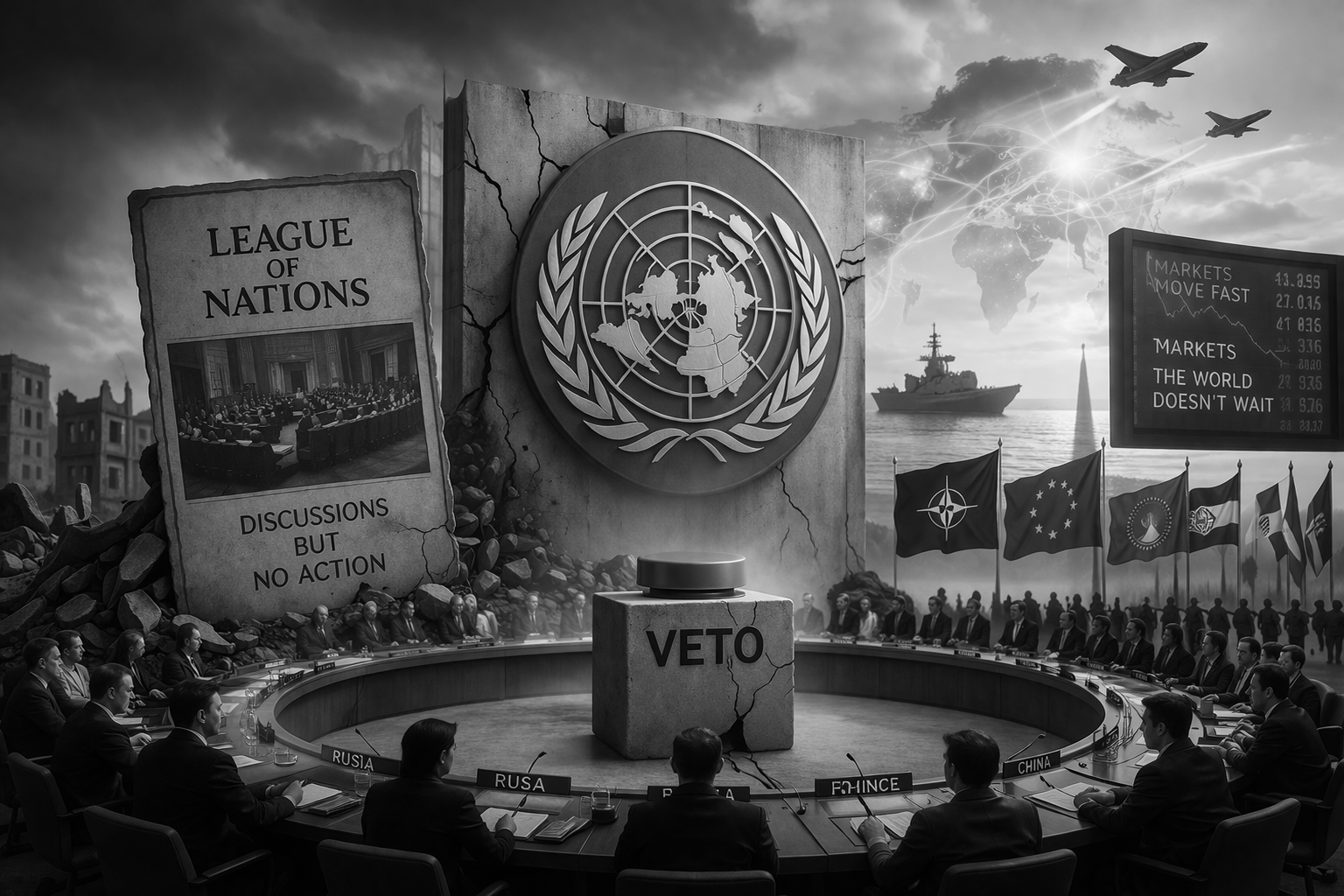
From Relevance to Ritual: Why the UN Is Becoming the New League of Nations
The Idea That Once Promised Peace now struggling, The United Nations was born out of a simple but powerful belief: if countries talk enough, they might stop fighting. After the devastation of the World War II, the world wanted a system where wars could be prevented, not just remembered. And for a while, it worked. The UN was not just a meeting place, it was where decisions actually mattered. It had authority, it had relevance, and most importantly, it had the attention of the world.
The Warning From History We Conveniently Forgot
But this idea was not new. After the World War I, the world had already tried something similar with the League of Nations. That experiment went like this: Japan invades Manchuria, the League condemns it. Italy invades Ethiopia, the League imposes “serious” sanctions, carefully avoiding anything that might actually hurt. The result? Both invasions continue, and the League continues… mostly as a discussion club with excellent attendance. By the time the next world war began, it was still functioning, just not influencing anything.
When the UN Actually Meant Business
The early years of the UN looked very different. During the Korean War, it authorized military action. During the Suez Crisis, even when big powers disagreed, it found a way to step in and force a withdrawal. It even invented peacekeeping along the way. Back then, the UN wasn’t just issuing statements, it was shaping outcomes. It felt less like a debating society and more like an institution that could actually do something when the situation demanded it.
Then Reality Slowly Walked Back In
Over time, the tone began to change. In Rwanda, the UN was present, watching a tragedy unfold with limited ability to act. In Kosovo, while debates continued inside the UN, NATO stepped in and took action outside it. In Syria, the United Nations Security Council became a place where resolutions went to be vetoed, repeatedly. In Ukraine, strong resolutions were passed in the General Assembly, firmly stating what should happen… while the opposite continued to happen on the ground.
The UN was still there in every crisis. It just wasn’t deciding the outcome anymore.
The Iran Crisis: Fast World, Slow System
Now look at the current tensions around Iran, especially near the Strait of Hormuz. This is where modern geopolitics reveals its new speed. Markets react in minutes, military moves happen quickly, and leaders speak instantly. Statements from Donald Trump arrive like breaking news alerts, direct and immediate, sometimes mixing threats and negotiations in the same breath. Iran responds just as firmly, rejecting pressure and setting its own terms.
And then the UN enters the scene.
• It calls a meeting.
• It expresses concern.
• It urges restraint.
By the time the sentence “we urge all sides” is completed, the situation has already changed twice.
The Veto: The Button That Freezes Everything
At the centre of this slow-motion drama is the United Nations Security Council and its famous veto power. The idea behind the veto was clever: give powerful countries the ability to block decisions so they stay inside the system and don’t break it from outside.
Mission accomplished. They stayed inside. And also made sure nothing moves without their approval.
So today, the system works beautifully:
• If everyone agrees → action happens.
• If even one disagrees → discussion continues… indefinitely.
And since major powers rarely agree, discussion has become the final outcome.
When Process Becomes the Product
Over time, the UN has perfected a rhythm that is almost comforting in its predictability. A crisis happens, meetings are called, speeches are delivered, resolutions are drafted, votes are taken. Everything moves exactly as it should, except the actual problem.
• The number of resolutions grows.
• The number of real interventions… not so much.
It is like writing detailed instructions on how to stop a fire, while politely watching it burn.
The World Has Already Moved On
Meanwhile, the rest of the world has adjusted to this reality. Countries no longer wait. They act through alliances, coalitions, and regional groups. NATO steps in when needed, regional powers take charge in their own areas, and decisions are made outside the UN framework.
The UN is still invited to the conversation. It’s just no longer hosting it.
This is exactly how the League of Nations slowly faded, not by collapsing, but by becoming optional.
The Cost of Being Ignored Politely
This shift has real consequences. When countries know that the strongest response they might face is a strongly worded resolution, the fear of consequences reduces. When powerful nations block action while others are expected to follow rules, the system starts looking unfair. And when different groups begin acting on their own, the risk of conflicts spreading increases.
In simple terms, the referee is still on the field. Players have just stopped waiting for the whistle.
Time to Think Beyond the Current System
History has a pattern. When institutions stop working effectively, new ones eventually replace them. The failure of the League of Nations led to the creation of the United Nations. Today, the world may be approaching a similar moment.
Whether it means reforming the UN, limiting veto powers, or building new global systems, one thing is becoming clear: the current structure is struggling to keep up with a fast and complex world.
The Slow Slide Into Irrelevance
The United Nations is not collapsing. It still does important work, especially in helping people during crises. But when it comes to stopping wars and shaping global power, something has shifted.
It is no longer where decisions are made.
It is where decisions are discussed.
The League of Nations once followed the same path, active, present, and slowly ignored.
The uncomfortable truth is this:
The UN still speaks for the world.
The world has just stopped waiting for it to act.