
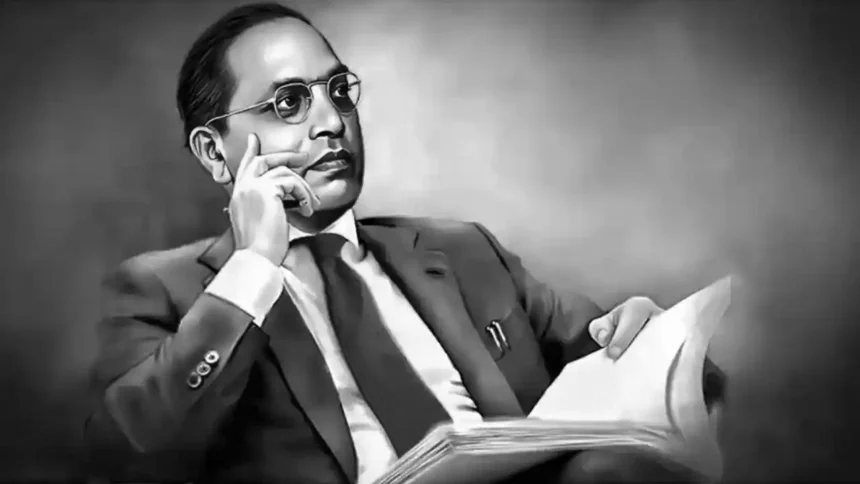
From Rejection to Republic: The Making of Ambedkar
The Night That Asked a Question . In 1917, a man returned to Baroda carrying the world in his suitcase. Degrees from Columbia University. Training from London. A mind sharpened across continents.
And yet, the city refused him. No inn would take him in. Not because he lacked money. Not because he lacked merit. But because he carried something heavier than both his caste.
A Parsi inn briefly gave him shelter. The next day, it withdrew it. And so, that night, B. R. Ambedkar walked through Baroda, knocking on doors that would not open.
Until he stopped knocking. And started thinking.
What is a human being worth?
A Childhood That Remembered Everything
Long before Baroda, there was a road where a boy was told to get off a cart because of his caste. There was a school where water depended on a peon. There was a barber who would not touch his hair. There was a world that kept reminding him you may exist, but you do not belong. But there was also something else.
A stubborn memory. Ambedkar did not forget humiliation. He archived it. Every insult became data. Every exclusion became evidence. Later in life, when he argued, he did not speak in anger alone. He spoke like a man presenting a case built over decades.
The Boy Who Almost Ran Away
There is a lesser-known moment almost cinematic in its fragility. A young Bhimrao, tired of constraint, decides to run away to Bombay. Freedom, he believes, lies in earning his own living.
He plans it. Waits. Then quietly opens his aunt’s purse. Inside half an anna. Not enough to escape. So he stays.
And something profound happens: he trades escape for education.
History, sometimes, is shaped not by what we do, but by what we cannot afford to do.
A Man Who Collected Books, Not Comfort
Ambedkar’s relationship with books was not academic. It was intimate.
He built one of the largest private libraries of his time tens of thousands of books. His house, Rajgruha, was designed less like a home and more like a sanctuary for ideas. He once said that reading a new book was his way of relaxing.
Imagine that. Not rest as silence, but rest as expansion. While society denied him space outside, he kept enlarging his space within.
The Private Cost of a Public Mission
Behind the public figure was a life marked by quiet loss. His wife, Ramabai, lived through extreme hardship poverty, illness, the loss of children. While Ambedkar studied abroad and later fought social battles, she carried the weight of survival. Most of their children did not survive into adulthood.
Their son Yashwant remained, but illness lingered around the family like an uninvited guest. Ambedkar taught Ramabai to read and write, but time was never generous enough to give them a peaceful life together. When she passed away in 1935, it left a silence that no public victory could fill.
Years later, he would remarry Savita Ambedkar, who stood by him during his final years, especially as his health declined. Because yes, the man who fought relentlessly for others was himself battling diabetes, insomnia, and exhaustion.
A Mind That Refused Easy Answers
Ambedkar was not just fighting caste. He was interrogating everything. Religion. Economy. Politics. Society. He disagreed not only with conservatives but also with nationalists when needed. His differences with Mahatma Gandhi were not personal they were philosophical. Where Gandhi saw reform within tradition, Ambedkar questioned the foundation itself. Where others spoke of unity, he asked unity for whom?
He was not trying to be agreeable. He was trying to be accurate.
The Paradox of Power
When India became independent, Ambedkar stood at the center of its legal imagination. As the architect of the Constitution of India, he gave the country its moral grammar. Equality. Liberty. Fraternity. But here lies the irony.
He wrote the rules of democracy…and then lost elections within it. Twice. It is a reminder that democracy is not always kind to those who design it. But Ambedkar was never chasing popularity. He was building permanence.
The Final Transformation
In 1956, after years of reflection, he chose Buddhism. Not as an act of faith alone, but as a philosophical decision. A rejection of hierarchy. An embrace of equality.
“I was born a Hindu, but I will not die a Hindu.”
It was not anger. It was closure.
What Did He Really Want?
Ambedkar did not just want legal equality. He wanted something far more difficult. Self-respect.
Not the kind given by law. But the kind felt in everyday life.
He wanted a society where:
• A child does not ask permission to drink water
• A surname does not determine destiny
• Merit is not filtered through birth
• And dignity does not need justification
And Where Do We Stand Today?
We have moved. There is no denying that.
A Dalit student in an IIT classroom. A Dalit officer in administration. A Constitution that guarantees rights.
But also: A rented house denied quietly. A marriage opposed violently. A discrimination that has learned to speak softly instead of loudly.
Ambedkar’s India exists. But so does the India he fought against.
The Question That Refuses to End
Return, once more, to that night in Baroda. A man outside a closed door. Degrees in his bag. Questions in his mind. He did not force the door open. He redesigned the building.
And yet, the question he asked still lingers, like an unfinished sentence:
What is a human being worth? The Constitution answers: equal.
Society… is still writing its response.