
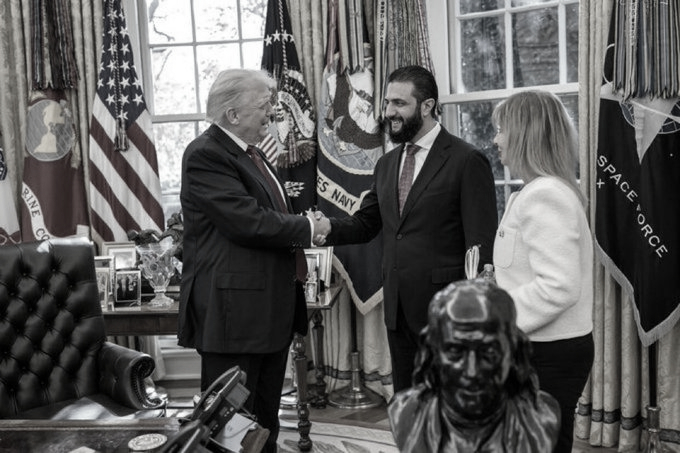
From Global Terrorist to Visiting Statesman: Syria’s Al-Sharaa Walks Into the White House
In a moment unthinkable just a year ago, Syrian President Ahmed al-Sharaa — once listed by Washington as a “Global Terrorist” — walked into the White House on Monday for talks with U.S. President Donald Trump. The visit, the first ever by a Syrian head of state, underscores an extraordinary geopolitical shift following the fall of Bashar al-Assad last December.
Sharaa, 43, rose to power after a rapid rebel offensive toppled Assad, ending decades of authoritarian rule. Regional diplomats say the U.S. and Israel benefited strategically from Assad’s collapse, with American intelligence cooperation intensifying in the lead-up to the offensive and Israel exploiting the post-Assad vacuum to further weaken pro-Iranian positions. While neither country publicly acknowledges direct involvement, the new Syrian order aligns closely with their security priorities.
But Sharaa’s alignment with Washington has come with uncomfortable consequences at home. Israel has expanded its presence along the Golan border, establishing new checkpoints and extending its buffer zone inside Syrian territory — moves that have drawn quiet frustration in Damascus. Sharaa has insisted he “will not recognize any further territorial breaches,” even as Israeli incursions complicate his position domestically.
Seeking strategic balance, Damascus has also reopened channels with Moscow. Sharaa’s Defence Minister met with Russian officials in October, part of an effort to stabilize relations after Syria’s sudden realignment away from the Kremlin.
At the White House, Sharaa received a muted welcome, entering through a side door rather than the formal West Wing driveway. Trump, however, praised him as a “strong leader” and pledged American support for Syria’s stabilization. “We’ll do everything we can to make Syria successful,” he said, acknowledging Sharaa’s past with the remark, “We’ve all had rough pasts.”
Central to Sharaa’s visit was his push for the repeal of the Caesar Act — sweeping U.S. sanctions imposed during the Assad era. The Treasury extended its waiver by 180 days, but only Congress can remove the law entirely. Sharaa argues that lifting sanctions is essential for reconstruction, with the World Bank estimating Syria will need over $200 billion after 14 years of war.
Despite high-level diplomatic recognition, Syria remains fragile, with over 2,500 killed in sectarian violence since Assad's ouster. For now, Sharaa walks a narrow line — recognized abroad, contested at home, and racing against time to redefine Syria’s future.