
From Classroom to Global Recognition: Can Student Innovation Change Lives?
A simple question from a visually impaired student has helped inspire an engineering innovation that is drawing international attention to India's student-led research. When 20-year-old Lingampalli Himaja, an engineering student from Andhra Pradesh, visited a school for visually impaired children, she encountered the difficulties students faced while writing in Braille. One student's question “Why should I type when I can speak?” encouraged her to explore a different approach to accessible writing.
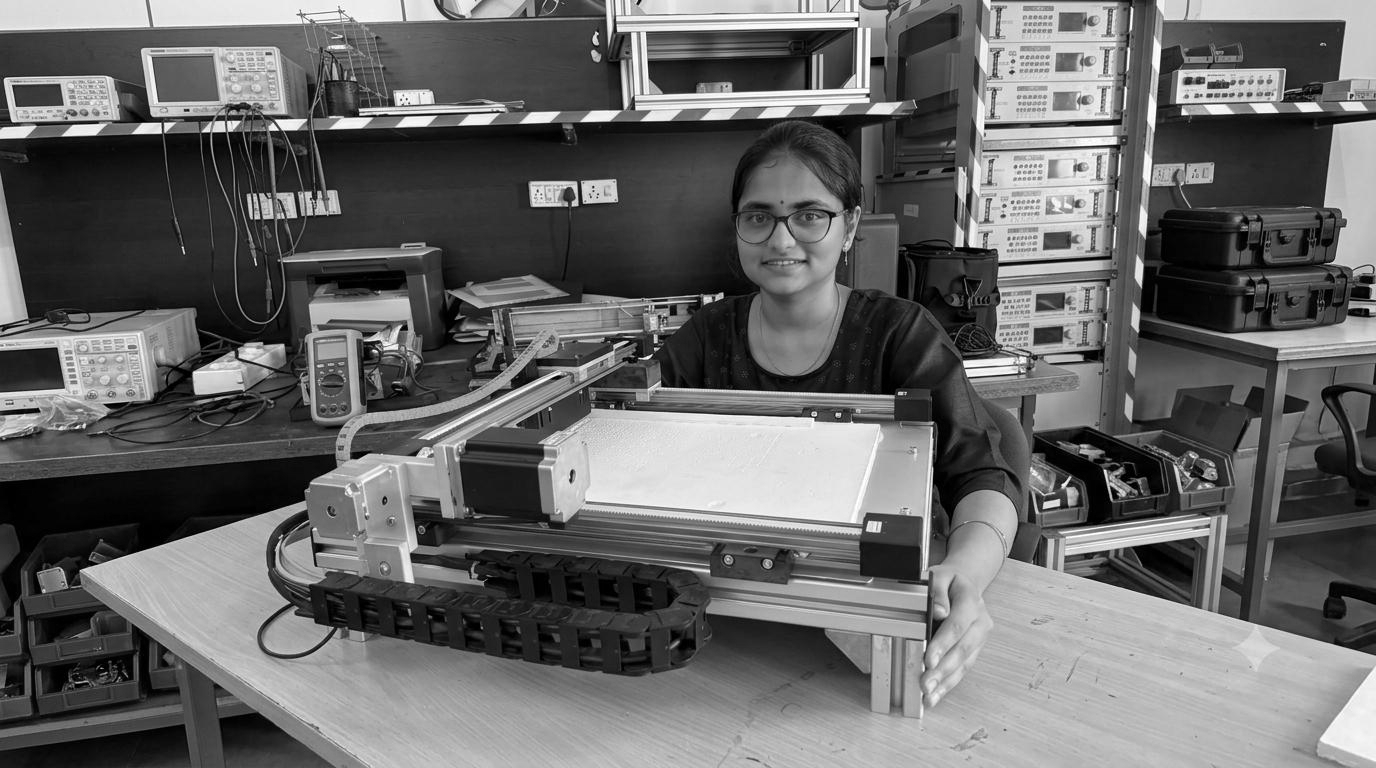
Her response was RUDHRA, a voice-enabled Braille printer that aims to convert spoken words into tactile text, allowing visually impaired people to produce written material more conveniently. The innovation earned the Indian national title in the James Dyson Award 2026 before securing a place among the competition's global top 20 entries. The recognition has brought attention to Himaja's work and raised a larger question: are Indian educational institutions doing enough to help students transform innovative ideas into affordable products that address real-world problems?
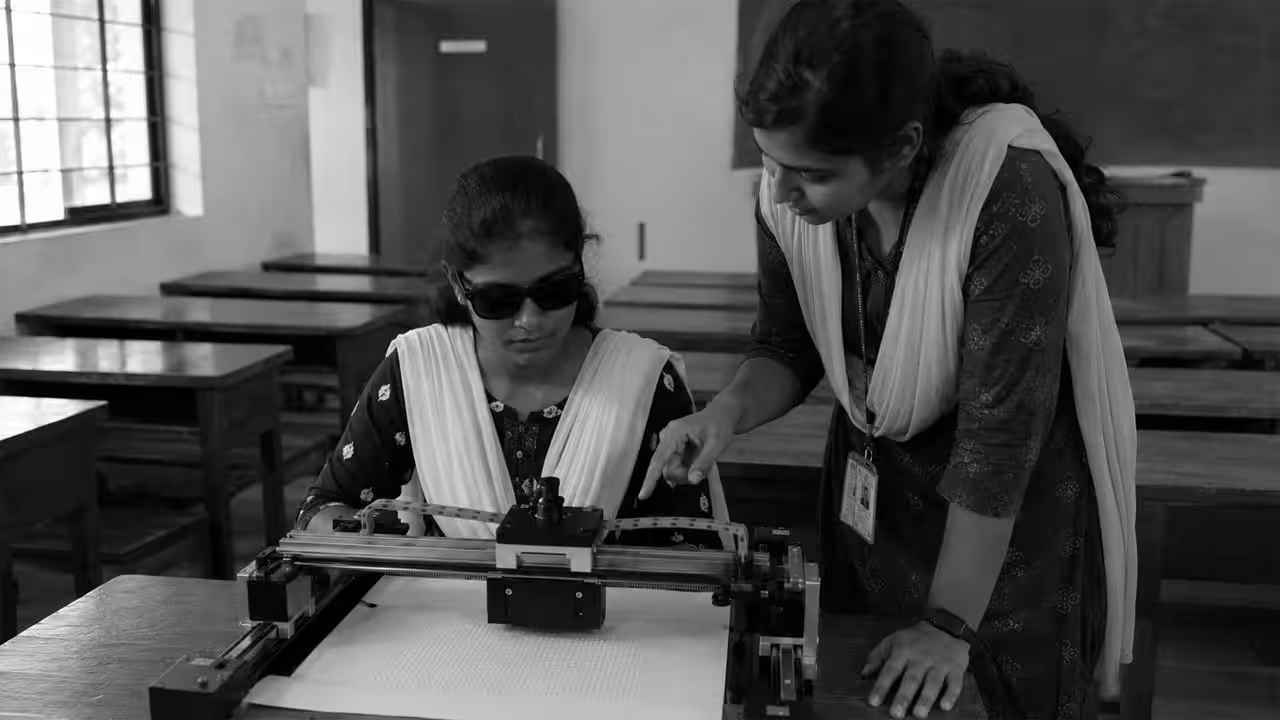
Himaja, who studies at Shri Vishnu Engineering College for Women in Bhimavaram, developed the idea after visiting a school for visually impaired students run by ophthalmologist UV Ramanaraju under the UV Subbaraju Memorial Trust. The visit helped her understand that accessibility challenges are not always solved by introducing more technology. Sometimes, the most effective solutions begin by listening to the people who experience the problem every day.
Traditional Braille writing can require considerable practice and coordination. Using a conventional slate and stylus involves arranging characters in a mirrored format so that the raised dots can be read correctly when the paper is turned over. Although the method remains important for Braille literacy, it can be cumbersome for beginners and for people who need to produce written material quickly.
Himaja initially developed a printer operated through six push buttons corresponding to Braille dots. However, feedback from the students prompted her to rethink the design. Rather than expecting users to learn another input method, she explored whether they could simply speak the words they wanted to print. This shift from button-based input to voice commands became a defining step in RUDHRA's development.
The experience highlights the value of involving intended users in the design process. Instead of assuming that she already understood what visually impaired students needed, Himaja used their feedback to reconsider the problem. The resulting innovation illustrates how interaction between students, educational institutions and communities can lead to practical solutions that might otherwise be overlooked.
RUDHRA combines Alexa and a Raspberry Pi to process spoken instructions and translate them into Braille output. Alexa facilitates voice interaction, while the Raspberry Pi acts as the computing unit responsible for processing information and controlling the printing mechanism. Stepper motors help position the mechanism, and a solenoid produces the raised dots on paper. The device is designed to generate Braille characters in their normal reading orientation, avoiding the reversed writing process associated with traditional slate-and-stylus methods.
The concept also envisages allowing users to create, edit and store notes before printing. Such features could be useful to students who need to prepare study materials, personal notes and other written documents. By reducing the need to operate individual buttons or manually arrange every character, the device aims to make producing Braille text more intuitive.
However, converting a promising prototype into a dependable assistive product requires more than making the basic mechanism work. Voice-recognition errors can result in incorrect text and, consequently, inaccurate Braille output. Differences in pronunciation, background noise and language requirements can also affect performance. The raised dots must be positioned consistently, with sufficient spacing for readers to distinguish characters through touch. Even small mechanical inaccuracies can reduce the usefulness of the printed material.
These challenges make testing and refinement essential. Himaja has worked on improving the design and collecting feedback, but the printer still needs to demonstrate reliable performance under everyday conditions. Its usefulness will ultimately depend on whether visually impaired users can operate it easily and obtain accurate output without repeated corrections.
The financial challenge is equally important. Reports have put the current prototype's cost at approximately ₹1.5 lakh, while Himaja has estimated that redesigning the device could bring the price down to around ₹50,000–₹60,000. These figures are significant because affordability will determine whether the technology can reach the students and families who may benefit from it.
A device that attracts international recognition but remains beyond the budgets of its intended users cannot achieve its full social potential. Reducing manufacturing costs without compromising printing quality, durability and reliability will therefore be a major part of the next stage of development. The availability of replacement components, maintenance services and technical assistance will also influence whether schools can adopt the technology over the long term.
RUDHRA remains a developing prototype rather than an established, commercially available product. Further work is needed to improve its design, reduce its size and weight, enhance accuracy and establish how it will perform in regular educational settings. Features such as automatic paper feeding and additional software assistance could also be explored as development progresses. Before wider adoption, the device will need extensive user testing and a practical plan for manufacturing, distribution and after-sales support.
Himaja's experience also raises questions about the role of engineering colleges in supporting innovation. Technical education provides students with knowledge of electronics, programming, mechanical systems and design. Yet turning that knowledge into a functioning product often requires access to equipment, funding, experienced mentors and opportunities to test ideas outside the classroom.
Himaja drew on concepts related to engineering drawing, power electronics and embedded systems while developing RUDHRA. She also had to learn additional microprocessor concepts to address the project's technical requirements. Her experience demonstrates how a practical problem can encourage students to apply classroom knowledge while acquiring new skills that a conventional syllabus may not fully cover.
Faculty guidance and access to institutional facilities can make a substantial difference during this process. However, student innovators may struggle if laboratories are available only for scheduled academic work, prototype materials must be purchased personally or research projects receive limited time beyond examinations. Colleges need to examine whether students have sufficient opportunities to experiment, make mistakes and improve their designs.
Funding is another critical part of the innovation ecosystem. Developing a prototype may involve repeated purchases of electronic components, mechanical parts and testing equipment. Students who lack financial resources can find it difficult to move beyond an initial demonstration, even when their ideas have practical value. Colleges can help through prototype grants, innovation laboratories, incubation centres and partnerships with companies willing to provide technical assistance.
Mentorship must also extend beyond academic supervision. Industry professionals can help students select suitable components, improve manufacturing methods, estimate production costs and assess whether a design can be scaled up. Guidance on intellectual property, patent applications, product certification and business planning can help innovators navigate the transition from a classroom project to a market-ready product.
The commercialisation stage is often where promising ideas encounter their toughest obstacles. A working prototype does not automatically become a reliable product. It must be tested for safety and durability, manufactured consistently, supported through repairs and made available to the intended users at a reasonable price. Student innovators may need assistance identifying manufacturers, attracting investment and establishing distribution networks.
For assistive technology, these challenges are closely connected to accessibility and inclusion. Visually impaired students, schools and disability organisations should participate in testing and evaluating products before large-scale adoption. Their feedback can help identify practical problems that technical teams may overlook, including ease of operation, printing speed, paper handling and the cost of routine maintenance.
The question is not simply whether a device can perform its intended function, but whether people can use it independently and afford to keep using it. A lower price, reliable output and accessible technical support may ultimately matter as much as an award or an advanced technical feature.
Himaja's achievement also offers an opportunity to compare the support available to student innovators across Indian colleges. Some institutions have established research facilities, entrepreneurship programmes and industry partnerships, while others may have fewer resources. Interviews with students, faculty members, startup mentors and college administrators could reveal whether existing support reaches innovators from different economic backgrounds and institutions.
The experiences of other student innovators would help establish whether Himaja's journey reflects a broader pattern. Questions about access to funding, faculty involvement, laboratory facilities and commercial partnerships could show where institutions are succeeding and where gaps remain. Colleges should also assess how many student projects progress beyond competitions and demonstrations to become products that people can actually use.
The James Dyson Award recognition gives RUDHRA an important platform, but international attention should be treated as a starting point rather than the final measure of success. The next milestones will involve improving the prototype, demonstrating its reliability, reducing its cost and establishing whether it can meet the needs of visually impaired users in everyday settings.
RUDHRA demonstrates how listening to a real problem can inspire meaningful innovation. It also shows that talented students need more than technical knowledge and creative ideas. They require sustained institutional support, financial resources, practical mentorship and access to the people their inventions are intended to serve.
India's colleges have an opportunity to strengthen this process by encouraging problem-based learning, funding promising prototypes and building connections between students, industry and communities. If these efforts help more innovations move from laboratories into people's lives, student research can become a powerful instrument of social change. Himaja's journey therefore raises a question that extends well beyond one invention: can India's education system create the conditions in which promising ideas become affordable, reliable solutions for everyone who needs them?