
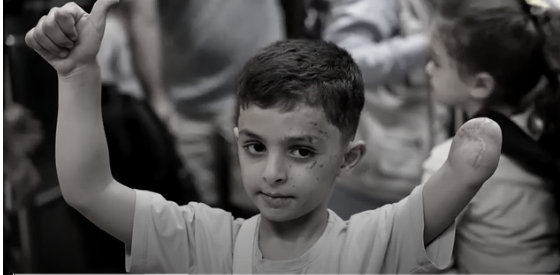
Fragments of hope: Gaza’s children begin healing journeys abroad
Six-year-old Omar Abu Kuwaik still believes that by his next birthday, his missing hand will have grown back. Omar, who lost his parents, sister, and grandparents in an Israeli airstrike on Gaza in December 2023, now rubs the stump of his left arm and whispers, “It’ll be big again when I turn seven.”
Omar is one of thousands of Gazan children scarred by war — physically and emotionally. With Gaza’s health system in ruins after nearly two years of relentless bombardment, medical evacuation abroad became the only chance for survival.
When did treatment abroad begin?
International evacuation of Gazan children for critical medical care started in late 2023, as local hospitals collapsed under overwhelming casualties. The first transfers were routed through Egypt, coordinated with the World Health Organization (WHO) , which arranged for stabilisation treatment in Cairo. Soon after, NGOs and humanitarian medical funds expanded the programme, sending children to Lebanon, Jordan, and some European countries, including Italy and Spain.
Who organises it?
While UNICEF and WHO provide logistical and psychological support, the main evacuation and treatment programmes are led by:
• Palestine Children’s Relief Fund (PCRF) – the primary NGO arranging safe passage, surgeries, and prosthetics.
• Ghassan Abu Sittah Children’s Fund – a British-Palestinian surgeon’s initiative to support reconstructive surgery in Lebanon.
• Partnerships with hospitals such as the American University of Beirut Medical Center and facilities in Cairo and Amman.
This is not a UNESCO initiative ; UNESCO’s mandate is cultural and educational preservation, not medical evacuation.
How many children have benefitted?
Since 2023, aid groups estimate more than 600 wounded Gazan children have been evacuated abroad, with at least 150 receiving advanced surgeries and prosthetics . The Beirut programme alone is preparing for 30 more arrivals in the coming months. Thousands more remain on waiting lists, trapped inside Gaza due to border closures.
Do families travel with them?
Yes — though often only one guardian is allowed to accompany each child. Many mothers, aunts, or older siblings have left other children behind in Gaza to ensure the wounded can receive care. Omar’s aunt Maha, for instance, had to make the wrenching choice to leave her own sons in a war zone to stay with him. “It was the hardest decision of my life,” she said.
Lives in transition
Children like 14-year-old Amir Hajjaj, who lost fingers to shrapnel, and sisters Aya and Mays Abdallah, who suffered leg amputations and fractures, are now undergoing complex surgeries and physiotherapy in Beirut. Alongside physical recovery, doctors stress the importance of psychological healing — providing trauma counselling and safe spaces for play.
Dr. Mohammed Ziara, a Gaza-born surgeon now in Beirut, said: “The children are not just patients. They are survivors who need both new limbs and new hope.”
A path forward
With 45,000 wounded and 18,000 dead children in Gaza since 2023 (UNICEF figures), the numbers far outweigh the reach of current programmes. Yet each evacuation is a lifeline. As international donors press to expand funding, the stories of children like Omar, Amir, Aya, and Mays embody both tragedy and resilience.
For families torn apart, the hope is that healing abroad will give their children not just prosthetics and surgeries, but also a chance at reclaiming childhood.