

Fourth-Largest Claim, Sixth-Place Reality: IMF Revises India’s Economic Standing
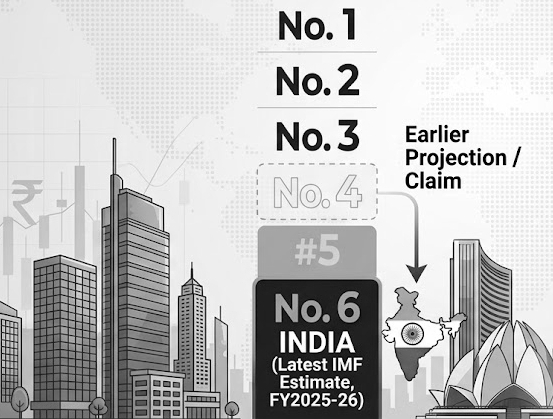
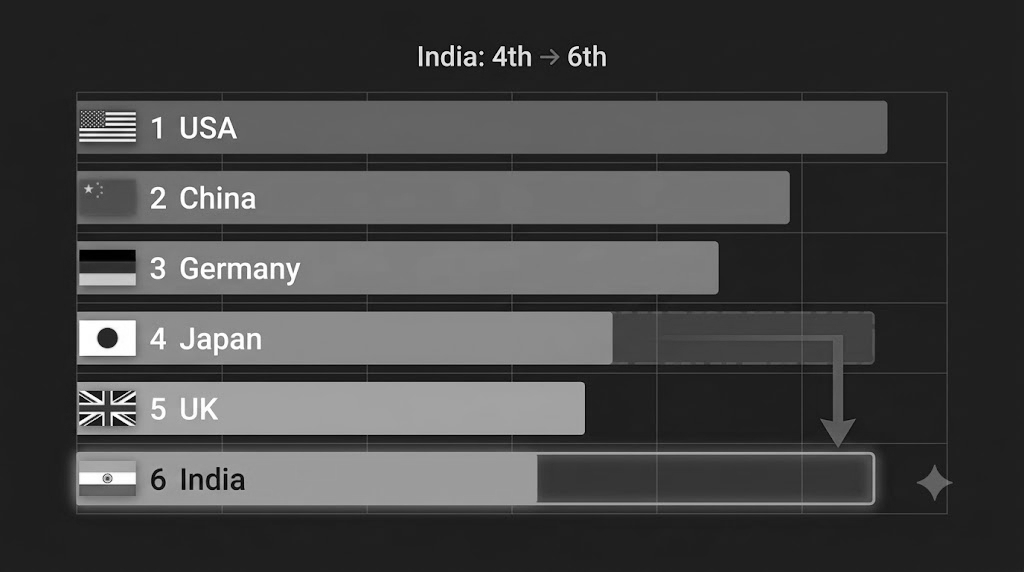
India’s much-publicised claim of becoming the world’s fourth-largest economy has run into a reality check, with the International Monetary Fund’s latest estimates placing the country sixth by nominal gross domestic product (GDP), behind Japan and the United Kingdom. The reversal comes despite repeated projections that India would overtake major economies and move closer to the government’s ambition of becoming the world’s third-largest economy.
The IMF’s April 2026 World Economic Outlook estimated India’s economy at $3.92 trillion for 2025-26, compared with $4 trillion for the UK and $4.44 trillion for Japan. India was projected to remain sixth in FY27, with GDP of $4.15 trillion, below the UK’s $4.26 trillion. The revised outlook pushed back the anticipated fourth-place milestone.
The change is significant because the government had already presented fourth place as an achievement. In May 2025, NITI Aayog CEO B. V. R. Subrahmanyam cited IMF projections to say India had overtaken Japan. A government backgrounder subsequently repeated the fourth-largest-economy claim. Those projections, however, were later revised, demonstrating the risks of presenting forecast-based rankings as settled economic milestones.
Two factors have contributed to the reversal: a revision in India’s GDP estimates and the depreciation of the rupee. The new GDP series, introduced with 2022–23 as the base year, put FY26 nominal GDP at approximately ₹345.5 lakh crore, below the roughly ₹357 lakh crore estimated under the previous series. Meanwhile, a weaker rupee reduced the dollar value of India’s output, affecting its position in international comparisons.
The implications extend beyond the ranking. India’s ambition to build a $5 trillion economy, originally associated with a much earlier timetable, has also faced repeated delays. The latest projections suggest India could narrowly miss the target in FY29, although the timeline remains sensitive to economic growth and currency movements.
There is, however, an important distinction between a falling ranking and a shrinking domestic economy. The IMF has raised its FY27 real GDP growth forecast to 7 per cent, signalling continued economic expansion. But rapid growth alone does not guarantee a higher dollar-denominated ranking, particularly when the currency weakens or competing economies grow in value.
On October 15, 2026, the IMF also welcomed India’s revised GDP methodology, saying it was consistent with good statistical practices and advice from its statistics department. That endorsement supports the revised methodology; it does not mean the IMF has independently certified every past government claim about India’s global ranking.
The central reality is that India remains a major and fast-growing economy, but the fourth-place milestone was not sustained in the latest estimates. The gap between political announcements and revised international projections highlights why economic achievements must be judged against updated data, transparent assumptions and measurable outcomes, not projections alone.