
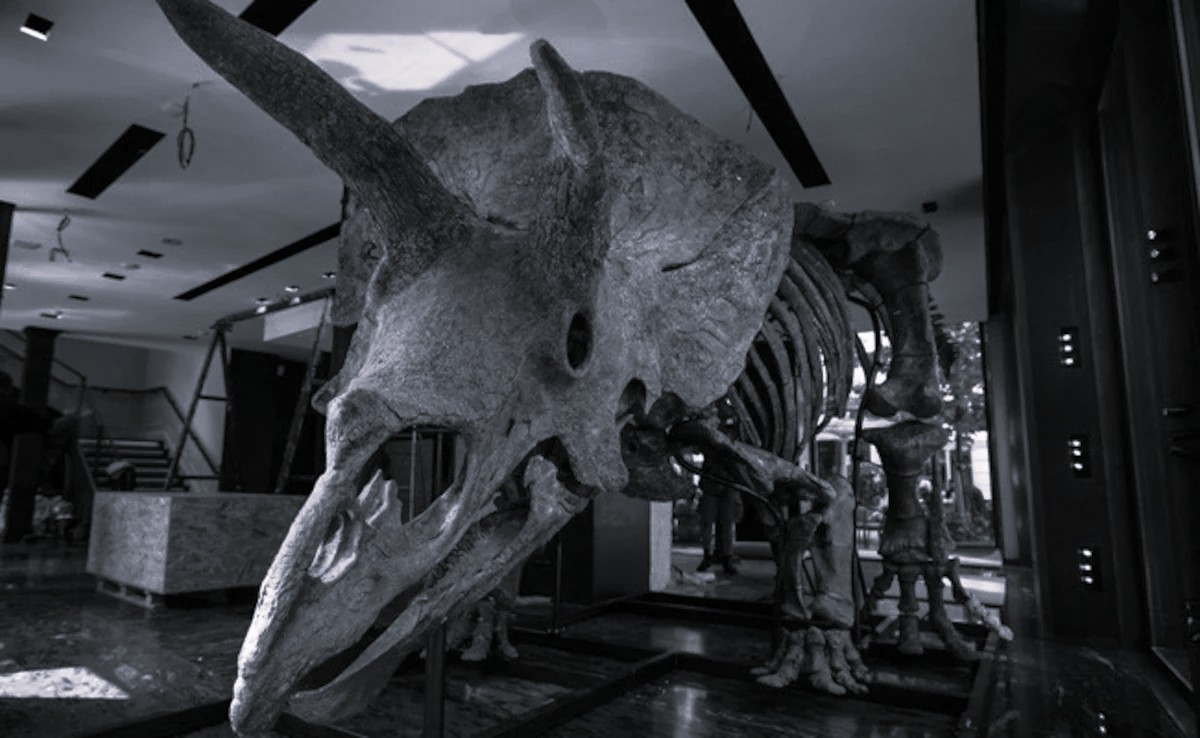
Fossil of three-horned dinosaur triceratops unearthed in UP
A remarkable fossil, believed to be the nasal horn of a Triceratops, the iconic three-horned dinosaur, has been excavated along the banks of the Sahansara River in Uttar Pradesh's Saharanpur district, a local researcher announced on Saturday. This discovery, if confirmed, could represent the first evidence of a North American ceratopsian on the Indian subcontinent, offering unprecedented insights into dinosaur migration patterns during the Late Cretaceous period.
The find, made in the Himalayan foothills, marks yet another significant excavation in an area that has yielded multiple ancient fossils in recent years, sparking growing interest among paleontologists. While Triceratops fossils are abundant in North America's Hell Creek Formation where they comprise up to five-sixths of large dinosaur remains, highlighting their role as dominant herbivores this would be a groundbreaking occurrence in India, where ceratopsian fossils are exceedingly rare. Experts emphasize that such a specimen could illuminate the biogeographic connections between ancient landmasses, as India was isolated for much of the Mesozoic era before colliding with Asia around 50 million years ago.
Mohammad Umar Saif, founder of the Natural History and Conservation Centre in Saharanpur, a hub for local paleontological research and conservation efforts described the specimen as exceptionally well-preserved. "A fresh fossil has been discovered, believed to be of a Triceratops... The fossil is a part of its nose. While we cannot definitively say that it belongs to a Triceratops, it closely resembles other Triceratops fossils found around the world. Its morphology, shape and size are very similar," Saif told PTI. Triceratops, known for its three facial horns, massive bony frill, and parrot-like beak, roamed Earth during the Late Cretaceous, between 100.5 million and 66 million years ago, often clashing with predators like Tyrannosaurus rex.
The fossil's pristine condition is attributed to heavy mineralisation over millions of years, transforming it into sandstone while buried in the sediment-rich foothills. "This is well-preserved as it has completely transformed into sandstone due to heavy mineralisation because it remained buried in the foothills of the Himalayas for approximately 35 - 40 million years. This is a good discovery," Saif explained. Such preservation allows for detailed analysis, potentially revealing growth patterns, diet, or even skin impressions details that have revolutionized our understanding of Triceratops as social herd animals in North America, where recent finds of grouped juveniles and adults suggest protective family structures.
India's dinosaur fossil record is already robust, with over 25 genera documented from the Triassic to Cretaceous periods, including unique species like Rajasaurus and Titanosaurus from sites in Madhya Pradesh and Gujarat. However, ceratopsian horned dinosaurs like Triceratops have been notably absent, with Indian finds limited to indeterminate fragments or related abelisaur predators. The Saharanpur region's emergence as a hotspot, with several million-year-old fossils uncovered recently, underscores the need for expanded excavations and international collaboration.
Paleontologists argue that this could bridge gaps in our knowledge of Gondwanan-Laurasian faunal exchanges, especially as India's subcontinent drifted northward, potentially carrying or attracting migratory species. The importance of this study cannot be overstated. Triceratops fossils have been pivotal in paleontology for decoding Late Cretaceous ecosystems, revealing evolutionary adaptations like horn use for defense, display, and intra-species combat evidenced by healed injuries on North American specimens. A confirmed Indian Triceratops could challenge existing models of dinosaur distribution, suggesting broader ranges or convergent evolution in horned herbivores. Moreover, in a country with fossil parks like Indroda in Gujarat, the world's second-largest dinosaur egg hatchery, this find could boost public engagement and tourism, fostering conservation awareness amid threats to Himalayan sediment sites from development.
Experts say further analysis, including CT scans and geochemical dating, will be required to confirm the specimen's identity and exact age. The discovery adds to India's growing repository of dinosaur-era relics, potentially shedding new light on prehistoric life in the subcontinent and the planet's final days before the asteroid-induced extinction 66 million years ago. As Saif's team prepares for peer-reviewed publication, the global paleontology community watches closely this could be the horn that rewrites the map of ancient beasts.