
Forget Delimitation-the fiscal penalty for population control has already begun
Long before the political battle over delimitation redraws parliamentary boundaries, southern states argue that a more immediate and consequential shift has already altered India’s federal balance. The 16th Finance Commission’s report, submitted to President Droupadi Murmu, signals yet another decline in the share of central tax revenues flowing to South India a trend leaders describe as a fiscal penalty for population control.
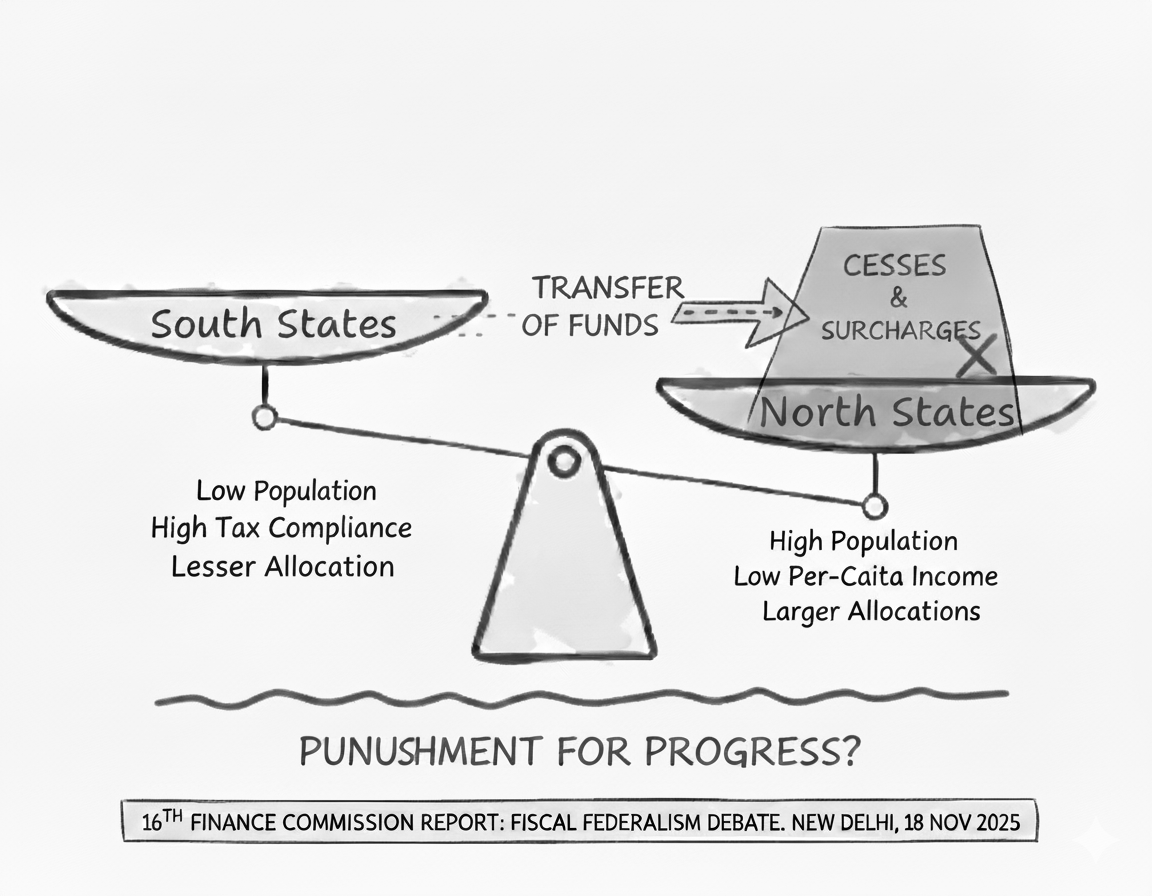
Chaired by economist Arvind Panagariya, the Commission has retained the core criteria used in previous cycles: the 2011 population, income distance, area, and limited weights for fiscal effort and demographic performance. These parameters structurally favour northern and central states with larger populations and lower per-capita incomes, while southern states which have achieved low fertility, higher tax compliance and stronger socio-economic indicators steadily lose their share of central revenues.
The numbers underline the imbalance. Uttar Pradesh, with 16.51% of India’s population, receives 17.939% of the FC-15 divisible pool. Bihar, with 8.60%, receives 10.058%. In contrast, Tamil Nadu, with 5.96% of the population, receives just 4.079%, while Karnataka, contributing disproportionately to direct taxes, gets only 3.647%. Kerala’s population stability leaves it with a mere 1.925% share, despite high human-development achievements. Telangana, too, receives just 2.102%, while states like Madhya Pradesh receive far larger allocations due to population and income-distance advantages.
Adding to southern concerns is the Centre’s growing reliance on cesses and surcharges revenues that are not shared with states and shrink the actual pool available for distribution. Even the 15th Finance Commission’s “demographic performance” criterion, introduced to avoid penalising states with low fertility, carries only 12.5% weight and fails to offset the dominance of population and income distance.
Amid this, southern governments have launched their sharpest pushback in years. Tamil Nadu has demanded that states’ share of central taxes rise to 50%, arguing that fiscally responsible and high-performing states are being punished for their achievements. Kerala has echoed this, urging an increase from 41% to 50%, a reduction in income-distance weight, inclusion of population density as a criterion, stricter rules on cesses and surcharges, and higher disaster-relief allocations. Telangana Chief Minister A. Revanth Reddy has demanded the same 50% share, calling for greater weight to economic contribution. Karnataka Chief Minister Siddaramaiah has sought a cap on cesses and a growth-linked formula that recognises states generating higher revenues.
For these states, the implications extend beyond accounting. They argue that the model has “over-corrected,” penalising regions that controlled population growth, built stronger economies and delivered better governance all long-standing national goals. As one senior official involved in consultations put it, “We did everything right. Yet every Finance Commission rewards us with a smaller share. Forget delimitation, the punishment has already arrived through fiscal devolution.”
As Parliament prepares to take up the 16th Finance Commission’s recommendations, the debate over fiscal federalism long simmering is poised to return to the national stage, with the South warning that the system is drifting away from equity toward a structure that systematically disadvantages high-performing states.