
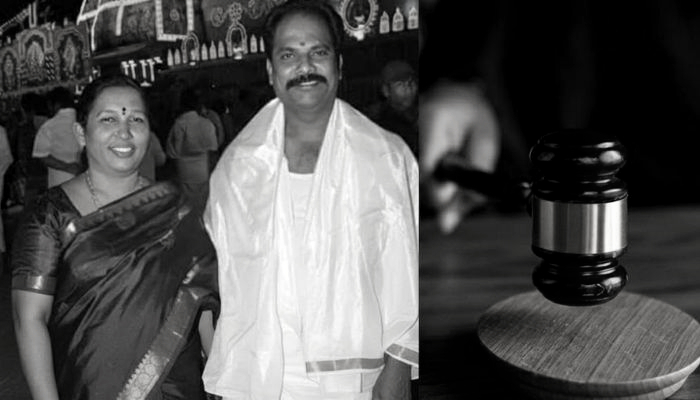
Five sentenced to death in 2015 Chittoor double Murder case
A Chittoor court has sentenced five persons to death in connection with the brutal murder of former Chittoor Mayor Katari Anuradha and her husband Katari Mohan, nearly ten years after the crime shocked the state. The judgment was delivered on October 31, 2025, by the VI Additional District and Sessions Court, Chittoor, bringing an end to one of the most sensational murder trials in recent Andhra Pradesh history.
The victims, both active members of the Telugu Desam Party (TDP), were killed inside the Chittoor Municipal Corporation office on November 17, 2015. Anuradha was the first woman Mayor of Chittoor, known for her political influence and community work.
According to the prosecution, the double murder had been orchestrated by the couple’s nephew, Shriram Chandrashekar alias Chintu, following a family dispute over property and political rivalry. The attack had been carried out in broad daylight, and the assailants had entered the office wearing burqas to conceal their identities. They had first stabbed the victims with knives and later fired gunshots at close range, resulting in their instant death.
Extensive evidence had been presented during the trial, including CCTV footage, forensic and ballistic reports, and eyewitness accounts from municipal staff. The investigation had confirmed that illegal firearms had been procured for the operation, and that the attack had been planned several days in advance.
After detailed examination, the court held that five accused — Shriram Chandrashekar alias Chintu, G. Satish, M. Manikanta, K. Ramesh, and S. Suresh — were guilty of criminal conspiracy and murder under Sections 120-B, 302, and 34 of the Indian Penal Code, 1860, and use of illegal firearms under Sections 25(1B)(a) and 27(1) of the Arms Act, 1959.
The court observed that the murders had been committed in a cold-blooded, deliberate, and calculated manner within a public office, demonstrating complete disregard for human life and law. The act was described as one that had shocked the collective conscience of society, prompting the court to apply the “rarest of rare” doctrine, as laid down by the Supreme Court in Bachan Singh vs. State of Punjab (1980).
It was stated in the judgment that life imprisonment would not be adequate punishment, given the gruesome and premeditated nature of the offence. The judge remarked that the murder of two unarmed public figures in their workplace represented an extraordinary level of moral depravity, warranting the death penalty.
The trial, which lasted almost a decade, had been delayed by procedural complexities, including the examination of more than 100 witnesses, the collection of forensic and ballistic evidence, and multiple adjournments sought by both sides. The process had also been affected by judicial transfers and COVID-19-related disruptions between 2020 and 2021.
The verdict has been viewed as a significant step in a long pursuit of justice for the victims’ family. However, it was clarified that the death sentence will not be carried out immediately, as the judgment must be confirmed by the Andhra Pradesh High Court under Section 366 of the Code of Criminal Procedure (CrPC) before it takes effect.
Legal experts noted that the confirmation of a death penalty by a High Court is mandatory under Indian law, and the convicts retain the right to appeal before the High Court and the Supreme Court, and to seek presidential clemency if the sentence is upheld.
The murders had sent shockwaves through the political and civic circles of Chittoor in 2015, as the couple were attacked within the very office where they had served the public. The killings had drawn widespread condemnation from political parties and citizens alike, and the case was cited as a grim reminder of how personal enmity and political rivalry can escalate into fatal violence.
After nine years of hearings and evidence evaluation, the Chittoor Sessions Court has now concluded that the prosecution successfully proved its case beyond reasonable doubt. The verdict, while subject to further judicial review, has been widely regarded as a milestone in Andhra Pradesh’s criminal justice record.
Justice, though delayed, has been delivered — in what the court described as one of the “rarest of rare” crimes committed in recent memory.