
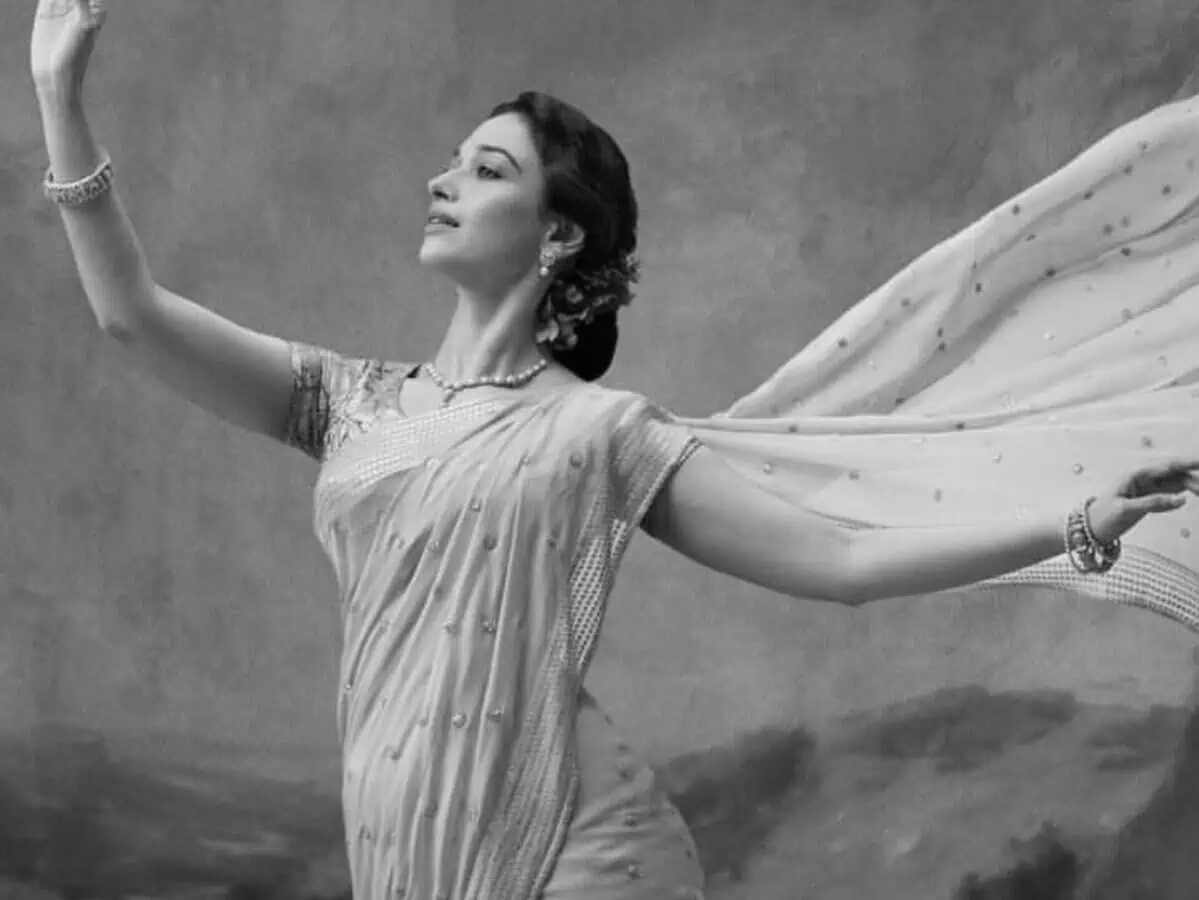
First look: Tamannaah transforms into Jayashree for V. Shantaram
Tamannaah Bhatia is set to play actress Jayashree in the forthcoming biopic on legendary filmmaker V. Shantaram, with Siddhant Chaturvedi in the lead. The makers unveiled a new poster revealing Tamannaah’s look, where she appears in a pink Nauvari saree that captures the timeless grace of Jayashree, the celebrated actor known for memorable roles in films such as Dr Kotnis Ki Amar Kahani, Shakuntala, Chandra Rao More, and Dahej. Jayashree also held an important place in Shantaram’s life as his second wife, and her contribution to the cinematic era he shaped remains significant.
The film, titled V Shantaram, is described as a historical biographical drama that pays tribute to the filmmaker’s life, creative spirit, and his revolutionary impact on Indian cinema. It traces his extraordinary journey from the silent film era to becoming one of the most influential auteurs in the country’s cinematic history. Tamannaah expressed her excitement about portraying Jayashree, calling it a responsibility she deeply values. She said she feels honoured to bring to screen a woman whose work and elegance left a lasting imprint. According to her, stepping into Shantaram’s universe has offered a chance to understand the brilliance of the man behind the legend, and bringing a part of that legacy to life is a uniquely special experience.
The makers had earlier revealed Siddhant Chaturvedi’s look as V. Shantaram, marking another key moment in the film’s promotional journey. The project is presented by Rajkamal Entertainment, Camera Take Films, and Roaring Rivers Production, and is produced by Rahul Kiran Shantaram, Subhash Kale, and Sarita Ashwin Varde. The film is directed by Abhijeet Shirish Deshpande, who aims to capture both the art and the spirit of the acclaimed filmmaker.
V. Shantaram, born Shantaram Rajaram Vankudre in 1901, remains a towering figure in Indian cinema whose career spanned almost seventy years. He founded the Prabhat Film Company in 1929 and later established Rajkamal Kalamandir in 1942, shaping the direction of the industry through both institutions. He also directed the first Marathi talkie, Ayodhyecha Raja, in 1932, marking a milestone in regional cinema. His acclaimed films such as Duniya Na Mane, Do Aankhen Barah Haath, Jhanak Jhanak Payal Baaje, and Navrang were widely praised for their technical innovation, rich visual language, and progressive storytelling. He addressed major social issues including communal harmony, dowry practices, and prisoner rehabilitation, using cinema as a medium for meaningful change.
Known for his grand sets, distinctive song picturizations, and symbolic imagery, V. Shantaram crafted a legacy that continues to influence filmmakers across generations. His contributions were recognised with India’s highest film honour, the Dadasaheb Phalke Award, in 1985, cementing his status as one of the true pioneers of Indian cinema.