
Final South Block Cabinet Meet Clears ₹1.5 Lakh Crore Mega Projects
The Union Cabinet chaired by Prime minister Narendra Modi held its final meeting in South Block on February 13, 2026, marking the end of an administrative era that has shaped governance since Independence. Beginning with the next session, Cabinet meetings will be held at the newly inaugurated Seva Teerth , a modern governance complex designed to improve coordination, efficiency and service delivery. Briefing the media, Union Minister Ashwini Vaishnaw said the transition reflects India’s move from colonial administrative structures to citizen-centric governance . The Cabinet also approved converting North and South Blocks into the Yuge Yugeen Bharat National Museum , preserving their legacy for future generations.
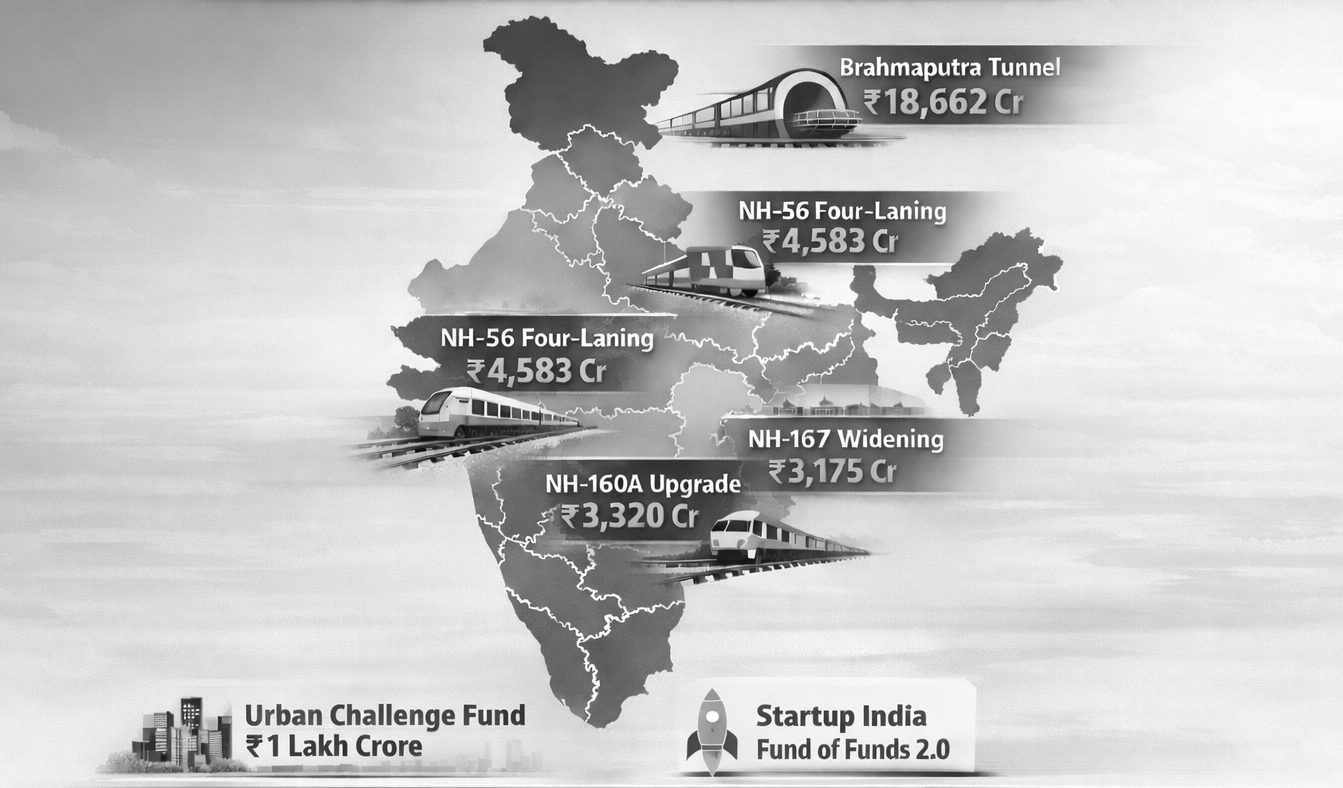
The meeting combined symbolism with major economic and infrastructure decisions. Among the most strategic approvals was the ₹18,662-crore Brahmaputra tunnel corridor project in Assam, which will build a 4-lane access-controlled greenfield link between Gohpur and Numaligarh featuring India’s first underwater road-cum-rail tunnel . The project will significantly reduce travel time, strengthen connectivity across the Northeast and generate about 80 lakh person-days of employment .
Several highway upgrades were cleared to improve logistics and regional connectivity. The ₹4,583.64-crore NH-56 four-laning project in Gujarat will improve connectivity in tribal and aspirational districts while enhancing access to the Statue of Unity and cutting travel time by nearly 40%. In Maharashtra, the ₹3,320.38-crore NH-160A corridor upgrade will decongest freight traffic around Nashik, provide an alternate route bypassing the city and improve connectivity to tribal and coastal regions. The ₹3,175.08-crore NH-167 widening project in Telangana will reduce congestion across fast-growing towns and strengthen connectivity to Hyderabad’s economic clusters.
Rail infrastructure expansion received a major boost with approval of ₹18,509 crore for multi-tracking projects on the Kasara–Manmad, Delhi–Ambala and Ballari–Hosapete corridors, adding about 389 km of capacity. The upgrade will improve operational efficiency, boost freight capacity by nearly 96 million tonnes annually , reduce emissions and benefit about 3,902 villages while enhancing access to key destinations including Trimbakeshwar Temple and Hampi.
Urban mobility will improve with the 11.56-km Noida Metro Extension , expanding the Noida–Greater Noida network to 61.62 km , improving connectivity to business hubs, institutions and healthcare centres while reducing congestion and emissions.
In a major urban policy shift, the Cabinet launched the Urban Challenge Fund (₹1 lakh crore) , expected to catalyse ₹4 lakh crore in urban infrastructure investment through market-linked financing and reforms. A ₹5,000-crore credit guarantee corpus will help smaller cities access funding.
To strengthen innovation, the Cabinet approved the Startup India Fund of Funds 2.0 (₹10,000 crore) to mobilise venture capital, support deep-tech innovation and expand funding beyond metro cities. Together, these decisions reinforce India’s push toward modern infrastructure, resilient cities, stronger logistics and innovation-driven growth aligned with Viksit Bharat 2047 .