
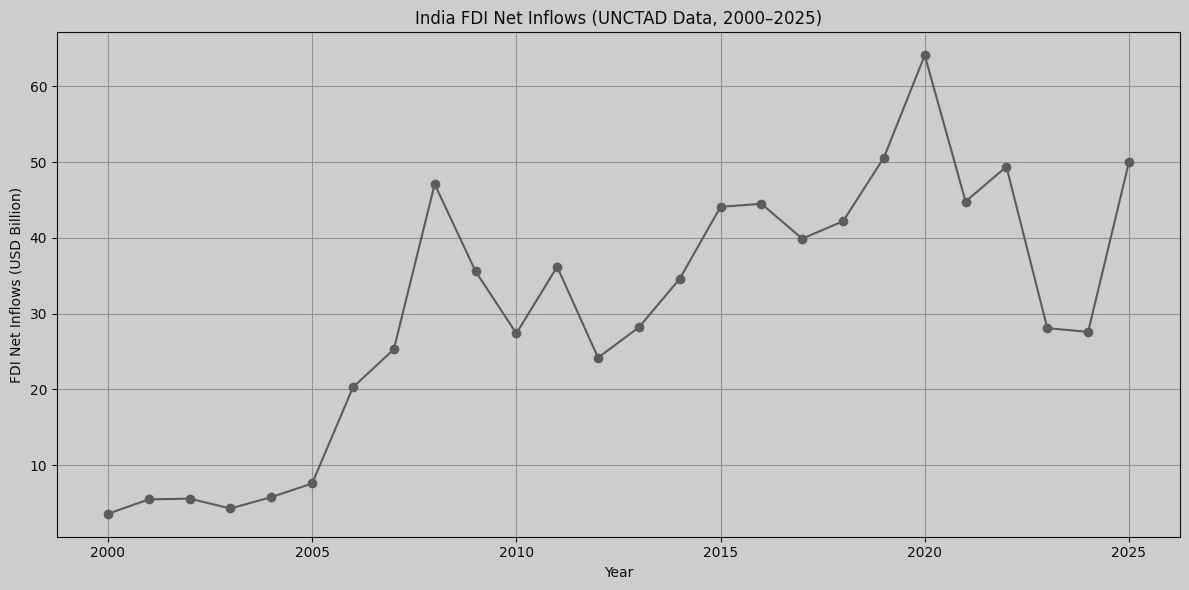
FDI net inflows bounce back to $50 billion level in 2025 after two years of sharp decline
India’s foreign direct investment net inflows rebounded to around $50 billion in 2025 , marking a recovery after two consecutive years of steep decline, according to data released by the United Nations Conference on Trade and Development (UNCTAD) .
The rebound comes after FDI inflows fell sharply to $28.1 billion in 2023 and further to $27.6 billion in 2024 , levels last seen nearly a decade earlier. The 2025 recovery restores inflows to the long-term average range but still remains significantly below the historic peak recorded during the pandemic era.
UNCTAD data shows that India’s average annual FDI net inflows between 2014 and 2025 stood at approximately $42–45 billion , reflecting a period of sustained investor interest supported by policy reforms, digital expansion and manufacturing incentives. In comparison, the average inflows between 2004 and 2014 were about $23–25 billion , highlighting the structural shift in India’s ability to attract long-term foreign capital over the past decade.
Despite the rebound, current inflows remain nearly 40 per cent lower than the all-time high of $64 billion recorded in 2020 , when global liquidity surged amid ultra-low interest rates and multinational companies accelerated investments in technology platforms, digital services and mergers and acquisitions.
The sharp decline witnessed in 2023 and 2024 was largely driven by global factors rather than country-specific weaknesses. Rising interest rates in the United States and Europe significantly reduced global capital flows, while aggressive monetary tightening made emerging market investments less attractive. At the same time, global mergers and acquisitions activity slowed sharply as valuations corrected and financing costs rose.
Geopolitical tensions, supply-chain disruptions, the Russia-Ukraine conflict, the Israel-Gaza war and continued uncertainty in global trade also dampened cross-border investment sentiment. In addition, large economies such as the United States and European Union witnessed a redirection of capital towards domestic reshoring and strategic industries, reducing available capital for emerging markets.
UNCTAD data further indicates that the decline was compounded by a slowdown in global technology funding after the post-pandemic boom, particularly in data centres, fintech and digital platforms sectors that had earlier driven a major portion of India’s FDI surge.
The recovery in 2025 has been supported by renewed greenfield investments, stabilising interest rates, easing global inflation and rising investments in manufacturing, services and digital infrastructure. India also benefited from multinational companies continuing to diversify supply chains beyond China, reinforcing its role in global production networks.
UNCTAD’s FDI inflow figures are based on balance-of-payments data compiled from national authorities , and the same underlying sources are used by the International Monetary Fund (IMF) and the World Bank , making the dataset globally comparable and widely accepted for cross-country analysis.
While the rebound signals renewed investor confidence, analysts note that sustained recovery will depend on global monetary easing, revival of cross-border mergers and acquisitions, and continued policy stability at home. Even at the $50-billion level, India’s current inflows represent a normalisation phase rather than a return to the exceptional liquidity-driven highs witnessed in 2020.