
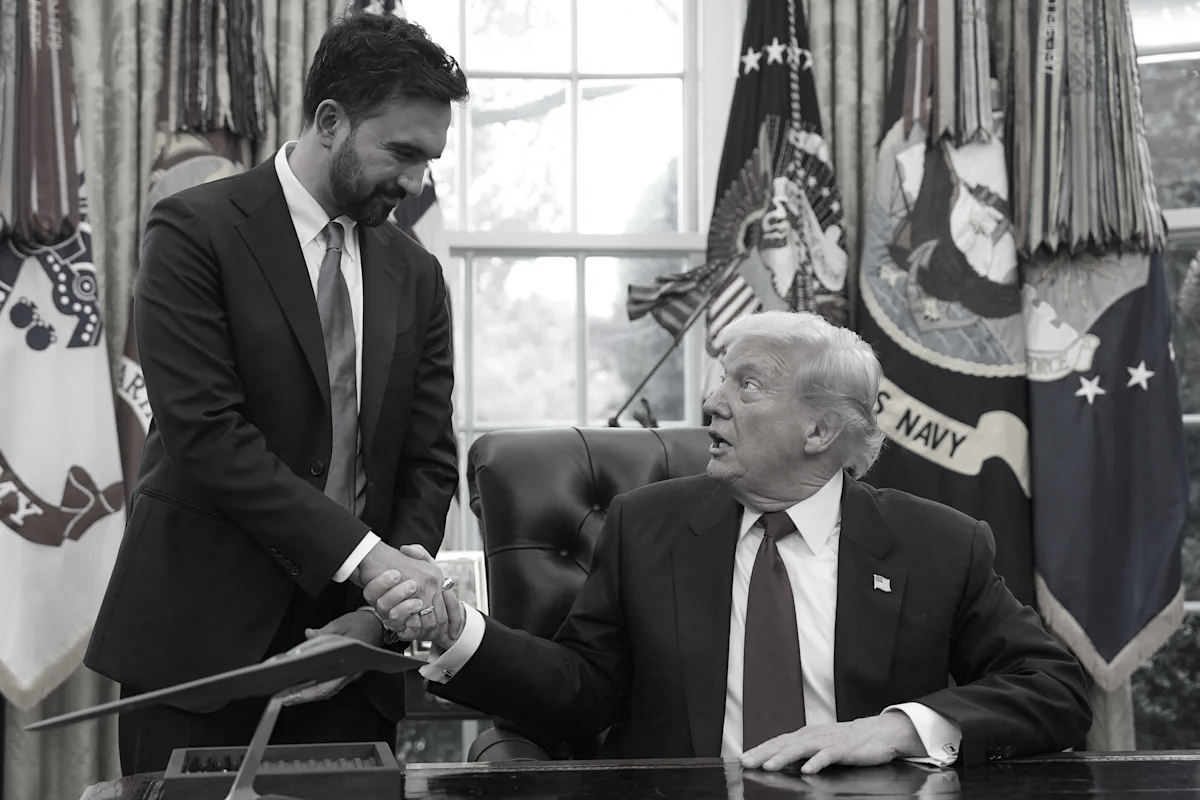
Fascist? Radical leftist? Just kidding! Trump and Mamdani share polite Oval Office smiles
President Donald Trump and New York City mayor-elect Zohran Mamdani held a closely watched Oval Office meeting on Friday, surprising observers given their long history of public political sparring. The meeting featured polite handshakes, photo opportunities, and unusually measured language from Trump, marking a sharp contrast to months of prior hostile remarks.
Trump noted that Mamdani himself had requested the meeting, and Mamdani later confirmed that he had reached out. This mutual acknowledgment added transparency to an otherwise tense relationship, highlighting that both sides were publicly open to dialogue.
New York City - an economy valued at around $1.2 trillion and over 8 million households, the city is heavily dependent on federal funding for housing, transit, child care, disaster relief, policing, and other essential services. This makes the city’s relationship with the White House particularly important. Observers suggested that the calm tone of the meeting may have reassured city officials that federal-city relations were stable, even as underlying political dynamics remain fragile, with Trump’s personal temperament capable of shifting outcomes in unexpected ways.
The meeting was also widely watched because of the leaders’ prior sharp exchanges. Trump had previously labelled Mamdani a “radical leftist,” warned of reconsidering federal funding to New York City, teased deploying the National Guard to assist with policing, and even joked publicly about arresting Mamdani. Mamdani, for his part, had called Trump a “fascist” during campaign rallies. These past confrontations made the meeting’s surprisingly cordial tone particularly noteworthy.
During discussion, Trump described the meeting as “great” and “very productive.” He told reporters, “One thing in common, we want this city of ours that we love to do very well. And I congratulated him, and we talked about some things in common, like housing and getting housing built, and food prices. The price of oil is coming way down.” Trump also extended goodwill toward Mamdani, saying, “I think you’re going to have, hopefully, a really great mayor. The better he does, the happier I am. I will say there’s no difference in party. I think he is going to surprise some conservative people, actually, and some very liberal people.”
Standing beside Trump, Mamdani echoed his assessment, describing the discussion as highly productive and focused on urgent cost-of-living challenges facing New Yorkers. “I appreciated the meeting with the president, as he said, it was a productive meeting focused on a place of shared admiration and love, New York City,” Mamdani said. He added that they discussed issues driving residents out of the city, including rent, groceries, and utilities. “We spoke about rent, we spoke about groceries, we spoke about utilities. We spoke about the different ways in which people are being pushed out. I appreciated the time with the president, I appreciated the conversation, and I look forward to working together to deliver that affordability for New Yorkers.”
Addressing past tensions directly, Trump said he would be “okay” if Mamdani continued to call him a “fascist.” When a reporter asked Mamdani about the remark, Trump interjected: “That’s okay. You can just say yes. It’s easier than explaining it. I don’t mind.” During the discussion, Trump also joked, “The new word is affordability,” appearing amused as he riffed on the term in his characteristic style.
Analysts observed that the widely photographed handshake and statements of cooperation were beneficial for Mamdani’s public visibility, even as questions remain about the depth of any real policy alignment. Some noted that Mamdani’s supporters had elected him primarily to focus on housing and affordability issues rather than political optics, while Trump’s supporters may view his conciliatory tone as a strategic display of bipartisanship ahead of upcoming midterm elections. Others suggested that Trump’s approach reflected his personal affinity for New York and his desire to highlight cooperation on key city issues, even if a single shift in his mood could change federal priorities.
Both leaders emphasized future collaboration, with Mamdani noting that coordination between city and federal leadership could help stabilise New York City’s future. He expressed appreciation for the meeting and said he looked forward to working with the president to improve affordability and living conditions for New Yorkers.
Reflecting on the spirit of the meeting, Indian politician Shashi Tharoor shared his thoughts on X: “This is how democracy should work. Fight passionately for your point of view in elections, with no rhetorical holds barred. But once it’s over, & the people have spoken, learn to cooperate with each other in the common interests of the nation you are both pledged to serve. I would love to see more of this in India and am trying to do my part.” His observation underscores the broader significance of bipartisan civility in governance, highlighting that even fierce political rivals can find common ground when focusing on public welfare.