
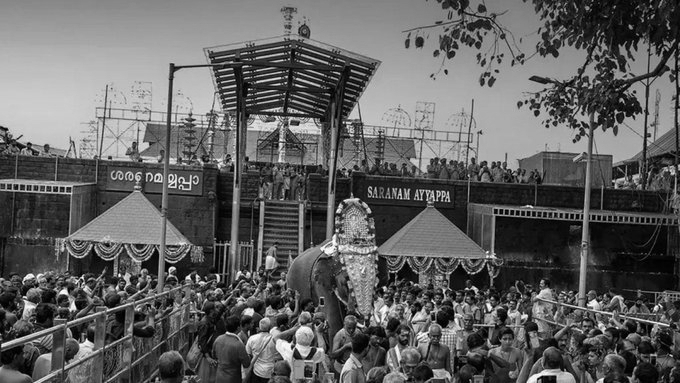
Faith, equality and judicial limits in focus as Sabarimala hearing rekindles national debate
The hearing in the long-pending Sabarimala case gathered fresh momentum on Tuesday, with the Union government defending religious autonomy before the Supreme Court of India, sharp observations from the bench on gender and equality, and political reactions adding to the broader national debate.
Appearing before a nine-judge Constitution bench headed by Chief Justice Surya Kant, Solicitor General Tushar Mehta argued that restrictions on the entry of women of menstruating age into the Sabarimala temple are rooted in faith and denominational autonomy, and should remain outside the ambit of judicial review. He submitted that courts should not evaluate religious practices on standards such as rationality or scientific validity, cautioning against substituting judicial reasoning for doctrinal beliefs.
The Centre maintained that the issue is not purely one of gender equality and contended that the 2018 judgment allowing entry of women aged 10–50 requires reconsideration. It emphasised that Articles 25 and 26 of the Constitution guarantee religious denominations the right to manage their own affairs, while also warning against expanding the concept of “constitutional morality,” which it described as vague and judicially evolved.
During the proceedings, the bench engaged with arguments on the scope of equality and the interpretation of exclusionary practices. Justice B V Nagarathna remarked that a woman cannot be treated as “untouchable” for a few days in a month and then cease to be so , raising questions over whether such exclusion could fall within the ambit of Article 17. The observation came in response to arguments surrounding the characterisation of the restriction in earlier proceedings.
Responding, Mehta clarified that the Sabarimala restriction is not based on menstruation but applies to a specific age group, describing the temple as a unique or “sui generis” case linked to the nature of the deity. He also objected to the 2018 judgment’s observation equating exclusion with untouchability.
The case traces back to the 2018 verdict in Sabarimala verdict 2018, in which a five-judge bench struck down the ban on women’s entry as unconstitutional. In 2019, a separate bench referred broader questions relating to religious freedom and gender equality across faiths to a larger bench, expanding the scope of the dispute.
Adding a political dimension to the ongoing legal debate, senior Congress leader Shashi Tharoor said legal interpretation must take into account the faith of devotees. Speaking in Thiruvananthapuram, he noted that the Sabarimala practice is historically linked to the belief in Lord Ayyappa as a “Nitya Brahmachari,” and argued that courts and governments operate within a society shaped by deeply held religious traditions.
Tharoor also criticised the handling of the issue by the Left Democratic Front government in Kerala following the 2018 verdict, saying it had learned a “hard lesson” after attempting to enforce the ruling in the face of widespread public resistance. He suggested that disregarding faith and sentiment had triggered backlash and called for a more gradual, society-led approach to change in sensitive religious matters.
The remarks come as the Supreme Court resumes hearings in the case, which now encompasses larger constitutional questions on the balance between religious freedom and fundamental rights. The Centre has reiterated that matters of faith should largely be left to religious denominations, while the bench continues to examine the limits of judicial intervention.
The hearings, which began on April 7, are expected to continue until April 22, with the outcome likely to shape the contours of religious liberty and equality jurisprudence in India.