
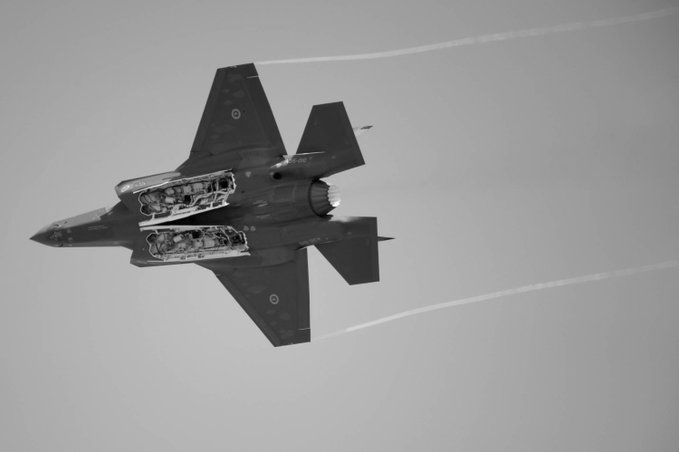
F-35 Parts End Up In Hong Kong: Has China Gained Access To US Stealth Technology?
A shipment containing F-35 Lightning II components was reportedly misrouted to Hong Kong instead of being sent to the United States for repairs, raising concerns that China could gain access to sensitive stealth technology.
The shipment contained unserviceable components from an Australian defence maintenance facility that were supposed to be returned to US manufacturers for refurbishment. The parts disappeared during commercial transit before being traced to Hong Kong. The incident comes as Chinese President Xi Jinping is in Washington for talks with US President Donald Trump and amid longstanding concerns over F-35 supply-chain vulnerabilities and Chinese cyber espionage targeting the Joint Strike Fighter programme.
According to sources familiar with the matter, the shipment included an F-35 cockpit canopy and components linked to the aircraft’s internal weapons-bay door. The canopy contains specialised radar-absorbent materials (RAM) and transparent conductive films, including indium tin oxide. These layers help prevent radar waves from penetrating the cockpit and reflecting off the pilot, helmet and internal avionics, contributing to the aircraft’s low-observable characteristics.
The diversion triggered classified briefings on Capitol Hill. US State Department and Defence Department officials briefed congressional staff about possible exposure of classified technology, while the F-35 Joint Program Office coordinated with US law enforcement and international partners to investigate and recover the material. UPS and Lockheed Martin also face scrutiny over how components subject to strict International Traffic in Arms Regulations reached foreign territory. Australian Defence Minister Richard Marles acknowledged the diversion but described the hardware as non-sensitive. Defence experts have warned that even worn stealth components could provide scientific value to a strategic rival.
Physical access could reveal information unavailable from stolen digital designs alone, including the composition and thickness of radar-absorbent coatings, how materials degrade in operational conditions and how transparent conductive layers are integrated into the canopy. China has meanwhile developed low-observable aircraft including the Chengdu J-20 and carrier-capable Shenyang J-35.
The incident also recalls a 2022 F-35 supply-chain scare, when the Pentagon temporarily halted deliveries after a specialised magnet in the aircraft’s turbomachine pump was found to contain an unauthorised Chinese-produced cobalt and samarium alloy. The material was later deemed to pose no flight-safety risk, transmit no data or compromise classified architecture, but the episode highlighted the programme’s complexity, involving more than 300,000 parts and over 1,700 international suppliers. A national security waiver allowed deliveries to resume while the alloy was replaced.
Concerns also stem from alleged Chinese cyber espionage. A mid-2000s campaign known as “Byzantine Hades” targeted defence contractors including Lockheed Martin, Northrop Grumman and BAE Systems. Documents disclosed by Edward Snowden indicated Chinese hackers obtained Joint Strike Fighter data involving the F-35’s AESA radar, engine thermal-management systems and stealth geometry. Chinese businessman Su Bin was prosecuted over a PLA-linked hacking conspiracy targeting F-35, F-22 and C-17 data and pleaded guilty in 2016.
There is no credible evidence China has recovered functional F-35 debris from deep-sea crash sites. After an F-35C slid into the South China Sea in January 2022, the US Navy used the CURV-21 remotely operated vehicle to recover it from more than 12,400 feet in March. Similar recovery efforts followed F-35 crashes involving Japan in 2019 and Britain in 2021.