
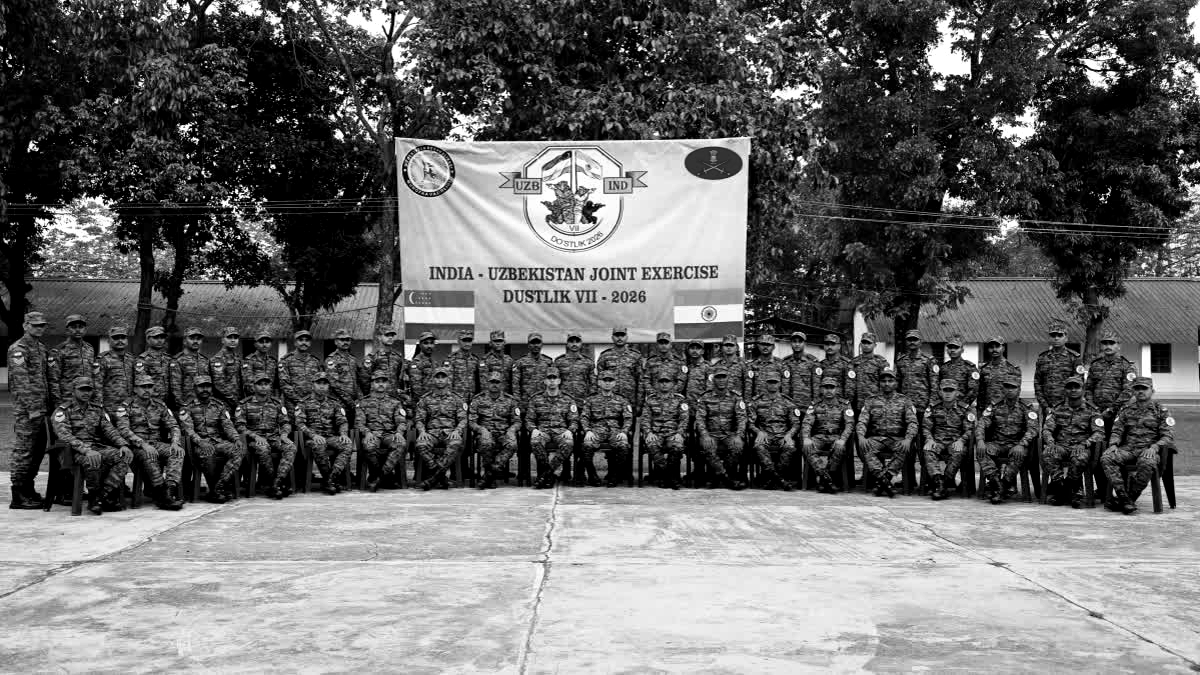
Exercise Dustlik: India and Uzbekistan boost defence cooperation
Troops from India and Uzbekistan have commenced the seventh edition of their annual joint military exercise, Dustlik , aimed at enhancing cooperation and strengthening capabilities for combined operations in semi-mountainous terrain .
The Indian contingent departed on Sunday for the exercise, which is being held at the Gurumsaray Field Training Area in Namangan, Uzbekistan , from April 12 to 25. The drill brings together around 60 personnel from each side , including 45 soldiers from the Indian Army, primarily from a battalion of the Mahar Regiment and 15 personnel from the Indian Air Force. The Uzbekistan contingent comprises troops from its Army and Air Force.
According to officials, the exercise will culminate in a 48-hour validation phase focused on joint tactical drills and special operations, particularly targeting the neutralisation of unlawful armed groups . Key operational aspects include land navigation, strike missions on enemy bases , and the seizure of enemy-held areas.
The training programme emphasises a high level of physical fitness, joint planning , and the development of basic special arms skills. It also seeks to establish a unified command-and-control framework , enhancing coordination during joint missions. Dustlik is conducted alternately in India and Uzbekistan each year. The previous edition took place in April 2025 at the Foreign Training Node in Aundh, Pune .
Officials said the exercise will enable both countries to exchange best practices in tactics, techniques and procedures , while improving interoperability and operational synergy . It is also expected to foster camaraderie between troops and further strengthen defence cooperation and bilateral ties between India and Uzbekistan, which share a growing strategic partnership marked by counter-terrorism cooperation, joint military training, and regional security coordination in Central Asia . Both sides remain concerned about the threat posed by “unlawful armed groups” , particularly in the wider region surrounding Afghanistan, as instability there could enable cross-border terrorism, radicalisation, and movement of extremist groups , impacting regional peace and security.