
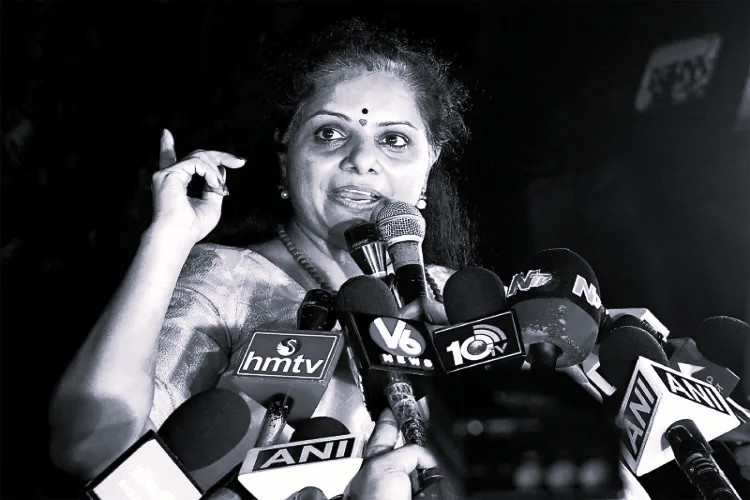
Excise Policy Row Returns to Court as Delhi HC Issues Notice to Kavitha
The legal battle surrounding the Delhi excise policy case has taken a fresh turn with the Delhi High Court issuing a notice to BRS leader K. Kavitha after the Central Bureau of Investigation (CBI) challenged a recent trial court decision that discharged several accused in the matter. CBI officials served the notice to Kavitha at her residence in Hyderabad on Thursday as part of the court proceedings linked to the agency’s appeal.
The development comes weeks after a Delhi trial court delivered a significant ruling on February 27 , dismissing charges against 23 individuals , including former Delhi Chief Minister Arvind Kejriwal , former Deputy Chief Minister Manish Sisodia , and Kavitha. In its judgment, the trial court held that the investigation had failed to present sufficient material to establish even a prima facie case , sharply questioning the quality of evidence placed before it.
Challenging that verdict, the CBI approached the Delhi High Court , arguing that the trial court’s decision requires closer scrutiny. Acting on the agency’s petition, the High Court issued notices to all those who were discharged and sought their responses. The matter is scheduled to come up for hearing on March 16 , when the court will consider the arguments from both sides.
Kavitha confirmed receiving the notice through a post on the social media platform X , stating that CBI officials had formally delivered the court’s communication. She said she is currently consulting her legal team and will respond through appropriate legal channels. Kavitha also reiterated that she will fully cooperate with the judicial process and respect the course of law.
The BRS leader, who is the daughter of former Telangana Chief Minister K. Chandrashekar Rao (KCR) , emphasized that the issuance of a notice when an investigating agency files an appeal in a higher court is a routine legal procedure . She urged people not to misinterpret the development or make remarks that could undermine the credibility of the judicial system .
Earlier this month, the Delhi High Court had already intervened in another aspect of the case. On March 9 , the court temporarily stayed the trial court’s recommendation that departmental action be initiated against a CBI investigating officer. During the hearing, Justice Swarna Kanta Sharma observed that certain remarks made in the trial court’s order appeared prima facie questionable , indicating the need for a deeper examination of the matter.
The Delhi excise policy case relates to alleged irregularities in the now-scrapped 2021–22 liquor policy of the Delhi government. Investigating agencies have alleged that the policy was manipulated to provide undue benefits to select private liquor distributors in exchange for illegal financial gains. The prosecution has claimed that a network of intermediaries, sometimes referred to as the “South Group,” played a role in the alleged transactions.
However, the trial court had taken a strong view against the investigation, stating that the prosecution’s claims were not backed by credible evidence and that forcing the accused to face trial without adequate material would violate principles of justice. The court’s observations became a key reason for the CBI to move the High Court seeking a review of the decision.
With the CBI’s appeal now before the Delhi High Court , the case has once again entered a critical legal phase. Legal observers say the outcome of the March 16 hearing could significantly influence the direction of the politically sensitive investigation, determining whether the discharged accused may once again face trial or whether the earlier ruling will stand.