
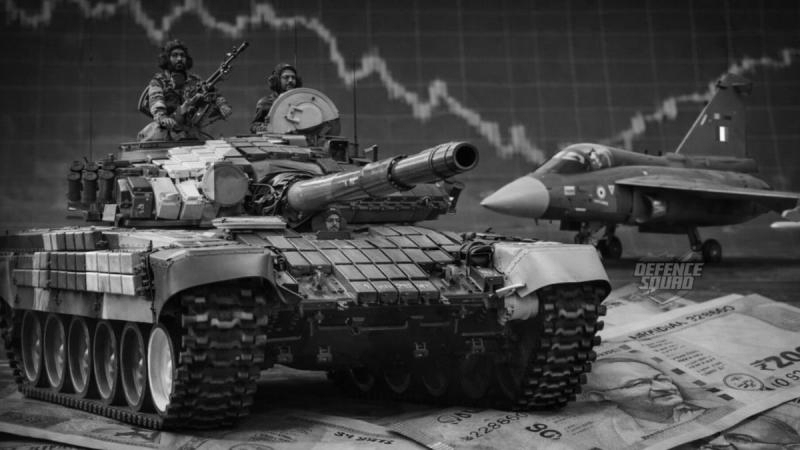
Every rupee spent: India’s defence ministry utilises full ₹1.86 lakh crore budget
India's Ministry of Defence has fully utilised its entire capital expenditure allocation of ₹1.86 lakh crore for financial year 2025–26, the second consecutive year of complete spending after a long stretch where defence procurement routinely fell short of its own targets.
The number tells only part of the story. The original allocation of ₹1.80 lakh crore was enhanced by the Finance Ministry after strong spending momentum in the first two quarters and additional operational requirements arising from the aftermath of Operation Sindoor , India's precision strikes in May 2025 against terrorist infrastructure in Pakistan, triggered by the Pahalgam attack that killed 26 civilians. The conflict didn't just justify the spending; it reshaped it.
Notable procurements during the year included medium-altitude long-endurance remotely piloted aircraft for the Indian Air Force, mine countermeasure vessels for the Indian Navy, quick-reaction surface-to-air missile systems , and the Nag Mk-2 anti-tank missile for the Army. Aircraft and aero engines led overall expenditure, followed by land systems, electronic warfare equipment, armaments, shipbuilding, and aviation stores. Contracts formalised during the year included 97 Tejas Mk-1A fighters and 156 Prachand light combat helicopters , both designed to bolster air superiority and high-altitude operational capability.
The procurement pipeline itself expanded dramatically. The ministry accorded Acceptance of Necessity for 109 proposals amounting to ₹6.81 lakh crore , compared to 56 proposals worth ₹1.76 lakh crore in 2024-25, nearly doubling the number of programmes cleared for formal tendering in a single year. A total of 503 contracts worth ₹2.28 lakh crore were signed, the highest volume in a single fiscal period. Overall budget utilisation, including civil expenditure and pensions, stood at 99.62 per cent .
Critically, Operation Sindoor also crystallised the danger of import dependency. The government has earmarked ₹1.39 lakh crore, 75 per cent of the capital acquisition budget , for procurement through domestic industries in FY 2026–27. Despite the hike, India's defence budget remains nearly four times smaller than China's estimated spending, while facing a two-front strategic challenge from both Beijing and Islamabad.
Looking ahead, India's total defence outlay of ₹7.85 lakh crore for 2026–27 will, according to the International Institute for Strategic Studies, make it the world's fourth-largest military spender , behind only the United States, China, and Russia, a ranking that reflects not just ambition, but a country recalibrating its strategic posture in real time.