
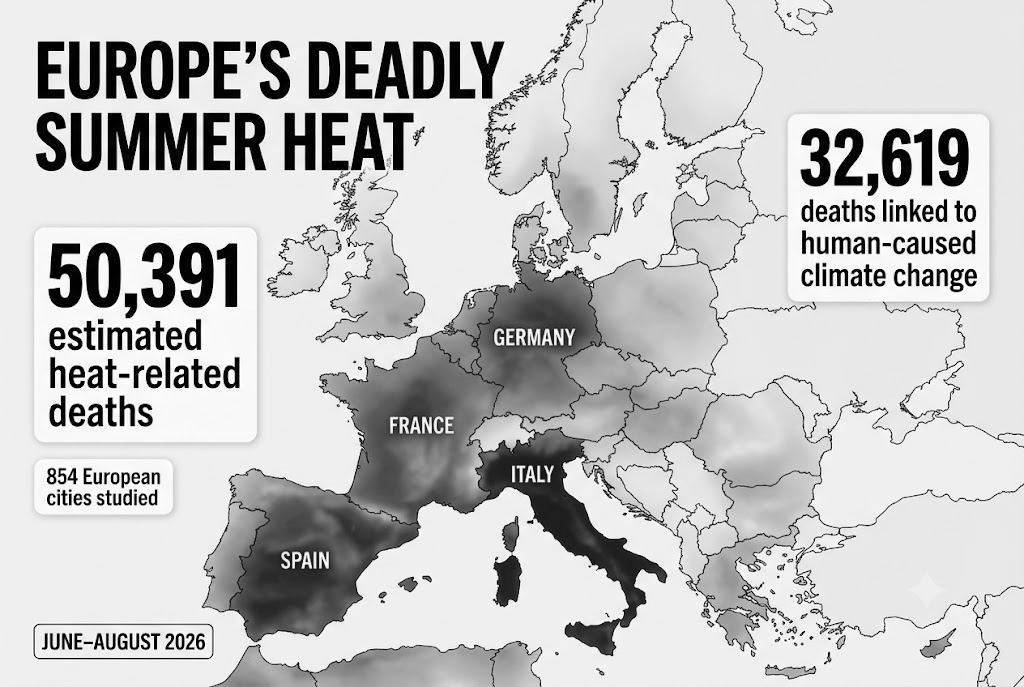
Europe’s Deadly Summer Heat Claims 50,391 Lives as Climate Change Fuels the Crisis
Europe’s scorching summer of 2026 claimed more than 50,000 lives across 854 cities, with human-caused climate change responsible for nearly two-thirds of the deaths, according to a new study that highlights the growing threat of extreme heat.
The research, set to be published in Nature Health, estimated that 50,391 people died from heat-related causes during June, July and August, including 32,619 deaths attributable to additional warming caused by human activities, particularly the burning of coal, oil and gas.
The toll was 71 per cent higher than the previous record of 29,480 deaths in 2022, according to researchers. They cautioned that the actual figure could be considerably higher, as the study excluded a deadly heatwave in May and covered only 854 cities, representing around 40 per cent of Europe’s population.
The most devastating period was between June 17 and July 1, when temperatures soared 5.3 degrees Celsius above normal. Nearly one-third of the estimated summer deaths occurred during this particularly intense heatwave. Some European cities experienced temperatures as much as 12 degrees Celsius above normal, researchers said.
Italy, France, Spain and Germany recorded the highest death tolls. Older people were disproportionately affected, with more than half of the victims aged 85 or above. However, extreme heat also killed more than 800 people aged between 20 and 44, underlining that the danger extends beyond the elderly.
Researchers from Imperial College London used computer simulations to compare actual summer conditions with a hypothetical world without human-caused climate change. The difference helped estimate the number of deaths linked specifically to global warming. Heat-related deaths are often underreported because heat is not always identified as a contributing factor on death certificates.
Europe has warmed by around 2.5 degrees Celsius since pre-industrial times, making heatwaves more dangerous. Scientists warned that even a seemingly small rise in average temperatures can push conditions from uncomfortable to potentially fatal.
Experts said governments must strengthen heat-warning systems, expand access to affordable, low-carbon cooling and protect vulnerable communities through local support networks. However, adaptation alone will not be enough.
They stressed that rapidly reducing fossil fuel consumption is essential to tackling the root cause of the crisis, as rising temperatures increase the frequency and intensity of deadly heatwaves.