
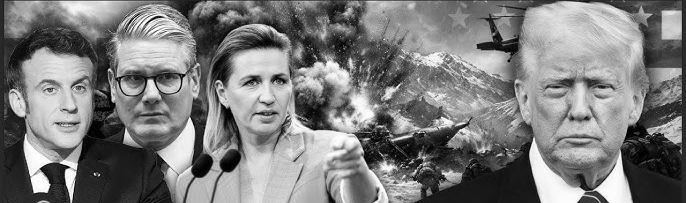
Europe and Greenlanders unite against Trump’s Greenland tariff threats
US President Donald Trump has announced that eight European countries Denmark, the United Kingdom, Norway, Sweden, France, Germany, the Netherlands, and Finland will face a 10 per cent tariff on goods imported to the United States starting February 1, 2026, escalating to 25 per cent by June if no agreement is reached on his proposed “complete and total purchase of Greenland.” Trump cited national security and Greenland’s strategic Arctic location as justification, framing the tariffs as leverage to force negotiations with NATO allies over the semiautonomous island.
The announcement sparked immediate outrage across Europe. French President Emmanuel Macron described the tariffs as “unacceptable” and warned that intimidation would not dictate Europe’s policy. British Prime Minister Keir Starmer called the move “completely wrong,” emphasizing that Greenland’s future is for its people and Denmark to decide and stressing the shared NATO responsibility for Arctic security. Swedish and Norwegian leaders echoed the message, rejecting any attempt at coercion. EU officials convened emergency meetings to coordinate responses, signaling potential retaliatory measures to protect sovereignty and deter economic pressure.
Even Trump’s European allies expressed concern. Italy’s Premier Giorgia Meloni called the tariffs a mistake, clarifying that recent European troop deployments to Greenland were for Arctic security training, not opposition to the US. European Commission President Ursula von der Leyen warned that the tariffs risked undermining decades of transatlantic relations and creating a “dangerous downward spiral.” Analysts noted that geopolitical rivals such as China and Russia could benefit from divisions between the US and Europe.
The move also drew criticism in the United States . Some lawmakers argued that punishing allies over Greenland would harm American consumers and weaken alliances crucial to collective security. Others defended the administration’s position as a preemptive measure to secure the Arctic. Trump indicated that negotiations would only end when a deal over Greenland was finalized, and he is scheduled to meet European leaders at the upcoming World Economic Forum in Davos, where the dispute is expected to dominate discussions.
Amid this diplomatic crisis, thousands of Greenlanders staged a massive protest in Nuuk on Saturday, expressing opposition to any American takeover. Participants carried placards reading “Greenland is not for sale, ” waved the red-and-white Greenlandic flag, and chanted slogans supporting self-governance. About 4,000 people roughly a quarter of Nuuk’s population joined the march, which also featured traditional songs and public speeches from local leaders. Demonstrations were held simultaneously in Copenhagen and other cities across Denmark and the Arctic, highlighting widespread concern for Greenland’s autonomy.
Protesters emphasized that the fight is about sovereignty, culture, and the right of Greenlanders to decide their own future. Parents brought children to rallies to teach civic engagement, and many observers stressed that the island’s residents overwhelmingly oppose any transfer of control. Former Greenlandic parliament members and local officials framed the protest as part of a broader struggle to protect NATO unity, Arctic security, and freedom in the Western Hemisphere.
The standoff has turned Greenland into a focal point of global diplomacy, uniting local communities with European leaders in defense of sovereignty while challenging the United States to reconsider its approach to allies and strategic priorities in the Arctic.