
Essar Bets Big on 30,000 LNG and EV Trucks with 100 Nationwide Fuel Hubs
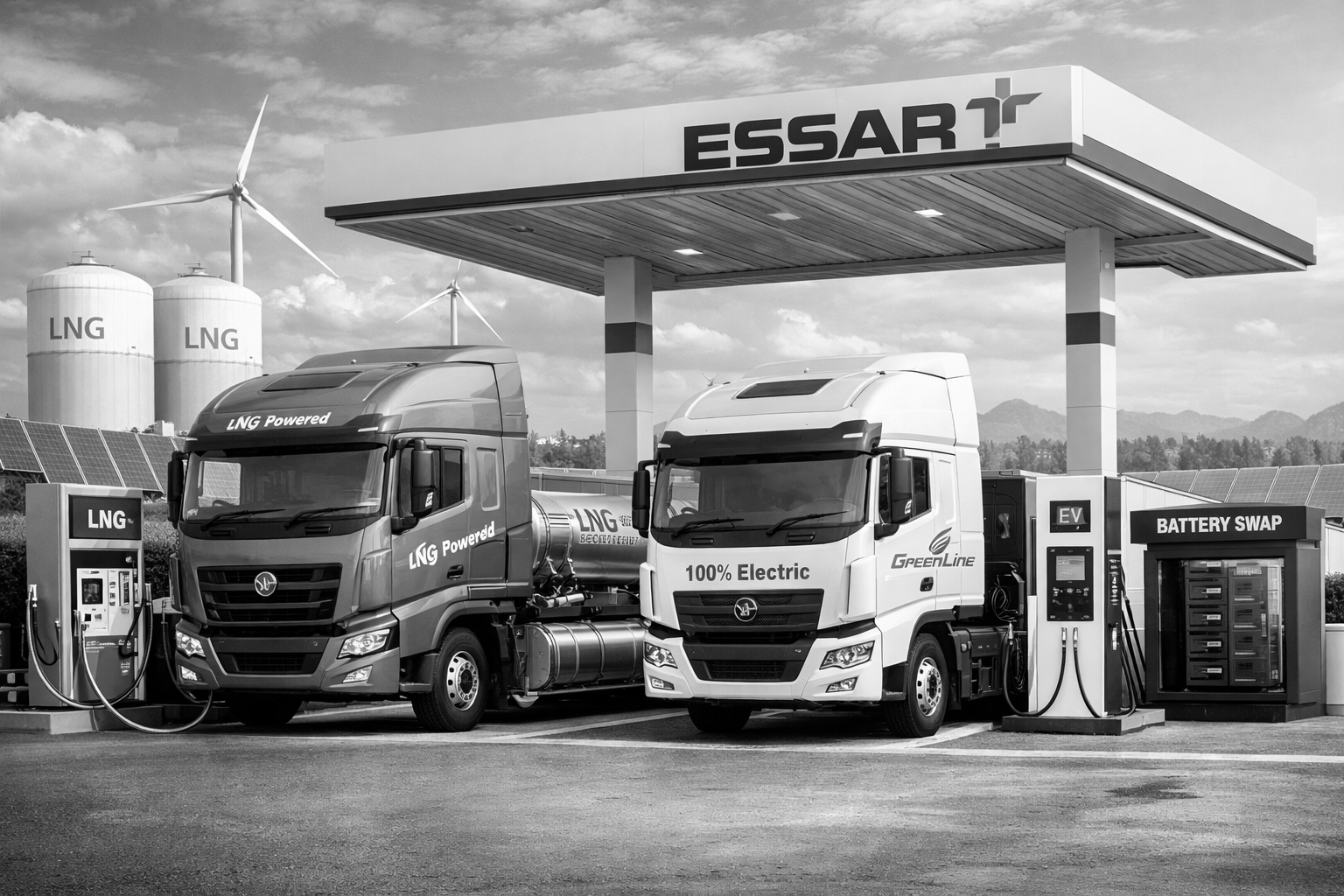
Essar Group has unveiled one of India’s most ambitious clean logistics programmes through its Green Mobility initiative, targeting the deployment of 30,000 LNG and electric trucks supported by a nationwide network of 100 alternative-fuel and charging hubs . The initiative is aimed at transforming the country’s carbon-intensive freight sector by building a fully integrated ecosystem that links vehicle production, fleet operations and fuelling infrastructure. By addressing both operational and economic barriers, Essar estimates the programme could help reduce nearly one million tonnes of CO2 annually from road freight emissions, marking a major step in India’s transport decarbonisation journey.
Unlike fragmented clean-mobility efforts, Essar’s approach is based on a vertically integrated model. Truck manufacturing is handled by Blue Energy Motors , fleet deployment and logistics operations are managed by GreenLine Mobility Solutions , and fuelling and charging infrastructure is being rolled out by Ultra Gas & Energy . This structure allows the group to synchronise truck supply with fuel availability and charging access, helping to overcome persistent industry challenges such as high upfront vehicle costs, limited refuelling networks and operational downtime that have slowed the adoption of low-emission freight technologies.
Technologically, the programme adopts a dual-fuel strategy tailored to freight duty cycles. LNG-powered trucks are designated for long-haul operations, where extended driving range, fast refuelling and heavy payload capacity are essential. Each heavy-duty LNG truck can haul around 40 tonnes of cargo and travel close to 1,200 kilometres on a single tank, making it commercially viable for intercity corridors. For short-haul and urban routes, Essar is deploying electric trucks , which deliver higher energy efficiency, regenerative braking benefits and zero tailpipe emissions, particularly important for cities struggling with air pollution.
The supporting infrastructure is designed as multi-fuel hubs that combine LNG refuelling, fast-charging systems and battery-swapping facilities. Battery swapping is a key technological focus because it can reduce vehicle downtime to minutes rather than hours, a critical factor in commercial freight where utilisation determines profitability. Ultra Gas & Energy has already commissioned several LNG refuelling stations across major industrial corridors and is expanding through a ₹900-crore investment plan to build a 100-station network expected to cover a large share of India’s long-haul freight routes.
Operational data from existing deployments underline the feasibility of the model. GreenLine’s LNG fleet, already numbering in the hundreds, has collectively covered over 70 million kilometres and achieved substantial emission reductions compared to diesel trucks. These early results demonstrate that alternative fuels can meet real-world logistics demands in sectors such as steel, cement, FMCG and chemicals, where reliability and turnaround time are crucial.
Financial backing is also strengthening the rollout. A recent USD 275 million equity raise, which includes a Nikhil Kamath investment, is helping accelerate the next phase of truck deployment and infrastructure expansion. The integrated model also positions Essar to adopt future technologies, with hubs designed to accommodate emerging fuels such as bio-LNG, hydrogen or advanced battery systems as they mature.
However, the transition’s success will depend on broader ecosystem readiness. Scaling heavy electric vehicles requires reliable battery cell supply, stronger grid infrastructure for high-capacity charging and continued policy support to ensure cost competitiveness against diesel. Methane management across LNG supply chains will also be important to maximise lifecycle emission benefits.
Overall, Essar’s strategy represents a pragmatic blend of immediate and long-term solutions. By combining LNG for long-distance freight with electrification for urban logistics, and backing both with integrated infrastructure and fleet management, the company is building a replicable model for cleaner logistics. If executed at the planned scale, the initiative could significantly reshape India’s freight transport landscape while supporting national climate and energy-security goals.