
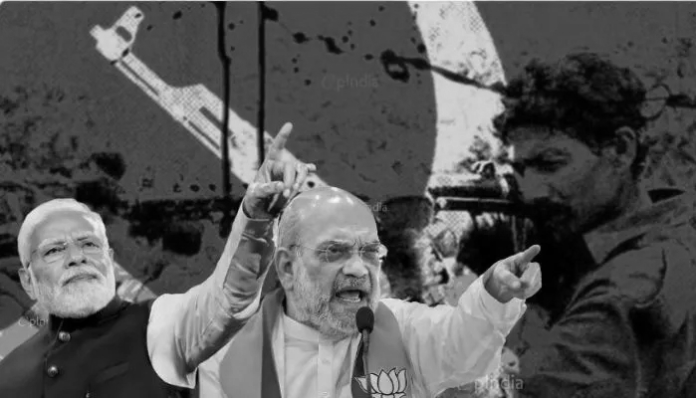
End of red terror? How close India is to its Naxal-free target as Amit Shah’s March 31 deadline ends
Today is the day. The deadline is here. But is India actually Naxal-free, or is this just political theatre?
In 2024, Amit Shah set an ambitious deadline : the complete eradication of armed Naxalism by March 31, 2026 . Yesterday , standing in the Lok Sabha , he declared the mission essentially accomplished, a day ahead of schedule. The insurgency, he said, has been “effectively dismantled,” with the Maoist Politburo and central leadership nearly eliminated . Shah noted that only a handful of senior cadres remain active, and the movement is in its “last breath,” particularly in Chhattisgarh’s Bastar region. He praised security forces, state police and local communities for weakening the network, while sharply criticising the Congress for past inaction, alleging that some of its leaders had indirect ties or sympathies with Maoist elements.
According to official figures, 2025 alone saw 317 Naxals neutralised , over 800 arrested, and nearly 2,000 surrendering. Between 2023 and 2025, more than 3,500 insurgents laid down arms. In May 2025, a major operation in the Karregutta hills led to the killing of 31 Naxals, including CPI (Maoist) General Secretary Nambala Keshava Rao . Senior commander Madvi Hidma was eliminated in November 2025, and multiple senior leaders including Prabhakar Rao were killed in February 2026. These are real operational gains. The Maoist leadership has been systematically dismantled.
But here is the problem with calling it "done." Security forces are still tracking about 130-150 armed cadres , two central committee members of the outlawed CPI (Maoist), and some divisional-rank operatives. These are not ghosts, they are armed, active fighters in forests. Misir Besra alias Bhaskar is stated to be based in Jharkhand, and CoBRA teams are actively searching for him.
A fresh review has reduced the number of Left Wing Extremism-affected districts to seven from eight . These are Bijapur, Narayanpur, and Sukma (the most affected), Kanker and Dantewada (classified as "districts of concern"), all five in Chhattisgarh , plus West Singhbhum in Jharkhand and Kandhamal in Odisha. Five of the seven remain concentrated in Chhattisgarh's Bastar belt alone, which tells you exactly where the problem still lives. And the deadline that was supposed to end it was political from the start, large operations were undertaken in the final days of the countdown , not because the ground situation organically demanded it, but because a political clock was ticking. Security forces were reshuffled and redeployed on a minister's calendar. A 56-year insurgency does not end because someone picked a date.
Seven districts still officially classified as LWE-affected are not zero . That is the honest picture, regardless of what was declared from a parliament podium.
Shah also used the occasion to attack Congress, alleging that no decisive action was taken during their decades in power, despite former PM Manmohan Singh himself acknowledging Naxalism as a major internal security threat. That criticism has some merit, Naxal expansion did happen across multiple governments. But using a security briefing to score political points skips the harder questions entirely: What happens to the tribal communities caught between Maoists and security forces for decades? Who is accountable for the roughly 20,000 lives lost over this conflict?
The Naxal movement is broken, its leadership killed or surrendered, its territory shrunk, its finances choked. That is a genuine achievement by security forces who paid for it with their lives . But declaring "India is Naxal-free" while 130+ armed cadres are still being hunted in forests is a political statement, not a security assessment.
The Red Corridor is shrinking. It has not vanished. Call it progress. Don't call it finished.