
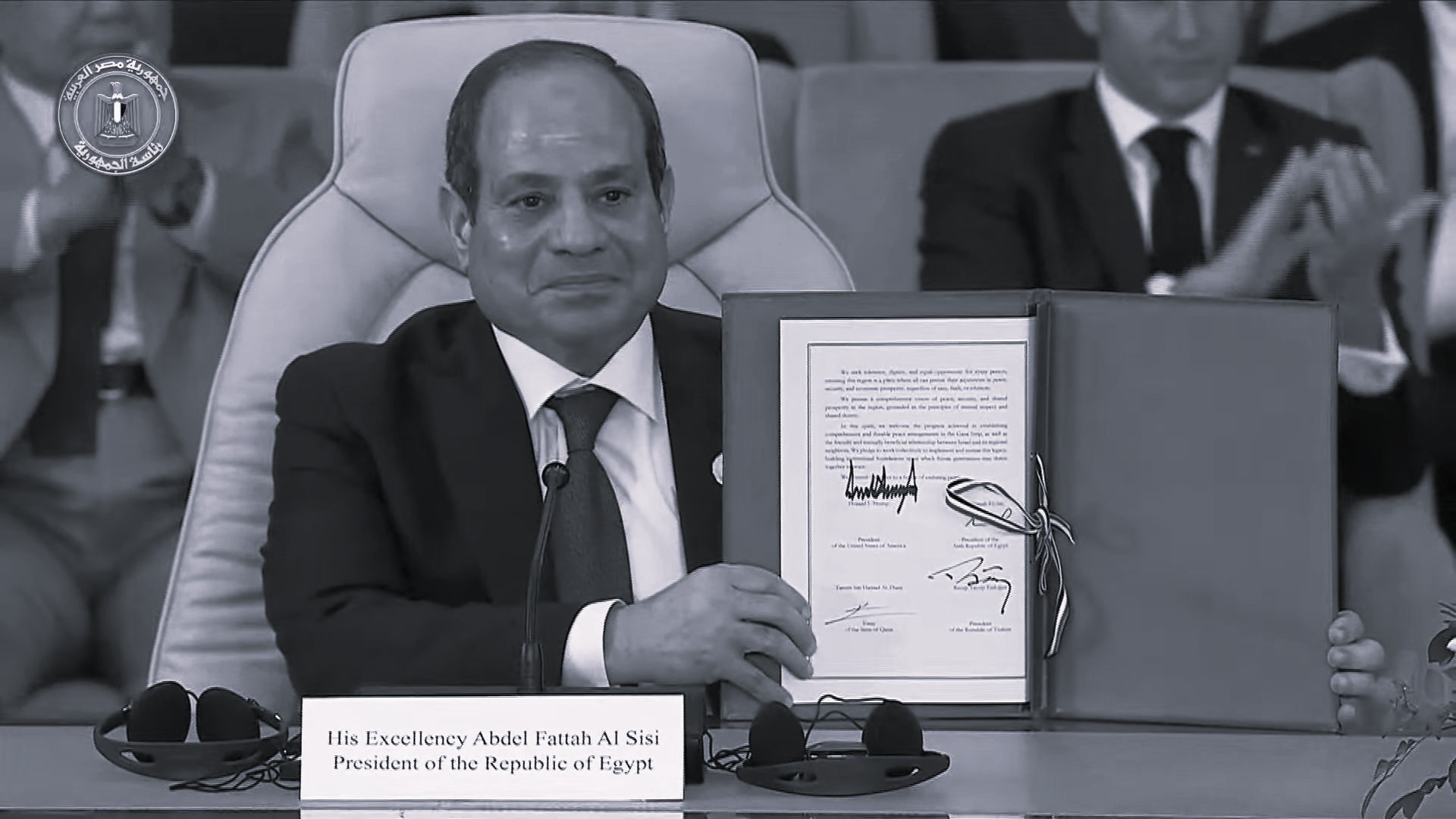
El-Sissi calls Trump’s plan the region’s final hope for peace
Egyptian President Abdel Fattah El-Sissi on Monday described U.S. President Donald Trump’s Middle East peace proposal as the “last chance” for lasting peace in the region, urging global leaders to support a two-state solution that ensures Palestinians’ right to an independent state.
Addressing a high-level summit convened in the Egyptian resort town of Sharm el-Sheikh, El-Sissi said the gathering aimed to sustain the fragile ceasefire in Gaza, end the prolonged Israel-Hamas war, and outline a roadmap for rebuilding the devastated Palestinian territory.
Trump’s plan, which envisions a phased path toward Palestinian statehood following a transition and reform period in Gaza under the Palestinian Authority, has drawn mixed reactions. Israeli Prime Minister Benjamin Netanyahu, who has long opposed Palestinian independence, skipped the summit due to a Jewish holiday, his office said.
El-Sissi, in a symbolic gesture, conferred the Order of the Nile, Egypt’s highest civilian honour, on Trump for his efforts in brokering the ceasefire. The truce, negotiated in Qatar with U.S., Arab, and Turkish mediation, took effect Friday and led to the release of 20 Israeli hostages by Hamas and hundreds of Palestinian prisoners by Israel.
More than 20 world leaders attended the summit, including Jordan’s King Abdullah, Turkish President Recep Tayyip Erdoğan, Qatar’s Emir Sheikh Tamim bin Hamad Al Thani, British Prime Minister Keir Starmer, French President Emmanuel Macron, and UN Secretary-General António Guterres. Israel and Hamas did not participate directly.
New page for the region
El-Sissi’s office said the conference sought to “end the war” in Gaza and “usher in a new page of peace and regional stability” in line with Trump’s vision. Egyptian Air Force jets escorted Air Force One as Trump landed in Sharm el-Sheikh to a warm reception from El-Sissi.
In his address, Trump called on Israelis to “work toward peace” and urged Palestinians to “focus on rebuilding.” Egyptian Foreign Minister Badr Abdelatty emphasised that the success of the peace process depends on sustained U.S. engagement and possibly an international peacekeeping deployment authorised by the UN Security Council.
“We need American engagement, even deployment on the ground, to define the mission and mandate of this force,” Abdelatty told The Associated Press.
Next phase and challenges
The second phase of the deal will involve disarming Hamas, establishing a post-war governance structure for Gaza, and negotiating Israel’s military withdrawal. A 15-member committee of Palestinian technocrats, unaffiliated with any faction and vetted by Israel, will administer Gaza temporarily under supervision from a proposed “Board of Peace.”
Reconstruction of Gaza remains a major challenge. The World Bank and Egypt estimate the territory’s rebuilding costs at USD 53 billion. Egypt will host an international recovery and reconstruction conference for Gaza in November.
Global Roles and Support
Several nations announced commitments to the peace and rebuilding process. Turkiye, which previously hosted Hamas leaders, played a key role in the truce negotiations. Jordan and Egypt will jointly train the new Palestinian security forces.
British Prime Minister Keir Starmer pledged £20 million (USD 27 million) for water and sanitation projects in Gaza and said Britain would host a three-day conference on the region’s reconstruction.
Germany, represented by Chancellor Friedrich Merz, expressed concerns over Israel’s military conduct while affirming support for Gaza’s rebuilding. Iran, a key backer of Hamas, did not attend, marking its diminished influence following the recent Israel-Iran conflict.
Historic venue
The summit took place in Sharm el-Sheikh, a city with a storied history in Middle East diplomacy. Situated at the southern tip of the Sinai Peninsula, it has hosted multiple peace conferences since its return to Egypt in 1982 following the Egypt-Israel Peace Treaty.
Monday’s gathering marked the first major peace summit under El-Sissi’s presidency, symbolising renewed international determination to stabilise Gaza and revive the long-stalled Middle East peace process.