
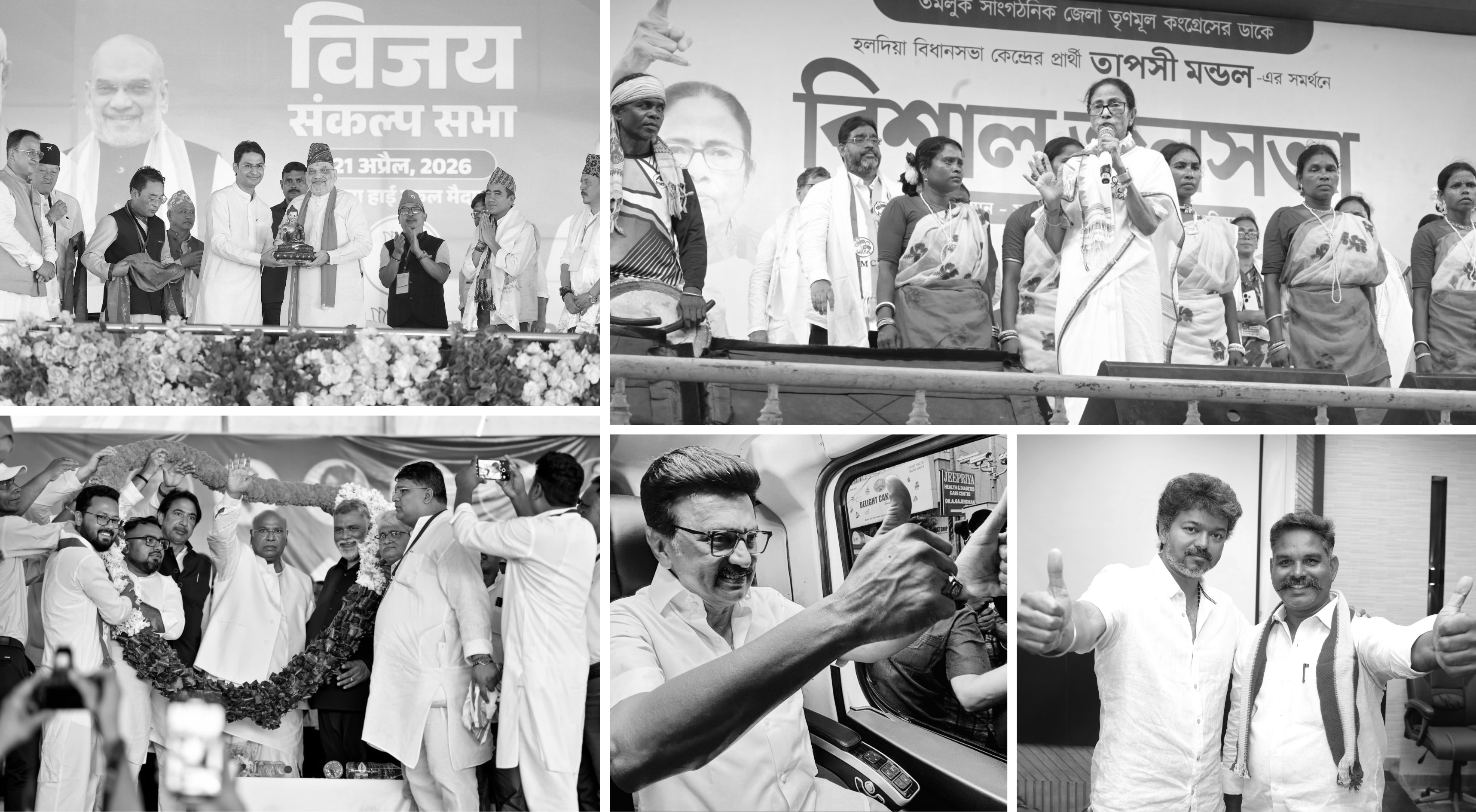
Election Campaigns End in Bengal and Tamil Nadu, Security Tightens for April 23 Polls
Election campaigning in West Bengal and Tamil Nadu came to a close on Tuesday evening, bringing an end to weeks of intense political activity. With the enforcement of the 48-hour silent period, both states now move into the final phase before voting, scheduled for April 23, under tight security arrangements.
West Bengal: High-Stakes Battle Amid Tight Security
West Bengal heads into the first phase of polling across 152 constituencies , with nearly 36 million voters expected to participate. The scale of the election and the state’s history of electoral tensions have led to massive security deployment, including over 2,450 companies of central forces and around 2.5 lakh personnel . More than 8,000 polling stations have been identified as sensitive, particularly in districts such as Malda, Murshidabad, Cooch Behar, Birbhum, and Bardhaman.
The election is shaping up as a direct contest between the ruling Trinamool Congress (TMC) and the Bharatiya Janata Party (BJP) . While the TMC is aiming for a fourth consecutive term, the BJP is attempting to expand its political footprint and challenge Chief Minister Mamata Banerjee’s dominance.
The campaign witnessed sharp exchanges, with Prime Minister Narendra Modi and Home Minister Amit Shah accusing the state government of corruption, violence, and encouraging illegal infiltration. In response, the TMC alleged voter list manipulation and raised concerns over the deletion of more than 7.4 lakh names in Murshidabad , a claim the Election Commission described as part of routine revision.
Key issues such as the Gorkhaland demand , tea garden workers’ wages, and agricultural distress played a significant role in shaping voter sentiment across regions.
Tamil Nadu: Multi-Cornered Contest and Alliance Politics in Focus
In Tamil Nadu, campaigning also concluded on Tuesday, triggering the silent period ahead of polling. The election is being seen as a complex political contest driven by alliances, leadership narratives, and new entrants.
The ruling DMK-led alliance has focused on development and welfare, while the opposition AIADMK-led front has targeted the government over allegations of corruption and dynastic politics. The issue of delimitation has emerged as a key talking point, with concerns that it could affect the state’s political representation.
Chief Minister M.K. Stalin, concluding his campaign in Kolathur, positioned the election as crucial for safeguarding Tamil Nadu’s progress. On the other hand, AIADMK leader Edappadi K. Palaniswami urged voters to bring change and end what he termed misgovernance.
The campaign also saw participation from several national leaders, including Narendra Modi, Amit Shah, Rahul Gandhi, Chandrababu Naidu, Devendra Fadnavis, Revanth Reddy, and Arvind Kejriwal, highlighting the broader political importance of the election.
This time, the contest has become more competitive with the entry of actor Vijay’s Tamilaga Vettri Kazhagam , contesting all 234 seats , along with the continued presence of Naam Tamilar Katchi. Actor Kamal Haasan also played a role in campaigning, making the election a multi-cornered fight .
With over 4,000 candidates and more than 57 million voters , the outcome is expected to be closely contested, with even small vote swings potentially influencing results.
As both states head into polling day, the focus now shifts entirely to voters, whose decisions will shape the next political phase in these crucial regions. While West Bengal will test the strength of an incumbent government against a determined challenger, Tamil Nadu’s verdict could redefine alliance dynamics and highlight the impact of emerging political forces. With high voter participation expected and security measures firmly in place, the elections are set to deliver a decisive and closely watched outcome.