
Eight Nandurbar Poultry Workers’ Samples Sent To NIV For Avian Flu Testing In Maharashtra
The Maharashtra health department has sent eight human samples from poultry workers in Nandurbar district to the National Institute of Virology (NIV), Pune , for avian influenza testing , as surveillance intensifies following a major bird flu outbreak in the region.
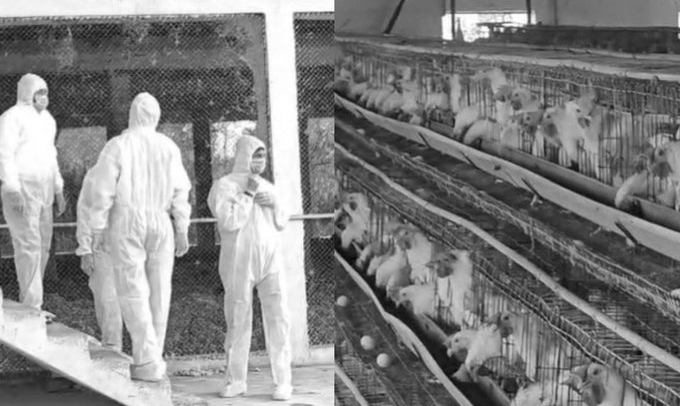
The samples belong to workers who were either engaged in poultry handling or bird culling operations in Navapur taluka, one of the worst-affected poultry zones in Maharashtra. Officials said all individuals remain asymptomatic , with no signs of human avian flu infection detected so far.
District health officer Ravindra Sonawane said the samples were collected as part of expanded contact tracing and exposure monitoring after confirmed avian influenza cases in poultry farms. He added that nasal swabs have been sent for laboratory analysis to NIV, Pune, on Tuesday.
Authorities confirmed that the workers are being administered Tamiflu , an antiviral drug used as a post-exposure prophylaxis measure to reduce infection risk among high-risk contacts.
Officials further clarified that no government employees are among those tested, with monitoring restricted to individuals directly exposed to infected birds during containment operations.
The development comes amid a wider H5N1 avian influenza outbreak in Nandurbar’s Navapur region, where multiple poultry farms have been affected. According to earlier containment reports, lakhs of birds have already been culled , along with the destruction of millions of eggs and poultry feed stocks , as authorities attempt to contain the spread.
The outbreak has prompted strict containment zones of up to one kilometre around infected farms , with intensified surveillance in surrounding areas. Additional testing of poultry and environmental samples has been carried out by national reference laboratories, including the ICAR-NIHSAD in Bhopal , which confirmed infection in earlier batches.
Health and animal husbandry departments continue to maintain round-the-clock surveillance , focusing on preventing spillover into human populations, although no human infections have been reported in the current cluster.