
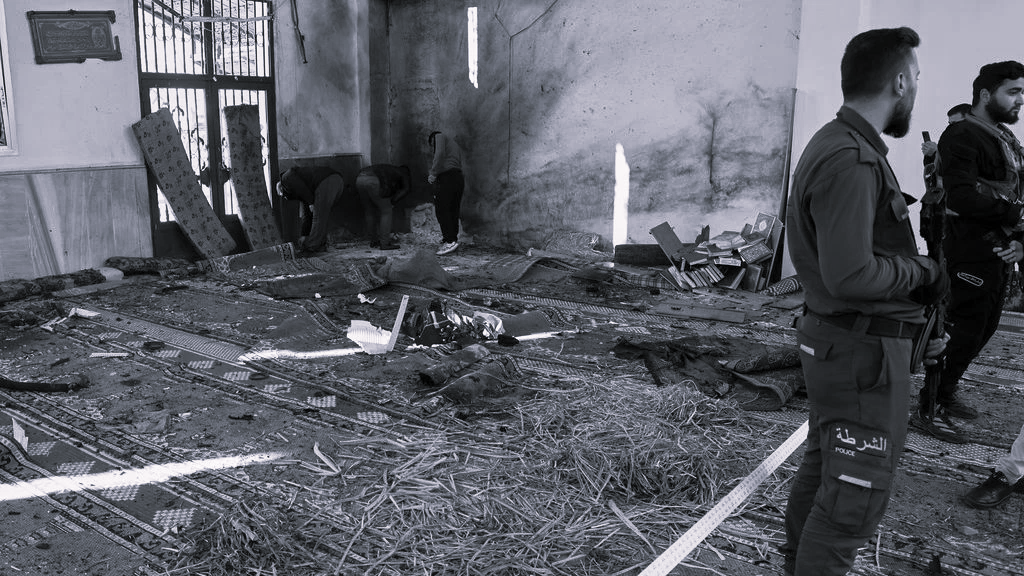
Eight killed in Homs Mosque bombing as sectarian tensions simmer in Syria
A deadly bombing at a mosque in the Syrian city of Homs during Friday prayers has underscored the fragile security situation in the country, where long-standing sectarian and ethnic divisions continue to fuel violence despite the decline in large-scale fighting.
At least eight people were killed and 18 others wounded when explosive devices detonated inside the Imam Ali ibn Abi Talib Mosque , located in the Wadi al-Dhahab neighbourhood of Homs, Syria’s third-largest city. The area is predominantly inhabited by members of the Alawite minority, a sect that has increasingly come under attack since the collapse of the former government.
Images released by Syria’s state-run Arab News Agency showed extensive damage inside the mosque, including blood-stained carpets, shattered windows, holes in the walls and fire damage. Authorities said preliminary investigations suggest that multiple explosive devices had been planted inside the building. A security cordon was imposed around the site as investigations continued.
A little-known extremist group calling itself Saraya Ansar al-Sunna claimed responsibility for the attack in a statement posted on its Telegram channel. The same group had earlier claimed a June attack on a Greek Orthodox church in Dweila, near Damascus, where a gunman opened fire before detonating an explosive vest, killing 25 worshippers. Syrian authorities later blamed that attack on a cell linked to the Islamic State (IS) group, although IS itself did not claim responsibility.
The Syrian government has intensified operations against suspected IS cells in recent months, particularly after an attack earlier this month that killed two US service members and a civilian translator. Syria recently joined the global coalition against IS as part of broader counterterrorism efforts.
UN Secretary-General Antonio Guterres condemned the Homs bombing “unequivocally,” calling it a terrorist attack and urging that those responsible be identified and brought to justice. He also noted Syria’s stated commitment to combating terrorism and holding perpetrators accountable.
The attack comes amid heightened tensions involving the Alawite community following the fall of former president Bashar Assad last year. Assad, himself an Alawite, fled to Russia, and members of his sect have since faced crackdowns and retaliatory violence. In March, an ambush by Assad loyalists against security forces sparked days of clashes that left hundreds dead, most of them Alawites.
In a strongly worded statement, the Supreme Alawite Islamic Council in Syria and the Diaspora described the mosque bombing as part of “organised extremist terrorism specifically targeting the Alawite community,” warning that such crimes would not go unanswered.
Regional and international condemnation followed swiftly, with Saudi Arabia, Jordan and Lebanon denouncing the attack. Lebanese President Joseph Aoun reaffirmed his country’s support for Syria in its fight against terrorism.
Meanwhile, fresh clashes between Syrian government forces and Kurdish-led Syrian Democratic Forces in Aleppo this week have further highlighted the persistence of ethnic and political fault lines, raising concerns that instability may continue even as the broader war has largely subsided.