
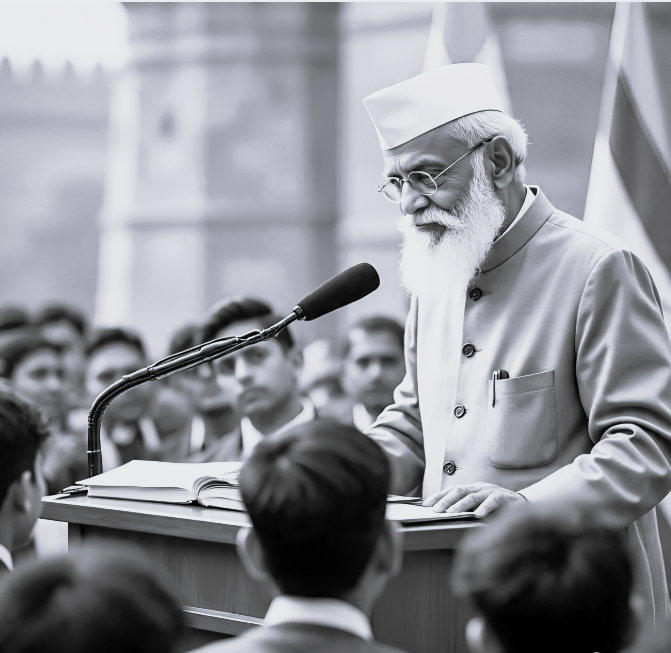
Education is India’s biggest Nation-Building force - Remembering Maulana Azad
Every year on November 11, India observes National Education Day, not merely as a commemorative date, but as a reminder that nation building truly begins with learning. This day marks the birth anniversary of Maulana Abul Kalam Azad, India’s first Education Minister, a visionary who believed that education must democratize opportunity, empower the poorest and serve as the foundation for social, cultural and economic transformation. As the architect of several core institutions of modern education in independent India, he laid the foundation for a system that would convert a newly free nation into a knowledge-driven society. His legacy lives through the creation of IITs for world-class technical education, the University Grants Commission for regulating higher education standards, and prestigious academies such as Sahitya Akademi, Sangeet Natak Akademi and Lalit Kala Akademi which preserved, protected and nurtured India’s cultural literacy. National Education Day is therefore not just a tribute, but a moment for collective national reflection to evaluate where India stands today, how far it has travelled and how far it must still go. Across the country, academic programmes, workshops, discussions and cultural activities highlight the significance of strengthening education at every level, innovation in teaching and the need to expand literacy into curiosity, critical thinking and nation building.
From Independence in 1947, India’s education system evolved through different stages. The early decades after Independence focused on building institutional foundations, policy structures and national-scale systems. The Kothari Commission recommendations introduced the 10+2+3 structure and laid the foundation for the 1968 National Education Policy which formalized the goal of universal education access. The period through the 1980s and 1990s saw major reforms such as the 1986 National Education Policy which focused on equality and social justice, establishment of Navodaya institutions and open universities and the entry of private sector institutions particularly in engineering, medical and management education after economic liberalisation. The 21st century marked a shift from policy based growth towards a rights-based approach. Sarva Shiksha Abhiyan in 2001 and the landmark Right to Education Act in 2009 transformed education into a fundamental and enforceable right for every child. The 25 percent reservation for economically weaker children in private schools created a new moral benchmark in Indian public policy. The pandemic era and global digital disruption accelerated the need for new learning models. The National Education Policy 2020 introduced the 5+3+3+4 structure, prioritising experiential learning, foundational literacy, learning in mother tongue at early levels, skill integration from school stage and widespread acceptance of digital learning platforms including DIKSHA, SWAYAM and emerging e-learning ecosystems. Today, the focus is shifting from memory-based exam culture to innovation-based, skill-based, research-driven and future-ready learning. India must now prepare its youth for AI, green transition sectors, space technology, robotics, cybersecurity, smart agriculture and deep research led job markets of the future.
On this National Education Day, it is important to recognise that while India has made remarkable progress in literacy, institution building and higher education capacity, challenges such as quality parity between rural and urban schools, shortage of trained teachers, infrastructure gaps, equitable digital access and gender equity in STEM still remain areas needing deep focus and rapid acceleration. Education must be viewed as the strongest national investment, not merely a developmental sector. Maulana Abul Kalam Azad dreamed of an enlightened society where knowledge becomes a tool of empowerment, equality and national strength. The responsibility of fulfilling that dream rests now with our generation. As India steps into the next decade of AI-led global competition, National Education Day should serve as a reminder that the future of India will not be determined by how many students pass exams, but by how many young minds discover, innovate, question, solve and build. This is the time to reaffirm our national pledge that education is the only true equalizer, the only path that can take India from demographic potential to knowledge superpower.