
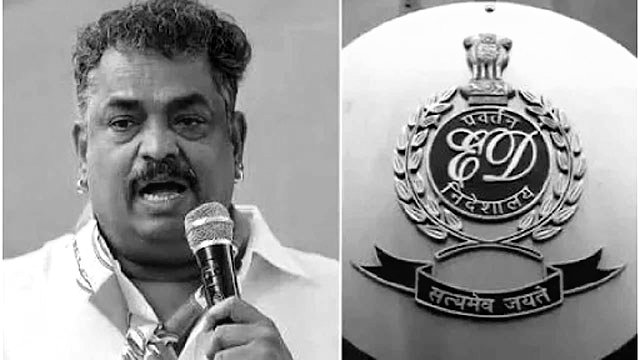
ED haul: Cash, gold, Congress MLA
The Enforcement Directorate (ED) has taken Karnataka Congress MLA Satish Krishna Sail into custody in a high-profile money laundering case linked to alleged illegal iron ore exports in the state. The 59-year-old legislator from Karwar Assembly constituency in Uttara Kannada was questioned at the ED’s Bengaluru zonal office and later produced before a special court, which granted one-day custodial remand. The agency is expected to seek further custodial extension as investigations continue into Sail’s alleged role in the illegal export of iron ore fines.
The case against Sail has roots in a 2010 Karnataka Lokayukta probe, which discovered around eight lakh tons of iron ore transported illegally from Bellary to Belekeri Port. According to the ED, Sail, along with other business entities and Belekeri Port officials, allegedly exported 1.25 lakh metric tonnes of iron ore fines between April 19 and June 10, 2010, with a total value of Rs 86.78 crore. Entities involved include Ashapura Minechem, Shree Lal Mahal, Swastik Steels, ILC Industries, and Sri Lakshmi Venkateshwara Minerals, with Sail reportedly linked to Shree Mallikarjun Shipping Pvt. Ltd., a company central to the illegal transactions.
During search operations on August 13-14 across Karwar, Goa, Mumbai, and Delhi, the ED seized Rs 1.41 crore in cash from Sail’s residence, Rs 27 lakh from a company office, and 6.75 kg of gold jewellery and bullion from family bank lockers. Additionally, bank accounts holding Rs 14.13 crore of associated entities were frozen. Sail had been previously convicted by a special court for MPs and MLAs for illegal iron ore export, though the Karnataka High Court suspended his seven-year prison sentence last year, allowing him to remain free during the current proceedings.
This arrest follows a recent pattern where the ED has targeted several opposition leaders. Sail is the second Congress MLA arrested in recent weeks, following Chitradurga MLA K.C. Veerendra ‘Puppy’, who was detained in an alleged betting-linked money laundering case. Critics point out that most high-profile ED actions in recent months have involved opposition politicians, particularly from the Congress and allied parties, whereas BJP leaders at the state or central level have faced comparatively fewer public probes. Analysts argue that this selective enforcement fuels perceptions of politically motivated investigations, even though officials insist the ED acts strictly on legal mandates, court orders, and ongoing investigations.
The broader reality is nuanced. Mining and financial irregularities in Karnataka have a long history, involving multiple companies, local officials, and politicians across party lines. However, ED cases often become visible when linked to opposition figures, partly because ruling party members rarely face active public scrutiny from central agencies due to administrative control and political leverage. Experts note that selective visibility does not necessarily reflect legal bias, but it does affect public perception, raising questions about impartiality.
The Sail case underscores both the seriousness of alleged financial crimes in Karnataka’s mining sector and the complex interplay between politics and enforcement. With massive cash, gold, and bank assets seized, it sends a strong message about accountability. Yet, the continued concentration of such probes on opposition leaders highlights the delicate balance between law enforcement and political optics, reminding citizens that the fight against corruption is inseparable from the political context in which it unfolds.