
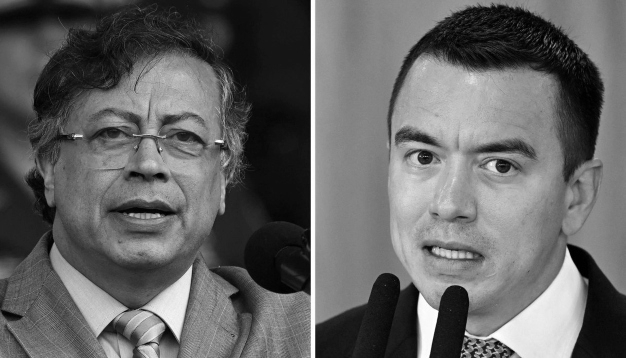
Ecuador's president rejects allegations that his government is bombing targets inside Colombia
Tensions between Ecuador and Colombia have escalated after Colombian President Gustavo Petro accused Ecuador of bombing Colombian territory , claims strongly denied by Ecuador’s President Daniel Noboa . Petro said nearly 27 charred bodies were found near the border, asserting that neither Colombian forces nor domestic armed groups could be responsible and implying Ecuadorian aerial operations . He also appealed to U.S. President Donald Trump to intervene.
Noboa responded on X, insisting all anti‑narco operations occur strictly within Ecuadorian territory , targeting hideouts of narco‑terrorist groups , and called the allegations “unfounded.” The dispute reflects deep cross-border challenges , including trafficking of cocaine and arms along Ecuador’s northern border. Criminal groups such as Los Choneros and Los Lobos collaborate with foreign cartels, increasing violence.
Economic tensions have worsened the crisis. Ecuador imposed a 50 percent “security tariff” on Colombian imports, claiming Bogotá fails to stop cross-border criminal activity, prompting retaliatory Colombian duties and suspension of electricity exports. Analysts describe the escalating trade measures as weaponization of commerce .
Domestically, Petro’s leftist government promotes peace talks under a “total peace” strategy, while Noboa, facing surging homicides, has imposed nightly curfews and deployed military and U.S. support, including FBI collaboration.
Religious leaders in Ipiales (Colombia) and Tulcán (Ecuador) urged both nations to strengthen dialogue and cooperation , warning that escalating actions threaten civilians and the environment. The crisis highlights the fragility of regional security in the Andean region, where decades of armed conflict, porous borders, and the cocaine trade complicate stability.
As investigations continue into the unexploded bomb, experts warn that without urgent high-level talks and cooperative security measures, the crisis could further strain bilateral ties and destabilize the broader region.