
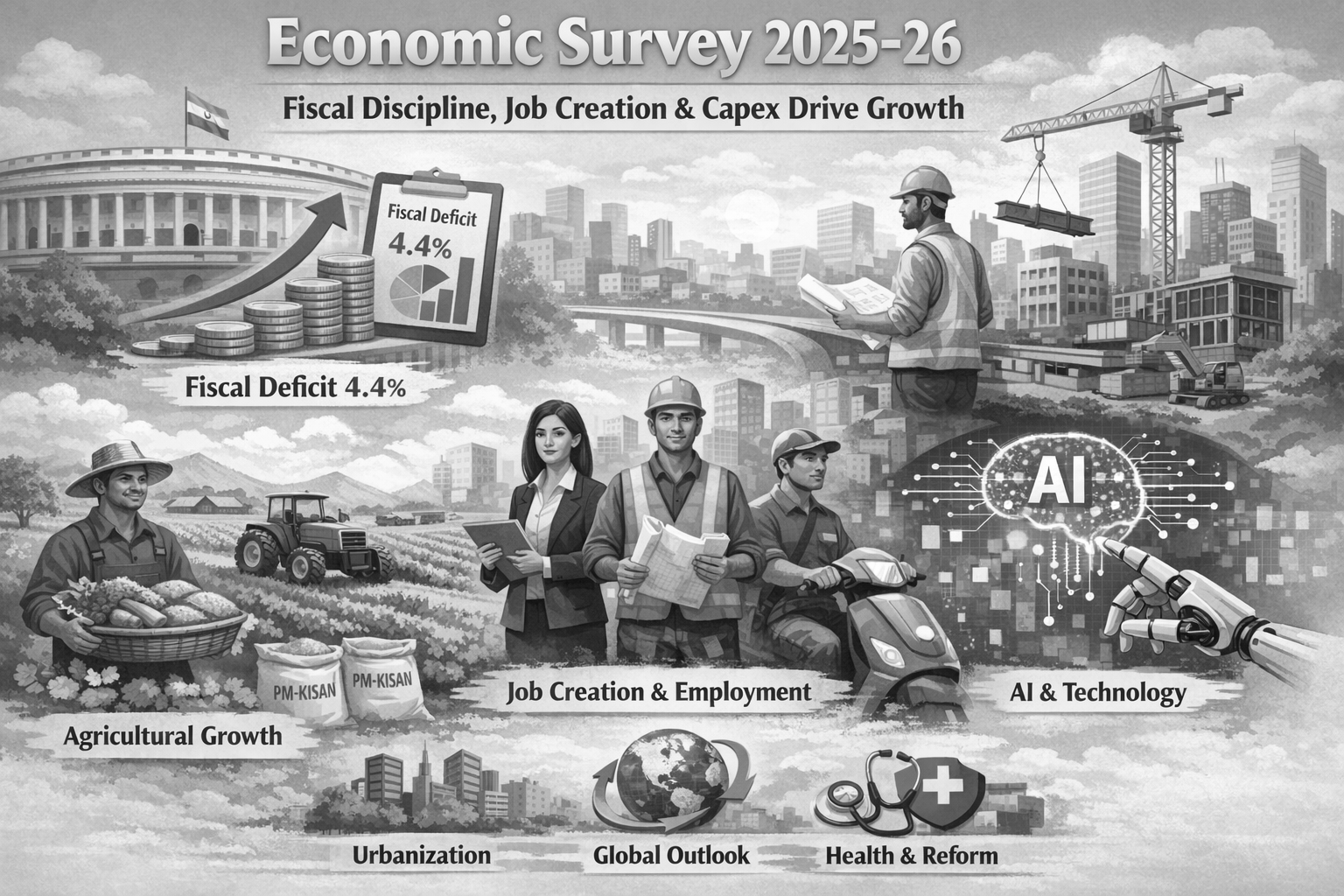
Economic Survey 2025–26: Fiscal Discipline, Job Creation and Capex Drive Growth
The Economic Survey 2025–26 tabled in Parliament on Thursday presents an economy on stable footing, combining fiscal consolidation with sustained public investment, while identifying employment generation, agricultural transformation, urbanisation and technology adoption as key drivers of India’s medium-term growth.
The Survey projects real GDP growth in the range of 6.8–7.2 per cent for FY27 , slightly lower than the estimated 7.4 per cent expansion in FY26 , citing global economic uncertainty, geopolitical realignments and volatile capital flows. However, it pegs India’s medium-term growth potential close to 7 per cent , supported by structural reforms undertaken over the past decade.
Fiscal consolidation on track
The Survey said the Centre remains well on track to achieve the fiscal deficit target of 4.4 per cent of GDP in FY26 , with the deficit already at 62.3 per cent of the Budget Estimates by November 2025 . The fiscal deficit has declined sharply from 9.2 per cent of GDP in FY21 to 4.8 per cent in FY25 , reflecting a sustained consolidation effort.
Capital expenditure has emerged as the cornerstone of fiscal strategy. The share of capex in total central government expenditure increased from 12.5 per cent in FY20 to 22.6 per cent in FY25 , while effective capex rose from 2.6 per cent to nearly 4 per cent of GDP . The Survey noted that markets have acknowledged the government’s fiscal discipline through lower sovereign bond yields and improved global credit ratings.
Employment gains and labour reforms
India’s labour market recorded notable improvement during the year. The unemployment rate declined to 3.2 per cent , while the female labour force participation rate rose to 41.7 per cent in 2023–24. More than 56 crore people are currently employed, with job creation visible across both organised and unorganised sectors.
The Survey highlighted the importance of the labour codes , notified in November 2025, in supporting formal employment and strengthening worker protection, particularly for women and gig workers. The gig economy has expanded rapidly, with the number of gig and platform workers increasing 55 per cent between FY21 and FY25 .
The e-Shram portal has emerged as a key institutional platform, with over 31 crore unorganised workers registered , of whom 54 per cent are women , enabling portability of welfare benefits and improved integration with the formal economy.
Agriculture central to inclusive growth
Agriculture and allied activities continue to play a pivotal role in India’s development strategy. The sector recorded an average annual growth of 4.4 per cent over the past five years , marking the strongest decadal performance in recent history.
Foodgrain production reached a record 357.7 million tonnes in 2024–25 , driven by higher output of rice, wheat, maize and coarse cereals. Allied sectors such as livestock and fisheries emerged as major growth engines, while horticulture now contributes around 33 per cent of agricultural gross value added .
The Survey highlighted improvements in irrigation coverage, mechanisation and input quality. The gross irrigated area has increased to 55.8 per cent of cropped area , over 25.5 crore soil health cards have been issued, and 25,689 custom hiring centres have been established to support small and marginal farmers.
Under PM-KISAN , more than ₹4.09 lakh crore has been transferred to over 11 crore farmers , while crop insurance coverage under Pradhan Mantri Fasal Bima Yojana expanded to 4.19 crore farmers in FY25. The Survey also pitched for voluntary crop diversification , particularly towards pulses, oilseeds and maize, without altering MSP or procurement mechanisms.
India more urban than official estimates
A key structural insight of the Survey is that India is far more urban in economic and functional terms than official definitions suggest . Satellite-based estimates indicate that nearly 63 per cent of India was urban by 2015 , with towns and cities contributing close to 70 per cent of GDP .
Urban infrastructure has expanded significantly, with 1,036 km of metro and RRTS networks operational across 24 cities , near-universal door-to-door waste collection, and over ₹1.64 lakh crore invested under the Smart Cities Mission . The Survey stressed the need to prioritise system-level urban planning over isolated projects, particularly in transport, housing and municipal finance.
AI as an economic strategy
The Survey devoted a full chapter to artificial intelligence, positioning AI as an economic strategy rather than a prestige technology race . It cautioned against excessive dependence on capital-intensive frontier models and advocated decentralised, application-driven and frugal AI systems aligned with India’s structural realities.
It highlighted the role of language-first and low-resource AI applications in healthcare, agriculture, education and urban governance, and underscored the importance of the National AI Mission in providing shared infrastructure, governance frameworks and funding support.
Health, governance and reform signals
Raising public health concerns, the Survey called for restricting advertisements of ultra-processed foods from 6 am to 11 pm , citing rising childhood obesity and rapidly growing consumption of high-fat, salt and sugar products.
It also suggested re-examining provisions of the RTI Act to protect confidential deliberations and draft policy documents, arguing that transparency must be balanced with effective governance and candid decision-making.
Outlook
Despite global headwinds, the Economic Survey concluded that India’s macroeconomic fundamentals remain strong. With moderate inflation, a manageable current account deficit, resilient exports and sustained public investment, the economy is positioned to pursue long-term growth anchored in productivity, employment and institutional reform.
As India advances towards the Viksit Bharat vision, the Survey underlined that growth must be broad-based spanning farms, factories, cities and digital systems while preserving fiscal credibility and social stability.