
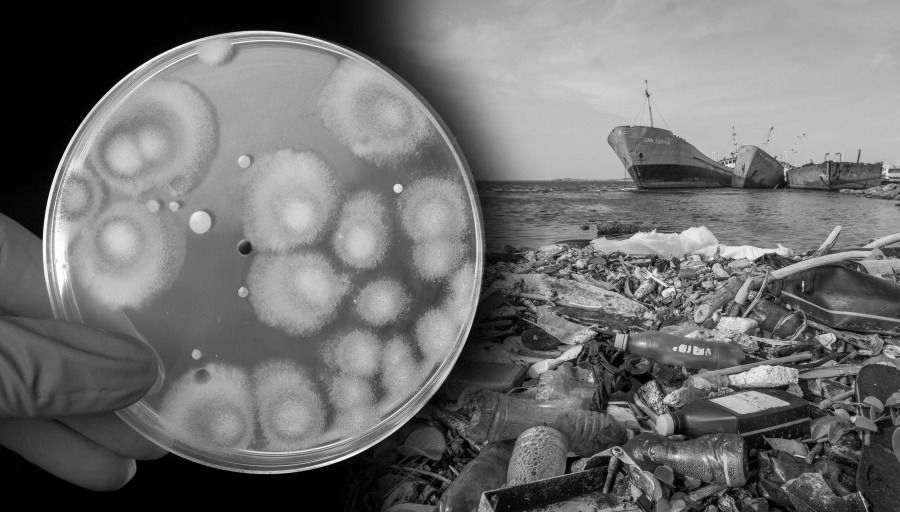
Earth's quiet avengers - Fungi that devour plastic
Oh, what a forgiving cradle our planet is. Scarred by ceaseless plunder, she rebirths life in defiance, cradling her kin in soil's embrace. And in this saga of resilience, behold a microbial marvel: fungi that feast on plastic, nature's sly riposte to humanity's synthetic sins. In 2011, Yale explorers unearthed Pestalotiopsis microspora in Ecuador's mist-shrouded Yanachaga rainforest a humble endophyte, dwelling symbiotically within plants, sipping their sap while gifting nutrients in return. This unassuming fungus doesn't just survive; it thrives on our trash, gnawing polyurethane (PU) the foam in your mattress, the sole of your sneaker with voracious glee. Astonishingly, it digests even in oxygen-starved tombs like landfills, shattering 90% of PU in mere 30 days. For PET, the stubborn stuff of water bottles, it cleaves ester bonds, yielding harmless monomers like terephthalic acid and ethylene glycol. Armed with enzymes serine hydrolase and cutinase it slices polymer chains into bite-sized morsels, exhaling them as CO₂ and water. A biochemical assassin, turning eternal waste into ephemeral breath.
But plastic's tale is no fairy tale; it's a dystopian epic. Since the 1950s, we've conjured 9 billion tons of this versatile demon light as air, tough as nails yet 75% now festers as waste, haunting oceans and arteries alike. In 2025 alone, we spew 445 million metric tons, with annual waste cresting 460 million more than double 2000 levels. PET, unyielding to sun or surf, spawns ghostly islands in seas; microplastics infiltrate fish guts and our forks. By 2050, plastic could outweigh ocean life threefold, recycling a pathetic 9%. Enter fungi: Earth's underground guerrillas, wielding enzymes honed on lignin nature's own tough polymer.
“Pestalotiopsis” isn't a solo. In 2017, Pakistani soil birthed Aspergillus tubingensis from a landfill, shredding PU's tensile strength to zero via mycelial might and enzymatic fury. Pleurotus ostreatus, the oyster mushroom of gourmet lore, proved in 2023 Nigerian labs it carbonizes PET flakes, birthing new spectral peaks in infrared scans after 60 days of siege. Penicillium citrinum hydrolyzes both PET and PU into benign byproducts; Fusarium oxysporum targets PET fibers with ruthless precision. These Ascomycetes kin, lignin veterans, now eye our synthetics.
China's Dafeng Salt Marshes, that briny frontier, yielded 184 fungal strains in 2023, devouring polylactide (PLA) bioplastic pretenders with salty zeal. Kew Gardens tallied 436 plastic-munching species that year, a plastisphere blooming on debris.
Fast-forward to 2025: Hope myceliates. Hawaiian shores host marine fungi chomping plastics 60% faster after "conditioning" a turbo-evolution hack. Berlin's Leibniz labs unveiled microfungi shredding synthetics in freshwater haunts. An Austin startup's fungi-laced diapers dissolve landfill dross; the EU's Fungal Solutions Project clocks Pestalotiopsis at 10% PU demolition in six months. Genetic tweaks supercharge PETase enzymes, vaporizing 90% PET in 16 hours.
Yet shadows linger: Crystalline PET resists, demanding UV or heat preambles. Scaling's costly; regulators hawk-eyed. Still, these spore-soldiers whisper redemption. Nature, even the alchemist, transmutes our folly into fertility. Our charge? Curb the crave, amplify the fungi. Let Earth exhale green once more, forgiven, flourishing, fierce.