
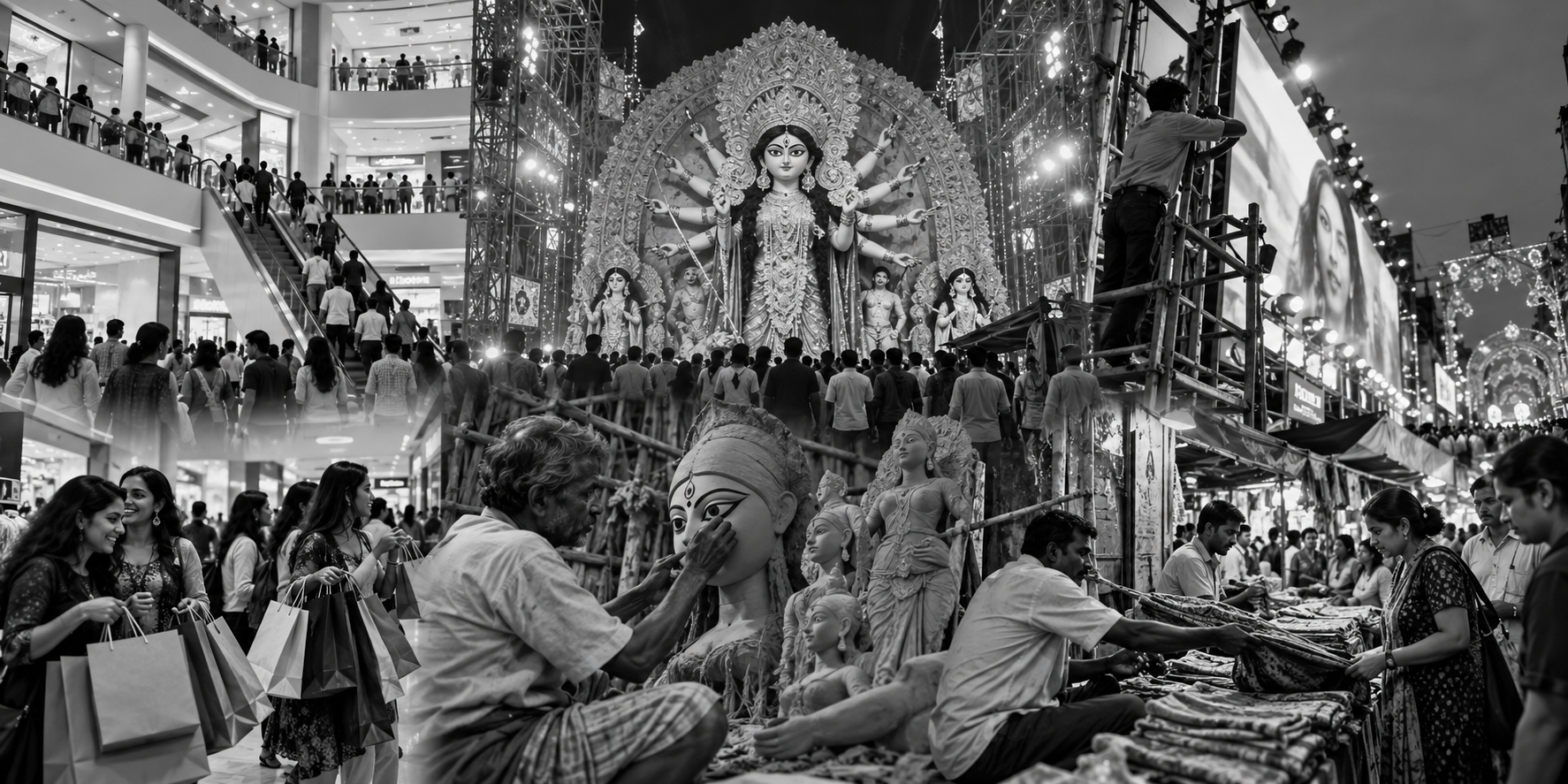
Durga Puja Economy Expands, but Small Traders Feel the Pinch
West Bengal’s Durga Puja economy continues to generate substantial commercial activity across retail, advertising, tourism, food, transport and creative industries, but the benefits remain unevenly distributed. While prominent puja committees, shopping malls, organised retailers and e-commerce platforms are reporting strong business, smaller community organisers, traditional market traders, street hawkers and artisans are facing mounting financial pressure.
A British Council-commissioned study estimated that Durga Puja-related creative industries generated ₹32,377 crore in economic activity in 2019, equivalent to 2.58% of West Bengal’s GDP. Industry estimates subsequently placed the broader festival economy at ₹55,000–57,000 crore in 2024 and approximately ₹65,000 crore in 2025, although these figures are not directly comparable or audited government totals.
The disparity has become more visible in 2026. According to PTI, around 30% of outdoor advertising slots at smaller pujas remained vacant, while prominent celebrations reported advertising rates rising by at least 20% amid increased use of LED displays. Kajol Sarkar of the Forum for Durgotsab said advertisers were concentrating spending on selected routes rather than distributing budgets across neighbourhoods. Park Street, Camac Street and Theatre Road emerged as major advertising hubs.
Organised retail recorded stronger performance. Primarc Projects managing director Siddharth Pansari reported a 17% increase in mall footfall during the 45-day pre-Puja period, with festive business expected to reach ₹38 crore in October. Footfall reportedly rose from five lakh in September to seven lakh in October.
Meanwhile, the Confederation of West Bengal Trade Associations warned that deep online discounts were hurting traditional retailers. E-commerce companies reportedly recorded ₹24,000 crore in sales during the first two festive-season days. Hawkers in Burrabazar, Hatibagan, Shyambazar and other markets reported shrinking margins, aggressive bargaining and concerns over possible post-Puja eviction.
The government’s financial assistance has also changed. The grant per eligible committee fell from ₹1.10 lakh in 2025 to ₹1 lakh in 2026, alongside electricity-charge and fire-safety fee waivers. Moneycontrol reported a ₹200-crore allocation for 2026–27, against ₹447.5 crore budgeted and ₹523.8 crore spent in 2025–26.
Economist Saibal Kar urged stronger protection for small businesses, highlighting the MSME sector’s employment significance. Artisans, idol makers and temporary workers also face rising material costs, seasonal uncertainty and payment risks.