
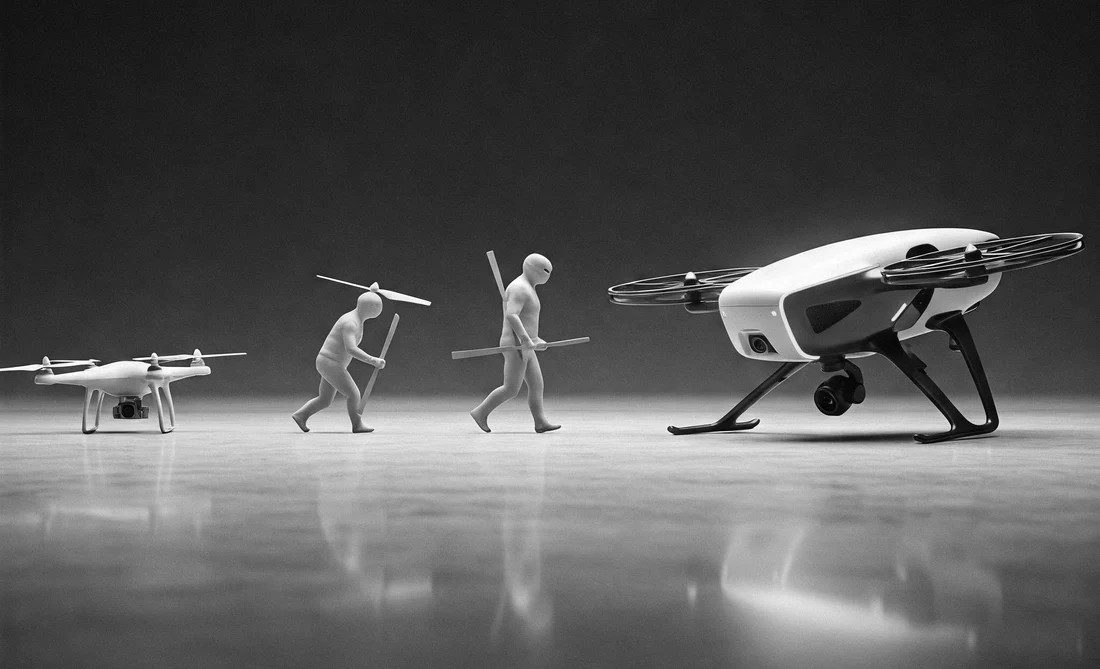
Drones: Evolution, Applications, and the Rise of AI Integration
Unmanned Aerial Vehicles (UAVs), commonly known as drones, have evolved significantly since their early military origins. First developed in the mid-20th century for reconnaissance, drones became widely recognised in the 1990s when the United States and other countries deployed them for surveillance and targeted operations. Over the past two decades, advances in batteries, lightweight materials, miniaturised sensors, and wireless communications have expanded their use far beyond defence into commercial and civilian markets.
By the 2010s, drones shifted from specialised tools to consumer technology. Industry analysts valued the global drone market at about USD 30 billion in 2022 and projected it will exceed USD 55 billion by 2030.
Types of drones
Drones vary by design and purpose. Multi-rotor drones, such as quadcopters, are common for photography and small deliveries. Fixed-wing drones can fly longer distances and are used for surveying and mapping. Single-rotor helicopters carry heavier payloads and can hover for extended periods. Hybrid VTOL (Vertical Take-Off and Landing) drones combine fixed-wing range with hovering capability. Military and industrial operations may also use large high-altitude long-endurance (HALE) drones for extended surveillance.
Applications across sectors
Today, drones are deployed across a wide range of industries. In agriculture, they conduct crop health analysis, precision spraying, and land mapping, helping reduce costs and improve yields. In film and media, drones capture aerial footage that once required helicopters. Construction and infrastructure projects use drones for land surveys, structural inspections, and 3D modelling. Logistics and e-commerce companies, including Amazon and Zipline, are trialling drone deliveries to reduce transit time. In public safety, drones assist in search-and-rescue, firefighting, and disaster response. Other sectors include oil and gas for pipeline monitoring, environmental research for wildlife tracking, and real estate for property imaging.
Advantages and challenges
Drones provide cost-effective aerial access, high-resolution data collection, real-time monitoring, and improved safety by reducing human exposure to dangerous environments. Challenges include airspace regulations, limited battery life, privacy and security concerns, and susceptibility to adverse weather such as strong winds or heavy rain.
Artificial Intelligence integration
Artificial intelligence (AI) has significantly enhanced drone performance since the late 2010s. AI-powered navigation allows autonomous flight, obstacle detection, and dynamic route optimization. Computer vision enables real-time object recognition, mapping, and tracking for uses such as infrastructure inspection, crowd monitoring, and wildlife counting. Machine learning models help drones analyse captured data, detect anomalies, and predict maintenance needs. Swarm intelligence allows multiple drones to coordinate tasks simultaneously, while AI-driven analytics process large volumes of imagery and sensor inputs faster than human operators. Combined with Internet of Things (IoT) networks and cloud computing, these capabilities make drones more efficient, adaptive, and reliable across industries.
With continuous innovation, drones have progressed from military reconnaissance tools to versatile, AI-enabled platforms reshaping agriculture, commerce, safety, and research worldwide.