
Driving India’s electronics future
India has taken another decisive step toward self-reliance in high-value electronics manufacturing, with the government approving the first seven projects under the Electronics Component Manufacturing Scheme (ECMS). These projects, involving a cumulative investment of ₹5,532 crore, are expected to generate an impressive ₹44,406 crore in production output and create 5,195 direct jobs across three states.
Union Minister Ashwini Vaishnaw announced the approvals, describing them as a crucial step in strengthening the country’s electronics value chain and expanding domestic capability in advanced component manufacturing. The move underscores the government’s strategy to make India a key link in the global electronics supply network while supporting its broader Make in India and Atmanirbhar Bharat missions.
Strengthening the Electronics ecosystem
The ECMS, launched on April 8, 2025, with an outlay of ₹22,919 crore (USD 2.7 billion), aims to establish a self-sustaining ecosystem for electronics component manufacturing. The scheme encourages both domestic and global investments in critical technologies, promoting higher value addition and reducing import dependence.
Progress under the scheme has already exceeded expectations. As of September 30, 2025, total investment commitments have reached ₹1.15 lakh crore, nearly double the original target of ₹59,350 crore. Expected production is pegged at ₹10.34 lakh crore, over twice the initial projections, while the incentive outlay is likely to reach ₹41,468 crore. Direct employment generation has already surpassed projections, with 1.41 lakh jobs expected, alongside substantial indirect employment opportunities.
Projects and Investments across states
The first set of ECMS approvals showcases strong participation from leading domestic manufacturers spread across Tamil Nadu, Andhra Pradesh, and Madhya Pradesh.
Among them, Kaynes Circuits India Private Limited has emerged as a major investor with four key projects in Tamil Nadu. The company will establish units for multi-layer printed circuit boards (PCBs), high-density interconnect (HDI) PCBs, camera module sub-assemblies, and laminates (copper-clad laminates). Together, these projects represent a combined investment of over ₹3,200 crore, projected to generate ₹28,315 crore in production and create 2,480 jobs.
In Madhya Pradesh, SRF Limited will set up a polypropylene film manufacturing facility—an essential component in electronic capacitors with an investment of ₹496 crore, expected production worth ₹1,311 crore, and 225 jobs.
Syrma Strategic Electronics Private Limited will invest ₹765 crore in Andhra Pradesh to manufacture multi-layer PCBs, with an estimated production output of ₹6,933 crore and 955 employment opportunities.
In addition, Ascent Circuits Private Limited will set up another multi-layer PCB unit in Tamil Nadu with an investment of ₹991 crore, anticipated production of ₹7,847 crore, and 1,535 jobs. Together, these seven projects signify a combined investment of ₹5,532 crore, a projected output of ₹44,406 crore, and 5,195 direct employment opportunities, marking a major milestone in India’s electronic manufacturing drive.
Electronics exports on a steady rise
India’s electronics sector has witnessed remarkable growth over the past decade. Electronics have now become the third-largest export category in FY 2024–25, rising from the seventh position in 2021–22. In the first half of FY 2025–26, exports touched USD 22.2 billion, maintaining strong upward momentum.
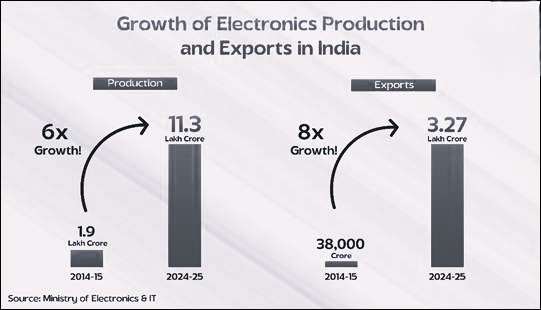
The country’s total electronics production surged from ₹1.9 lakh crore in 2014–15 to ₹11.3 lakh crore in 2024–25, while exports grew eightfold from ₹38,000 crore to ₹3.27 lakh crore during the same period. This boom has generated around 25 lakh jobs nationwide, highlighting the sector’s growing economic footprint.
The mobile manufacturing segment has driven much of this expansion, growing from ₹18,000 crore in 2014–15 to ₹5.45 lakh crore in 2024–25 a 28-fold increase. India now stands as the second-largest mobile phone producer in the world, home to over 300 manufacturing units, up from just two in 2014.
Mobile exports have surged dramatically, rising from ₹1,500 crore in 2014–15 to ₹2 lakh crore in 2024–25. Tech giant Apple alone exported iPhones worth ₹1.10 lakh crore last fiscal, registering a 42% year-on-year growth. In the first five months of FY 2025–26, smartphone exports have already reached ₹1 lakh crore, up 55% from the previous year.
A defining step toward global leadership
The ECMS approvals symbolize more than industrial growth; they mark a strategic step toward technological sovereignty and global competitiveness. India is transitioning from a market dependent on imports to a hub of advanced electronics manufacturing, producing components, sub-assemblies, and complete devices for global supply chains.
With strong policy support, deepening investments, and expanding infrastructure, India’s vision of emerging as a global electronics powerhouse is rapidly materializing. The ECMS is not just driving production, it is shaping the nation’s future as a self-reliant, innovation-led technology hub powering the world’s digital economy.