
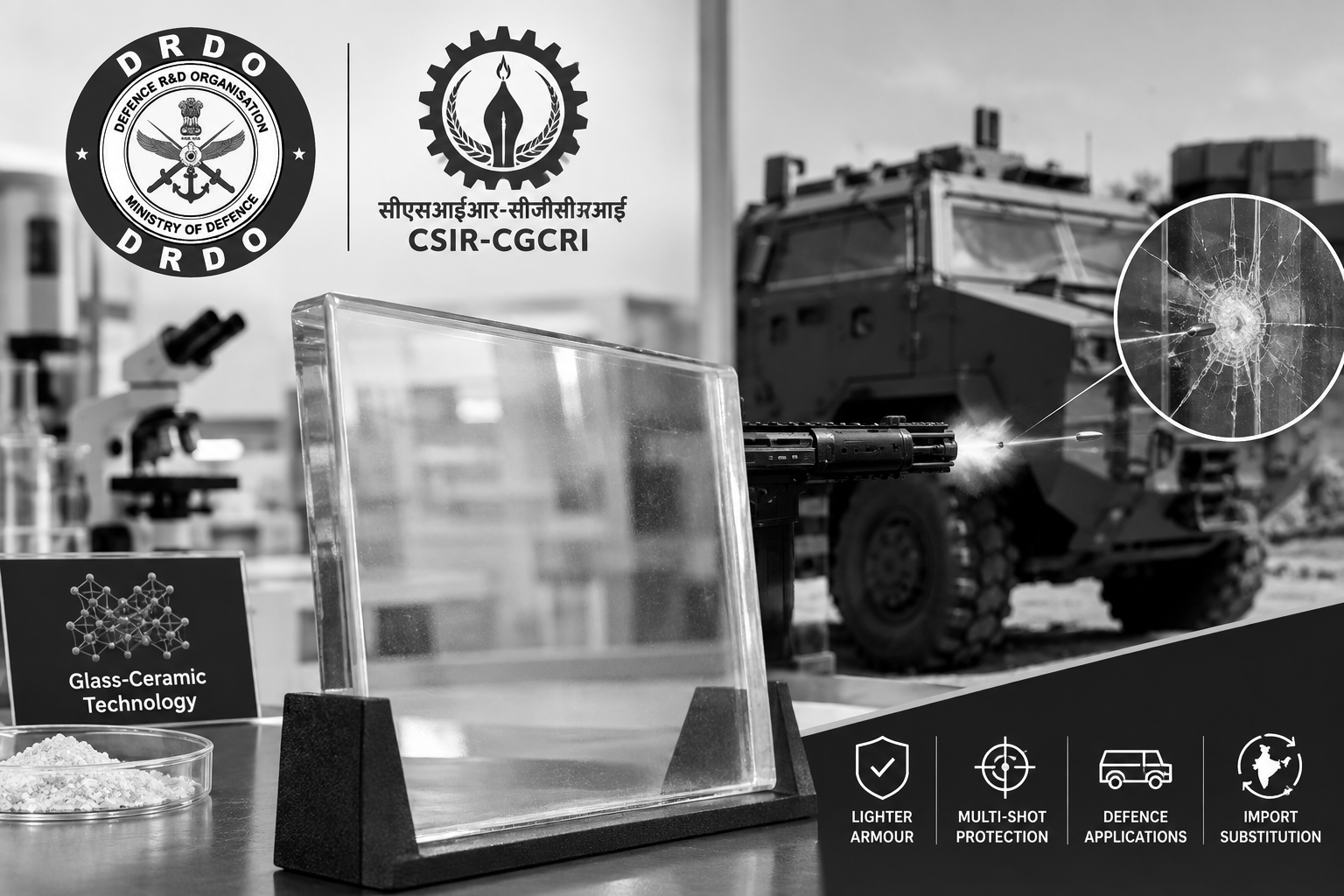
DRDO, CGCRI Partner to Develop Indigenous Lightweight Bulletproof Glass
The Defence Research and Development Organisation (DRDO) has partnered with the CSIR-Central Glass and Ceramic Research Institute (CSIR-CGCRI) on a ₹50-crore project to develop indigenous lightweight bulletproof glass for armoured vehicles, in a move aimed at strengthening domestic defence manufacturing and reducing dependence on imported transparent armour.
The four-year project is being executed with DRDO laboratories, including the Naval Materials Research Laboratory (NMRL) in Maharashtra and the Terminal Ballistics Research Laboratory (TBRL) in Chandigarh. It is at an advanced stage and seeks to take the technology from laboratory development to large-scale manufacturing through an industry partner to be selected by DRDO.
The project focuses on advanced glass-ceramics capable of providing multi-shot ballistic protection while reducing the weight and thickness of transparent armour by 30–50 per cent compared with conventional imported products.
"The Rs 50-crore project is aimed at developing advanced indigenous bulletproof glass technology for defence applications and aligns our R&D capabilities directly with national strategic requirements," CSIR-CGCRI Director Bikramjit Basu told PTI.
The material uses nanometre-sized crystals dispersed in a specially engineered glass matrix. Controlled crystallisation is designed to provide high strength and toughness while retaining transparency, making the material suitable for protective applications where both visibility and ballistic resistance are required.
Initial ballistic trials at DRDO-TBRL successfully stopped rounds fired from a Trichy Assault Rifle (TAR), comparable to an AK-47, from 10 metres at about 695 metres per second. The next stage will involve multi-shot testing to assess performance under more demanding ballistic conditions, including specified testing standards for higher levels of protection.
The lightweight design could improve mobility, fuel efficiency and payload capacity of armoured vehicles. The technology may also be adapted for aircraft, naval platforms, security systems and critical infrastructure. The DRDO-CGCRI partnership is expected to support import substitution by creating a domestic source of advanced transparent armour and facilitate commercial production through Indian industry, strengthening India's self-reliance in strategic defence materials.