
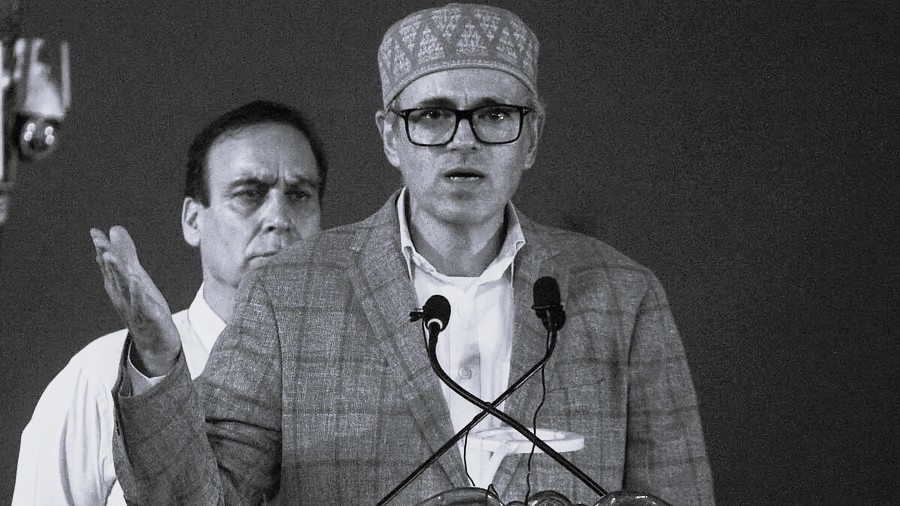
‘Don’t rush SIR before Bihar polls’: Omar Abdullah cautions Election Commission
Jammu and Kashmir Chief Minister Omar Abdullah on Monday cautioned the Election Commission of India (ECI) against rushing into a nationwide Special Intensive Revision (SIR) of electoral rolls, urging that the exercise be postponed until the Bihar Assembly elections conclude. His remarks come amid a growing political debate linking the SIR process to the groundwork for the “One Nation, One Election” (ONOE) initiative recommended by a high-level committee led by former President Ram Nath Kovind.
Speaking to reporters at the Assembly complex in Srinagar after the House was adjourned for the day, Abdullah said there were already apprehensions surrounding the SIR in Bihar and that the poll body should not rush into the process. “Let the elections in Bihar be completed first. Only then can we assess whether such an exercise is beneficial at all. The Election Commission should not appear to be working under pressure from any political party,” he remarked. The Chief Minister further warned that the Commission must maintain its independence, recalling the politically driven delimitation exercise in Jammu and Kashmir. “Delimitation here was not for the people’s benefit but for a political party’s. The EC should not repeat such mistakes,” he added.
The Special Intensive Revision (SIR) is a comprehensive verification of India’s voter rolls that aims to update the national electoral database in preparation for synchronized elections. According to officials, the upcoming pan-India SIR would verify voter identities, remove duplicates, and standardize electoral rolls across states, a technical prerequisite for implementing the One Nation, One Election framework. However, opposition-ruled states and regional parties have expressed skepticism, arguing that the EC’s push for a simultaneous national voter list, particularly during an active election cycle like Bihar’s, could compromise neutrality and raise suspicions of political motives.
The Ram Nath Kovind Committee, set up by the Union Government in September 2023, submitted a detailed report this year recommending constitutional, logistical, and administrative steps to implement simultaneous elections to the Lok Sabha, State Assemblies, and local bodies. The report proposed a single common electoral roll and voter ID system managed by the Election Commission, along with constitutional amendments to Articles 83, 85, 172, 174, and 356 to align the terms of Parliament and State Assemblies. It also suggested the creation of a permanent election calendar with mid-term adjustments through caretaker governments or President’s Rule in the event of early dissolutions, supported by advanced digital integration of electoral rolls and upgraded EVM-VVPAT systems. The committee argued that such synchronization would reduce election costs, avoid policy paralysis, and ensure governance continuity.
Despite these assurances, non-NDA ruled states and opposition parties have strongly opposed the proposal. The Congress, DMK, TMC, AAP, BRS, and Left parties have termed the ONOE proposal unconstitutional and anti-federal. Punjab and Jharkhand have formally rejected both the ONOE and the ongoing SIR process, passing resolutions against them. Critics contend that simultaneous elections could weaken state autonomy, marginalize regional parties, and centralize power in the hands of the Union government. Political analysts warn that while the exercise may appear democratic in form, it risks symbolically leaning toward a “one leader, one rule” model, potentially blurring the line between strong governance and over-centralization.
Experts also note that implementing One Nation, One Election across India would be a massive constitutional and logistical challenge. It would require amendments approved by at least half of the state legislatures under Article 368 of the Constitution, as well as synchronization of all assembly terms, a process that would either involve premature dissolution or extension of existing assemblies. Additionally, there would need to be a clear framework to handle mid-term dissolutions without violating democratic principles. Constitutional experts argue that without absolute federal consensus, simultaneous elections are nearly impossible, as the process demands both administrative alignment and political trust.
During his interaction, Abdullah also dismissed allegations of a “fixed match” in the recent Rajya Sabha elections in Jammu and Kashmir, where the National Conference won three seats and the BJP one. “There was no understanding with the BJP. The NC is the only party that takes them head-on,” he asserted, urging that the names of MLAs who cross-voted be made public.
As India debates the future of electoral reforms, Abdullah’s caution reflects a larger concern shared by many opposition states that rapid, centrally driven changes to the electoral process could tilt the balance of India’s federal democracy. While the One Nation, One Election proposal promises efficiency and cost reduction, its credibility will depend on transparency, timing, and the ability to build consensus among all stakeholders. Without that, as Abdullah implied, such reforms risk appearing as instruments of political consolidation rather than genuine democratic innovation.