
Do the Smallest Galaxies Hide Black Holes? New Study Explores a Cosmic Puzzle
A recent study has shed light on a long-standing question in astrophysics: can the smallest galaxies in the universe host black holes? Focusing on dwarf spheroidal galaxies orbiting the Milky Way, researchers have explored whether these faint, dark matter-dominated systems could contain central black holes, offering new insights into how such objects form and evolve over cosmic time.
Large galaxies are known to host Supermassive black holes at their centers. However, dwarf spheroidal galaxies present a unique challenge. These systems are extremely faint, contain very little gas, and are dominated by dark matter, making direct detection of black holes nearly impossible with current observational techniques.
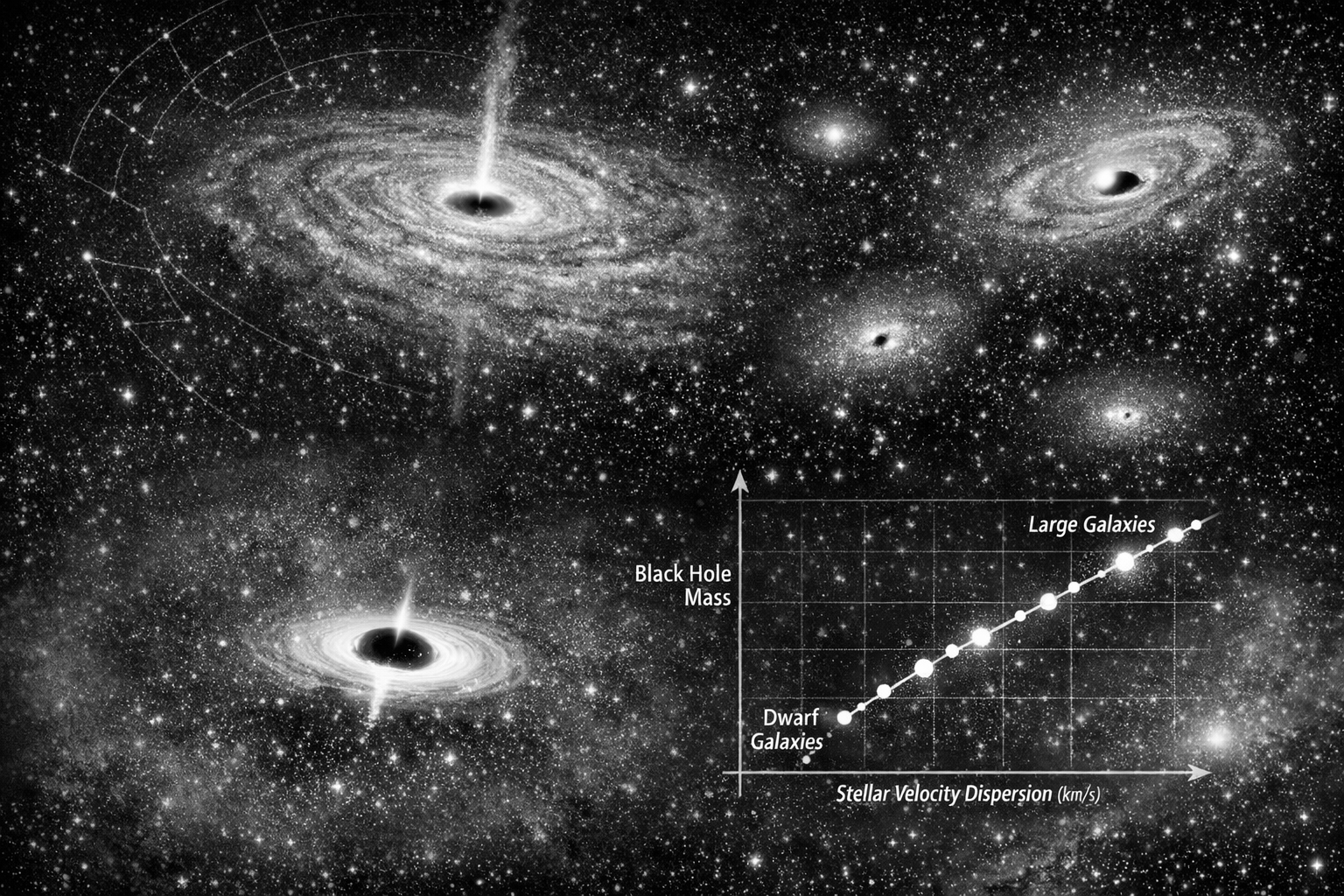
The question is closely tied to broader issues in astrophysics, including the formation of the first black holes, their growth in low-mass environments, and whether established scaling relations apply across all galaxy types. One such relation is the Black hole mass–velocity dispersion relation , which links the mass of a galaxy’s central black hole to the velocity dispersion of its stars. While well established for large galaxies, it has remained uncertain whether this relation extends to smaller systems.
In the new study, researchers K. Aditya and Arun Mangalam of the Indian Institute of Astrophysics, Bengaluru developed detailed dynamical models of dwarf spheroidal galaxies. Their models incorporate three key components: stars, a dark matter halo, and a possible central black hole.
Using high-quality stellar kinematic data, the team analyzed how stars move within these galaxies. A key feature of their approach was the inclusion of stellar anisotropy , which accounts for differences in stellar motion along radial and tangential directions. This allowed for more realistic modeling of stellar orbits and helped constrain both the dark matter distribution and any potential black hole mass.
The findings, published in The Astrophysical Journal , place strong upper limits on the masses of central black holes in these galaxies. In most cases, any such black holes would have masses below one million times that of the Sun, with some galaxies allowing only much smaller values. While the data do not require the presence of massive black holes, they are consistent with the existence of Intermediate-mass black holes .
Importantly, the study combines these results with previous observations to construct a unified black hole mass–velocity dispersion relation spanning a wide range of galaxy sizes. The analysis covers velocity dispersions from about 10 to 300 km per second and extends across nearly seven orders of magnitude in black hole mass.
The results suggest that the same fundamental scaling relation observed in large galaxies may also apply to dwarf spheroidal galaxies, albeit with greater uncertainty at lower masses. This provides one of the most comprehensive empirical calibrations of the relation to date and supports the idea that black hole growth may follow a common pattern across the full spectrum of galaxies.
By probing some of the smallest and least luminous galaxies, the study advances efforts to build a unified understanding of black hole formation and galaxy evolution in the universe.