
Desert Dust Carries Disease-Causing Bacteria to the Himalayas, Study Finds
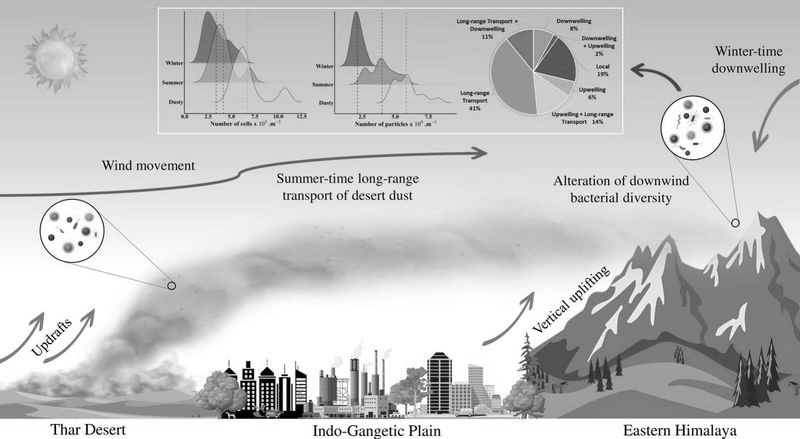
A recent aerobiological investigation has shown that desert-origin bioaerosols transported through long-range dust movement from western India reach the Eastern Himalayas , altering the high-altitude airborne microbiome and posing potential risks to human health. The study was conducted by scientists from the Bose Institute, Kolkata , an autonomous institute under the Department of Science and Technology (DST) , in collaboration with the Indian Institute of Tropical Meteorology (IITM), Pune .
Researchers carried out continuous atmospheric monitoring for over two years at a hill-top site in Darjeeling (≈2,200 m altitude) in the Eastern Himalayas. Using high-volume air samplers , they collected ambient airborne bacterial samples under varying conditions, including dust storm events , seasonal shifts, and normal background air. The collected samples were analysed using culture-independent metagenomic techniques to determine changes in microbial community composition linked to dust transport.
The process begins in arid regions of western India, where strong winds during storms cause aeolian uplift of soil particles. Microorganisms present on soil surfaces attach to mineral dust, forming bioaerosols capable of surviving long-distance atmospheric transport. These particles travel across the Indo-Gangetic Plain , where they mix with industrial pollutants and local microbial emissions . As air masses encounter the Himalayan foothills, orographic lifting pushes these mixed aerosols to higher altitudes.
The study found that dust events introduced non-local bacterial taxa , including organisms associated with respiratory , skin , and gastrointestinal infections . Researchers also detected elevated signals of antibiotic-resistance genes , indicating that dust plumes may act as carriers of microbial resistance elements, though detection does not automatically confirm infectivity. At high altitudes, cold temperatures and low oxygen (hypoxia) can weaken physiological defenses, potentially increasing vulnerability to inhaled pathogens.
Additionally, vertical uplift of local pollutants from foothill settlements contributes locally sourced microbes to upper atmospheric layers. The interaction between long-range transported bacteria and local communities results in a measurable shift in the Himalayan atmospheric microbial ecosystem .
Published in Science of the Total Environment , this study provides quantitative evidence that transboundary dust transport influences microbial exposure in Himalayan regions. The findings underline the need for aerobiological monitoring , integration of microbial data into air-quality forecasting, and development of climate–health surveillance systems to better protect vulnerable mountain populations.