
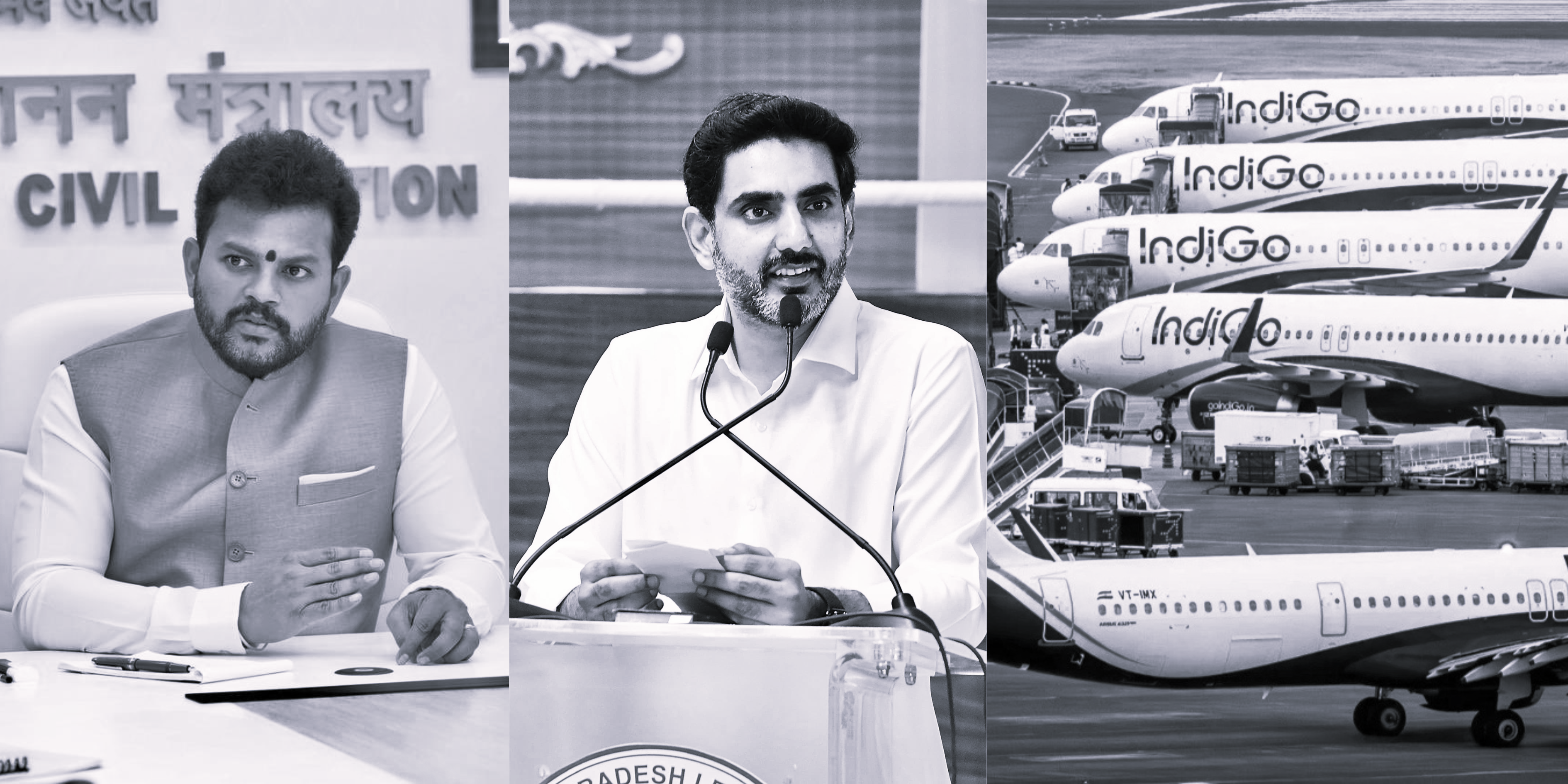
Demonetisation Deja Vu: Civil Aviation Ministry and TDP Red-Faced Over FDTL and IndiGo Meltdown
What began as the rollout of a regulatory safety framework has spiralled into India’s worst aviation disruption in years, leaving the Civil Aviation Ministry and the TDP which currently holds the portfolio scrambling amid nationwide anger. As IndiGo continues to cancel flights in large numbers for a second consecutive day, the Ministry’s handling of the Flight Duty Time Limitation (FDTL) norms is drawing comparisons to the government’s most chaotic policy experiment in recent memory: demonetisation .
On Saturday, over 200 IndiGo flights from Delhi and Mumbai were cancelled, following more than 1,000 cancellations the previous day. Airports across the country witnessed long queues, stranded passengers, and mounting frustration. What should have been a carefully sequenced transition to updated pilot-rest regulations instead became a cascading operational failure that crippled India’s largest airline.
The public mood turned sharper after a now-viral exchange on Arnab Goswami’s channel. As the anchor pressed, “There is a huge crisis where is the Aviation Minister?” , a TDP spokesperson insisted that the Minister was monitoring the situation and added, almost defensively, that “even Nara Lokesh sir is also closely watching.” Arnab shot back instantly: “Who is Nara Lokesh to monitor this?” The exchange upset the TDP camp and highlighted a growing perception that the leadership charged with overseeing India’s aviation sector was missing in action even as passengers endured unprecedented turmoil.
The Civil Aviation Ministry’s initial response was widely viewed as hesitant. For nearly two days after the crisis erupted, Minister Kinjarapu Rammohan Naidu remained absent from national television, from social media, and from public briefings. Officials familiar with the situation say the Minister appeared reluctant to speak until receiving political cues from Vijayawada , reinforcing the impression of a leadership vacuum during a national disruption.
Meanwhile, the underlying causes of the meltdown have now come sharply into focus. The Ministry enforced the second phase of the FDTL norms without ensuring that airlines especially IndiGo had adequate pilot strength to comply. The updated norms significantly expand weekly rest requirements and reduce permissible night landings. Yet no comprehensive audit was conducted to verify whether carriers had recruited sufficiently to meet the new thresholds. IndiGo alone faces an estimated 25% shortfall in pilot availability under the revised rules.
As a result, an airline known for its near-spotless operational reputation found itself overwhelmed within hours of the new regulations taking effect. What followed mass cancellations, clogged terminals, escalating passenger anger was, according to aviation analysts, entirely predictable and entirely avoidable.
The Ministry’s delayed intervention added to public frustration. Reports emerged of Delhi–Mumbai tickets touching ₹60,000 as other carriers seized the opportunity to surge fares. Only after widespread backlash did MoCA step in to cap prices and enforce strict refund and baggage-delivery rules on IndiGo. For many, the delay symbolised the Ministry’s reactive posture intervening only after the damage was already done.
The FDTL rollout has now been branded by several policy observers as “demonetisation in the skies.” The comparison is not merely rhetorical. In both cases, a well-intentioned policy was implemented without adequate preparation, without stakeholder readiness, and without mechanisms to absorb the shock. In 2016, the country saw serpentine queues at ATMs. In 2025, it sees the same chaos at airport terminals. Both crises were marked by ambiguity, public inconvenience, and a government asking citizens for patience while systems buckled under sudden change.
Political observers are also asking a more strategic question: whether Prime Minister Modi knowingly allowed a coalition partner and a first-time Union Minister to shoulder the political burden of a disruptive regulatory rollout whose risks were already known. The absence of strong public backing from senior Cabinet members has only strengthened this speculation.
IndiGo has warned that operations may not return to normal before February 2026 , as the airline undertakes fresh recruitment and roster restructuring to comply with the new norms. Until then, passengers must prepare for more cancellations, shifting schedules, and limited seat availability.
The crisis has exposed deep weaknesses in India’s civil aviation governance from the lack of pre-implementation audits to poor communication, inadequate contingency planning, and the inability to anticipate capacity shortfalls. As flights remain uncertain and passengers continue to bear the brunt, the Ministry and the TDP find themselves confronting a narrative that threatens to overshadow their