
Delhi Overtakes Lahore to Become World's Most Polluted Major City as AQI Reaches Severe Levels
Delhi has overtaken Pakistan's Lahore to become the world's most polluted major city, as a sharp deterioration in air quality blanketed the national capital in thick smog, reduced visibility and raised serious health concerns.
Delhi recorded an Air Quality Index (AQI) of 334 on IQAir's global pollution ranking, placing it at the top of the list of the world's most polluted major cities on Friday. Meanwhile, India's Central Pollution Control Board (CPCB) recorded an AQI of 403, categorising the city's air quality as 'severe'.
The two readings differ because IQAir and CPCB follow different AQI scales and methodologies. While the international ranking placed Delhi ahead of Lahore, the Indian monitoring agency's reading highlighted the severity of pollution within the capital.
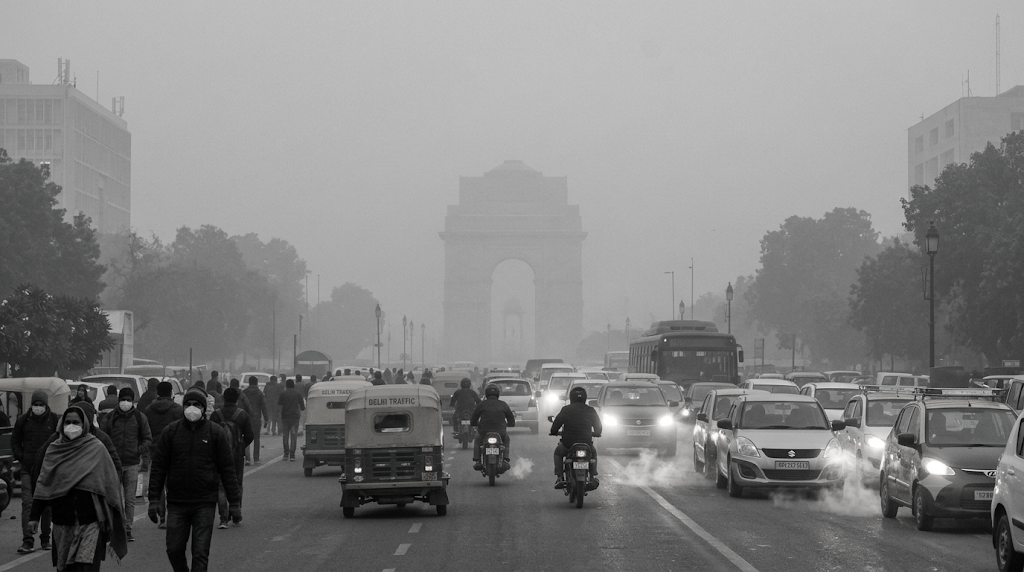
The deteriorating conditions were visible across several parts of Delhi, where dense haze enveloped roads and buildings. Vehicles moved through the smog with reduced visibility, while several high-rise structures appeared barely visible against the grey sky.
The seasonal pollution spike is driven by a combination of factors, including vehicle emissions, construction dust, agricultural residue burning and unfavourable winter weather conditions. During winter, colder and heavier air, coupled with stagnant atmospheric conditions, slows the dispersal of pollutants, allowing harmful particles to accumulate closer to the ground.
The worsening pollution has renewed concerns over its impact on public health, particularly among children, elderly people and those with respiratory conditions. Prolonged exposure to polluted air can aggravate breathing difficulties and increase the risk of respiratory and cardiovascular problems.
Meanwhile, the pollution crisis has also triggered a separate controversy involving television anchor Rubika Liyaquat. An old video in which she discussed how pollution and dust could create a layer that blocks some direct sunlight has resurfaced on social media, attracting criticism amid Delhi's worsening air quality.
In the clip, Liyaquat appeared to suggest that polluted air could offer some protection from harsh sunlight, while comparing conditions in India with cleaner air in European countries. The remarks drew sharp reactions online, with critics questioning the scientific basis of presenting pollution as beneficial. Liyaquat subsequently challenged a social media user questioning the clip, asking them to understand its original context.
Although airborne particles can reduce the amount of sunlight reaching the Earth's surface, this does not make polluted air safe or protect people from the harmful effects of pollution.
With winter conditions favouring the accumulation of pollutants, Delhi's air quality remains a major public health concern, putting renewed pressure on authorities to tackle the sources of pollution.