
Delhi Court Rejects Customs Defence, Grants Bail Over Prolonged Detention
A Delhi court has granted bail to a man accused of smuggling drone components worth more than Rs 1 crore, ruling that keeping an individual under restraint for over 24 hours without formally recording an arrest violates the fundamental right to personal liberty and constitutional safeguards against unlawful detention. Additional Sessions Judge Saurabh Partap Singh Laler, in an order dated November 18, granted bail to Shoaib Nawab Khan, who had been in judicial custody since September 27, observing that constitutional protection under Articles 21 and 22 begins when a person's liberty is actually curtailed, not when authorities formally record an arrest.
The court held that although customs officials can briefly detain passengers for baggage examination, keeping Khan under restraint from September 25 until September 27 without formal arrest was unlawful. Citing Article 22(2), which mandates production before a magistrate within 24 hours, excluding necessary travel time, the judge said investigative agencies cannot circumvent constitutional safeguards by delaying arrest records. Such prolonged detention violated Articles 21 and 22.
The ruling gains significance following the Supreme Court's November 5 judgment in Sujit Das and Others versus Union of India (2026 INSC 1195). A bench of Justices Ujjal Bhuyan and Atul S. Chandurkar held that the constitutional deadline begins when liberty is curtailed, not when formal arrest is recorded. The case involved four people intercepted in Tripura over 60.79 kg of methamphetamine. Rejecting investigative procedures as justification for delaying arrest, the apex court said only necessary travel time to reach a magistrate could be excluded. It also directed magistrates to record actual detention times and ensure compliance with Article 22(2).
In Khan's case, the court rejected the Customs Department's argument that he had voluntarily requested permission to rest at its office. It observed that a typed, signed letter could not legitimise prolonged detention or constitute a waiver of fundamental rights. Under Section 104 of the Customs Act, 1962, authorised officers can arrest individuals suspected of specified customs offences, but their powers remain subject to constitutional safeguards. Earlier judgments, including D.K. Basu versus State of West Bengal, established protections against arbitrary detention.
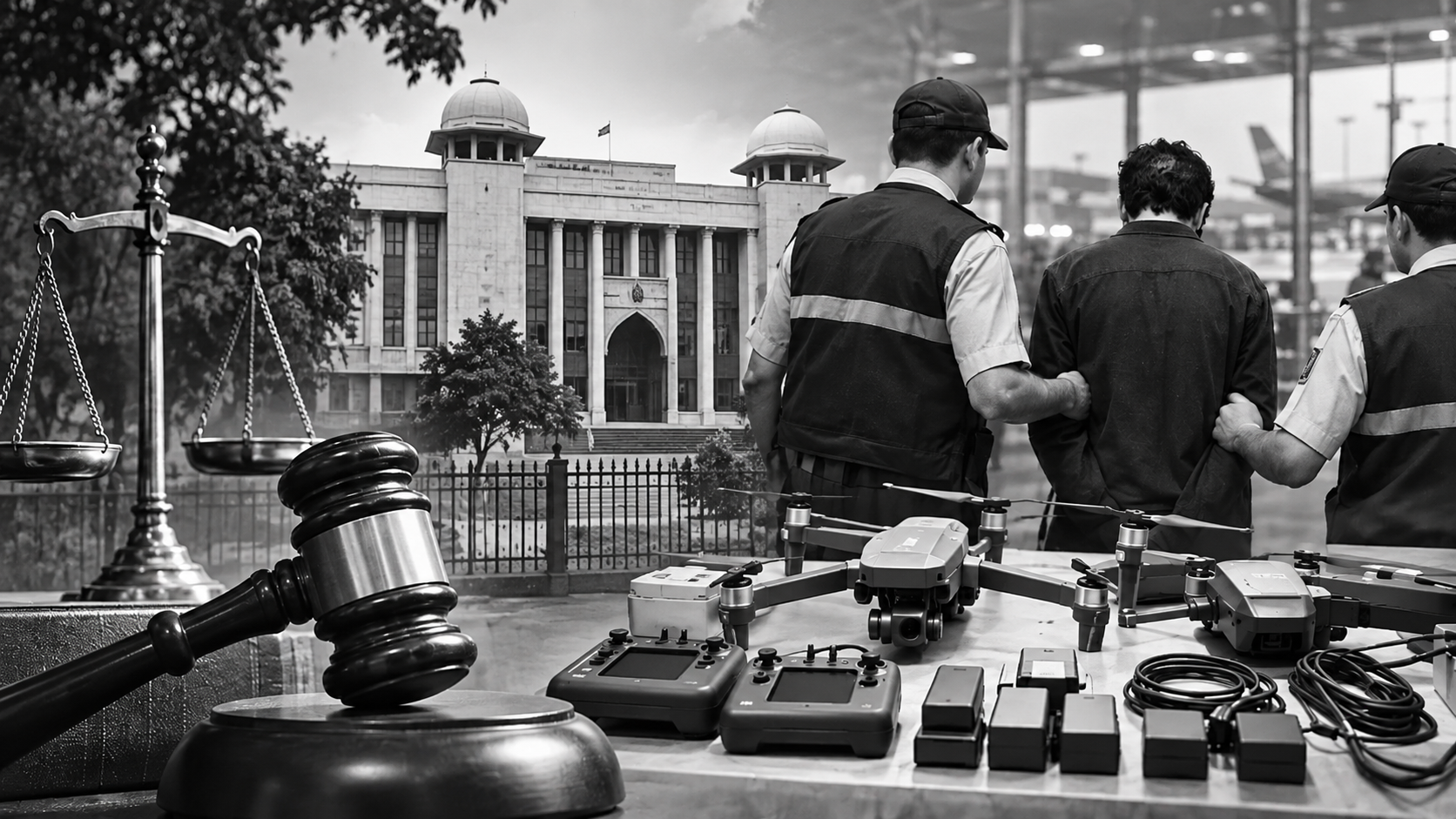
According to the prosecution, Khan and two others arrived from Hong Kong via Vietnam at Delhi's IGI Airport around 11 pm on September 25. Ten Autel Robotics drones, controllers, adaptors, cables and an iPhone, collectively valued at over Rs 1 crore, were allegedly seized. Four controllers, ten adaptors and ten power cables were recovered from Khan's baggage, while another passenger allegedly carried the drone bodies. The prosecution described the equipment as military-grade UAVs.
India's 2022 DGFT import policy generally prohibits importing complete drones, subject to exceptions, while individual components are freely importable. Khan's first bail plea was rejected on October 27. The Sessions Court granted bail against a Rs 1 lakh personal bond and one surety of the same amount, clarifying that its observations were tentative and confined to the bail application.