
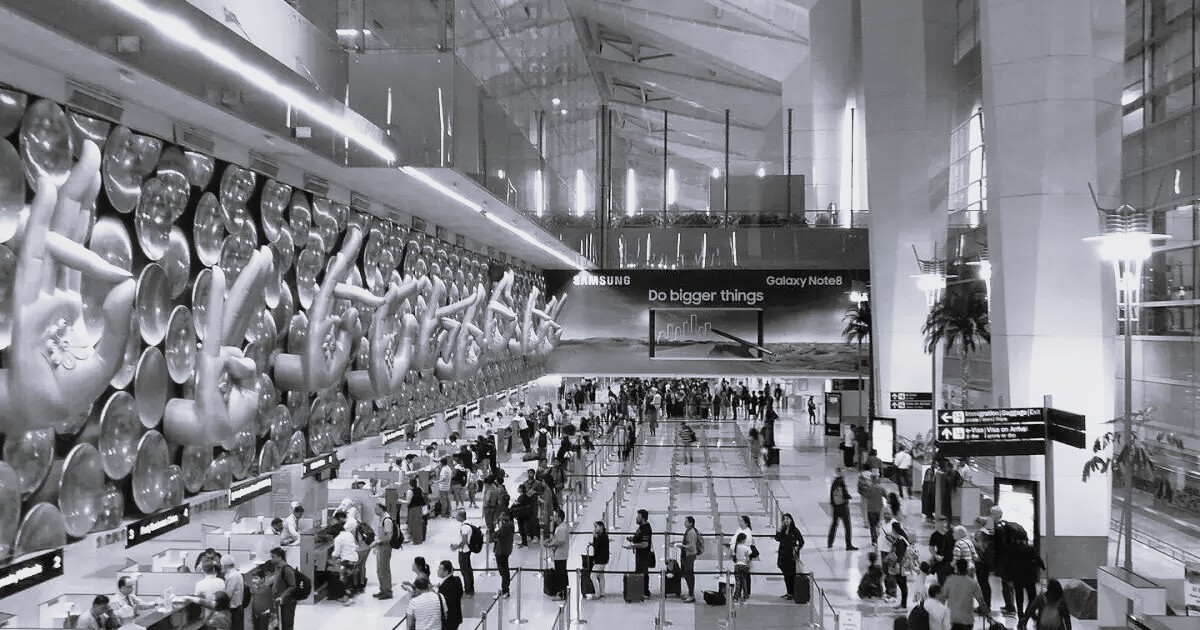
Delhi Airport scales up infrastructure to target 130 million annual passengers
Indira Gandhi International Airport (IGI) is pushing a major capacity expansion and operational-improvement drive to raise its annual passenger-handling capability to about 130 million, DIAL Chief Executive Officer Videh Kumar Jaipuriar said as the airport brought its refurbished Terminal 2 back into service on October 26. The move follows a steady recovery in air travel after the pandemic: IGI handled roughly 79.3 million passengers in FY 2024–25 even as its installed capacity already exceeds 100 million per year, and DIAL is using terminal upgrades, process automation and inter-terminal systems to bridge the gap between current throughput and future demand.
Jaipuriar outlined how refinements to each terminal will contribute to the 130-million target. Terminal 1 was designed for about 40 million annual passengers but can be nudged up by operational efficiencies to roughly the mid-40s (citing small percentage capacity gains from process and layout changes). Terminal 3, originally planned for about 34 million, is already handling over 50 million passengers, and conversion of additional piers there is expected to add 10–12 million yearly capacity. The refurbished Terminal 2 reopened to handle around 120 daily domestic flights for major carriers such as IndiGo and Air India is projected to add about 15 million annual capacity once fully stabilised in operations. These terminal-specific numbers and recent flight redistributions underpin DIAL’s short-to-medium-term capacity calculus.
Beyond raw terminal numbers, the airport has introduced passenger-experience and automation upgrades that directly lift throughput: self-baggage-drop systems, autonomous docking aerobridges, improved wayfinding and more efficient check-in and security flows — features highlighted in DIAL/GMR communications and media coverage around T2’s reopening. Such tech and process upgrades shorten per-passenger processing time, which effectively increases handling capacity without always requiring large civil works.
IGI is also trialling and scaling an inter-terminal baggage-transfer programme to smooth transfers for international passengers arriving at Terminal 3 who need to connect from or to Terminal 1. Under the pilot, passengers clear customs at T3, hand over checked baggage at a designated drop counter, and proceed to T1 unencumbered while the airport moves bags internally a practical step that reduces transfer friction and helps airlines and ground handlers fit more passengers through the same infrastructure. DIAL said the pilot has run for 8–9 months and has shown promising results.
The reopening of T2 and the T3 pier-conversion plans come at a time when Delhi is consolidating its position as India’s busiest aviation hub and seeking to close the gap between demand and capacity quickly. For context, DIAL is a GMR-led joint venture operating India’s only four-runway major civil airport; runways and airspace are crucial constraints in any capacity plan, so DIAL’s approach combines civil-works (piers, boarding bridges) with operational levers (turnaround improvements, tech tools) to extract extra capacity from existing runways and terminal footprints.
However, the expansion path is not without challenges. Earlier in 2025 DIAL took legal action regarding government approvals for commercial flights from a nearby defence airbase (Hindon), arguing potential viability and regulatory problems a reminder that political and regulatory developments can materially affect airport economics and traffic flows. Further, runway maintenance windows, slot coordination, airline scheduling, urban connectivity (metro/road links) and environmental/community clearances are practical constraints that can delay or blunt capacity improvements in the medium term. Stakeholders will watch how DIAL, the Ministry of Civil Aviation and airlines coordinate aircraft movements and terminal allocations over the coming months as T2 absorbs flights and T3 expands its international wing.
From an economic standpoint, the airport’s expansion supports multiple downstream sectors: tourism, business travel, cargo, hospitality and real-estate around the NCR and it can help India capture larger shares of growth in international transfer traffic as airlines restore pre-pandemic networks and add new routes. The operational upgrades (self-baggage-drop, autonomous aerobridges) also reduce per-passenger handling costs and can raise non-aeronautical revenue by improving dwell times and retail opportunities in terminals. Yet execution risk remains: moving a network of schedules and airlines among three busy terminals while keeping passenger satisfaction high will require tight change management, clear passenger communication, and close airline coordination.
In sum, DIAL’s 130-million target is an ambitious but plausible combination of civil upgrades (T2 reopening, T3 pier conversions), process and technology gains (automated baggage, self-check), and operational optimisation (turnaround improvements, baggage-transfer pilots). Success will depend on synchronising those technical gains with regulatory certainty, runway availability and close airline cooperation factors that will determine whether IGI’s throughput climbs to the new target or settles at a slightly lower plateau in the near term.