
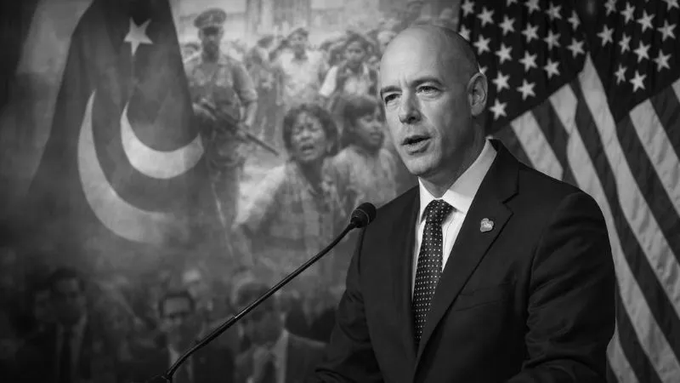
Declare Pak atrocities as genocide: US lawmaker seeks official recognition for 1971 Bengali Hindu massacres
A United States lawmaker has introduced a resolution in the House of Representatives seeking official recognition of the 1971 atrocities against Bengali Hindus as genocide, war crimes, and crimes against humanity during the Bangladesh Liberation War - a move carrying significant diplomatic weight more than five decades after the bloodshed.
The resolution was introduced on Friday by Democratic Congressman Greg Landsman of Ohio , reportedly motivated by advocacy from Hindu diaspora organizations, and has been referred to the House Committee on Foreign Affairs . However, political analysts note that without bipartisan co-sponsorship, such resolutions frequently stall at the committee stage and carry no legally binding force under domestic or international law.
Notably, no similar resolution has previously reached this stage in Congress, making this a rare and symbolically significant development, though its passage remains uncertain.
The resolution states that violence erupted on March 25, 1971 , when Pakistan's military detained Sheikh Mujibur Rahman and launched Operation Searchlight , a brutal crackdown aimed at suppressing the Bengali independence movement following the 1970 elections , in which the Awami League won a clear majority but was unconstitutionally denied power.
The Pakistani Army , aided by Islamist militias linked to Jamaat-e-Islami , carried out massacres, mass rapes, and village destructions. While Bengalis of all faiths were targeted, Hindu minorities were specifically singled out for extermination through killings, rape, forced conversion, and expulsion. The resolution cites figures of up to three million killed and over 200,000 women subjected to sexual violence .Specific atrocities documented include the Ramna massacre (250 Hindus killed near a Dhaka temple), the Jathibhanga massacre (over 3,000 killed in Thakurgaon), and killings at Dhapdhup (approximately 3,500 murdered in a single operation).
The resolution references the "Selective Genocide" telegram of March 28, 1971, sent by US Consul General Archer Blood , and the landmark Blood Telegram of April 6 , signed by 20 American diplomats protesting Washington's silence - a silence that remains a point of historical criticism.
India's perspective adds another dimension. Having sheltered nearly 10 million refugees during the crisis and intervened militarily to end the conflict, New Delhi has long maintained that the 1971 events constitute genocide. Indian officials and historians have periodically urged international recognition, viewing it as a matter of both historical justice and regional memory. India's concern also extends to the present - the persecution and exodus of Hindu minorities from Bangladesh in recent decades echoes the vulnerabilities exposed in 1971, making formal international recognition particularly meaningful to New Delhi.
Significantly, no country has formally recognised the 1971 atrocities as genocide under the UN Genocide Convention - a legal threshold requiring proof of specific intent to destroy a group - making any US recognition historically unprecedented. Within Bangladesh itself, how the war's Hindu victims are officially commemorated remains a sensitive and unresolved question.
The resolution urges the US President to formally recognise the atrocities as genocide and to condemn the Pakistani military and its collaborators, while stressing that entire communities must not be collectively blamed for crimes committed by individuals.