
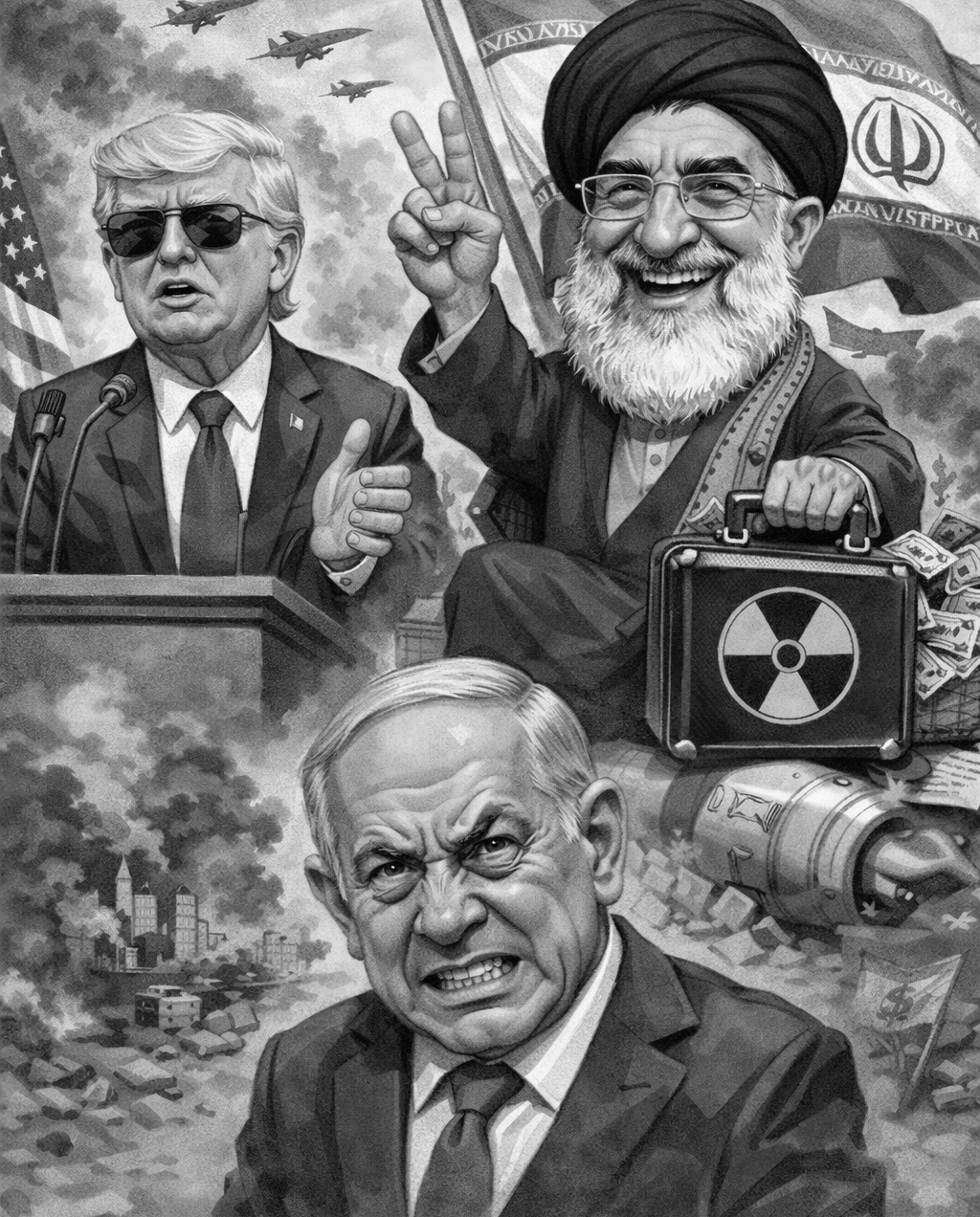
Damaged But Undefeated: How Iran Came Out of the Ceasefire Ahead
Iran emerged from the latest Gulf ceasefire battered but unbowed. Beneath the sirens, struck tankers, and missiles of Day 40, Tehran absorbed the blows while retaining strategic leverage . The United States escalated hard, aiming to extract its objectives and step back before the war could spiral out of control.
With ninety minutes left before a critical diplomatic deadline , President Donald Trump posted on Truth Social that Washington and Tehran had agreed to a 14-day ceasefire . The world exhaled. Then the missiles started flying anyway. The agreement had not arrived cleanly. It came in fragments, through back channels, in the final ninety minutes of a deadline that few believed would hold. China confirmed it had been in active negotiations with multiple parties, a quiet acknowledgment that the diplomatic architecture behind the deal was broader than any single nation's effort. Qatar and Oman , the near-permanent fixtures of US-Iran back-channel diplomacy, had been working the lines throughout. But it was Pakistan that emerged as the most visible and consequential mediating power. Prime Minister Shehbaz Sharif and Army Chief General Asim Munir held urgent, high-level talks directly with Trump in the final hours. Both sides will now travel to Islamabad this Friday to sit across from each other in the first direct structured talks of the conflict.
Trump called the deal "workable." He declared that Iran will not enrich uranium , that the American goal is the removal of nuclear material from Iranian territory entirely, and signaled possible sanctions relief , a significant carrot extended toward a government that has been economically strangled for years. He described Iran as having undergone a "productive change," though Washington has been careful not to define what that means precisely or who inside Tehran is actually driving it. Vice President JD Vance framed American moves as acts of good faith , not concessions, language chosen with surgical deliberateness. Defense Secretary Pete Hegseth was blunt. The US military campaign had already achieved its core objectives , Iranian air defense infrastructure degraded, key command nodes struck, the regime's conventional military capacity significantly diminished. The suspension of the bombing was not retreat. It was, in Hegseth's framing, the natural posture of a power that had won what it came to win and was now opening a window to see whether diplomacy had the nerve to follow . From Washington's point of view this was never a compromise. It was a calculated step back , the Trump doctrine in its clearest form: hit hard, extract maximum leverage, then offer the off-ramp on American terms.
Iran's Foreign Minister confirmed that the Strait of Hormuz would remain open for fourteen days . But the relief came with a condition that drew immediate and sharp scrutiny. Tehran made clear that passage through the strait would operate under Iranian military supervision , ships could move, but Iran held the lever . At the negotiating table, Iran's demands remain unchanged and uncompromising: full sanctions relief , the release of all frozen Iranian assets , a figure running into the hundreds of billions, the right to retain its nuclear program in some form, not absolute dismantlement, and effective continued control over Hormuz . Trump's declaration that Iran will not enrich uranium is a statement of American intent, not a signed agreement. The distance between those two things is, at present, unbridged. The United States has said, with equal firmness, that Iran's terms have never been received as an acceptable basis for agreement .
Inside Iran, the political picture is fractured. There are voices within the regime pushing for pragmatic engagement, whether from economic exhaustion under sanctions or genuine strategic recalculation remains unclear. But Supreme Leader Khamenei faces fierce domestic pressure from hardliners for whom any agreement with Washington is ideological surrender. The protests on Iranian streets following the ceasefire announcement were not celebrations.
Israel announced it would suspend attacks for two weeks , then immediately qualified that Lebanon was an exception . Hours after the ceasefire was declared, Israel struck central Beirut without warning . Iran warned it would withdraw from the agreement entirely if Israel attacked Lebanon. Pakistan's Prime Minister Sharif posted on X that Lebanon was explicitly included in the ceasefire terms. Three governments, three incompatible positions and Beirut absorbing the consequences of the gap between them. Hezbollah's current operational status inside Lebanon remains a live and unresolved variable that no ceasefire text has addressed.
Within hours of the announcement, Bahrain sounded its missile alert sirens . Alerts rang across multiple West Asian countries . The United Arab Emirates reported firing on an incoming Iranian missile barrage . Iranian state television reported an attack on an oil refinery after the ceasefire had been declared. A Saudi Arabian oil tanker was struck . Oil markets, which had briefly steadied on the ceasefire news, lurched again, shipping insurance rates spiked as the tanker hit reminded underwriters that the Gulf was not yet safe. The Houthis , operating from Yemen with their own command logic, showed no indication they considered themselves bound by any agreement reached between Tehran and Washington, their continued activity a reminder that this conflict has tributaries the main deal does not reach. France’s President Emmanuel Macron, Russia, Lebanon’s Prime Minister, the European Union, and India all welcomed the ceasefire. For a brief moment the world spoke with unusual unanimity. But back in Washington the politics were fracturing. Democrats called for Trump's removal , pushing back against what they called an opaque and unilateral process. Some Republicans also expressed reservations , rare internal pressure that the White House was visibly managing. Foreign policy analysts remain divided: is this a Trump masterstroke , a brash dealmaker forcing two hostile powers to the table on American terms, or a high-stakes gamble on a ceasefire violated before the ink dried, with nuclear stakes that could not be higher if miscalculation occurs. Turkey has been conspicuously silent and in this region, silence from Ankara is rarely accidental. The Abraham Accords framework and the Gulf normalization architecture Trump spent his first term building now hang in strange tension with the current chaos, Gulf states that signed normalization deals with Israel watching Beirut get struck and tankers get hit and quietly asking what the regional order actually means anymore.
What exists today carries no clean name. It is not peace. It is not quite war. It is a loaded pause .