
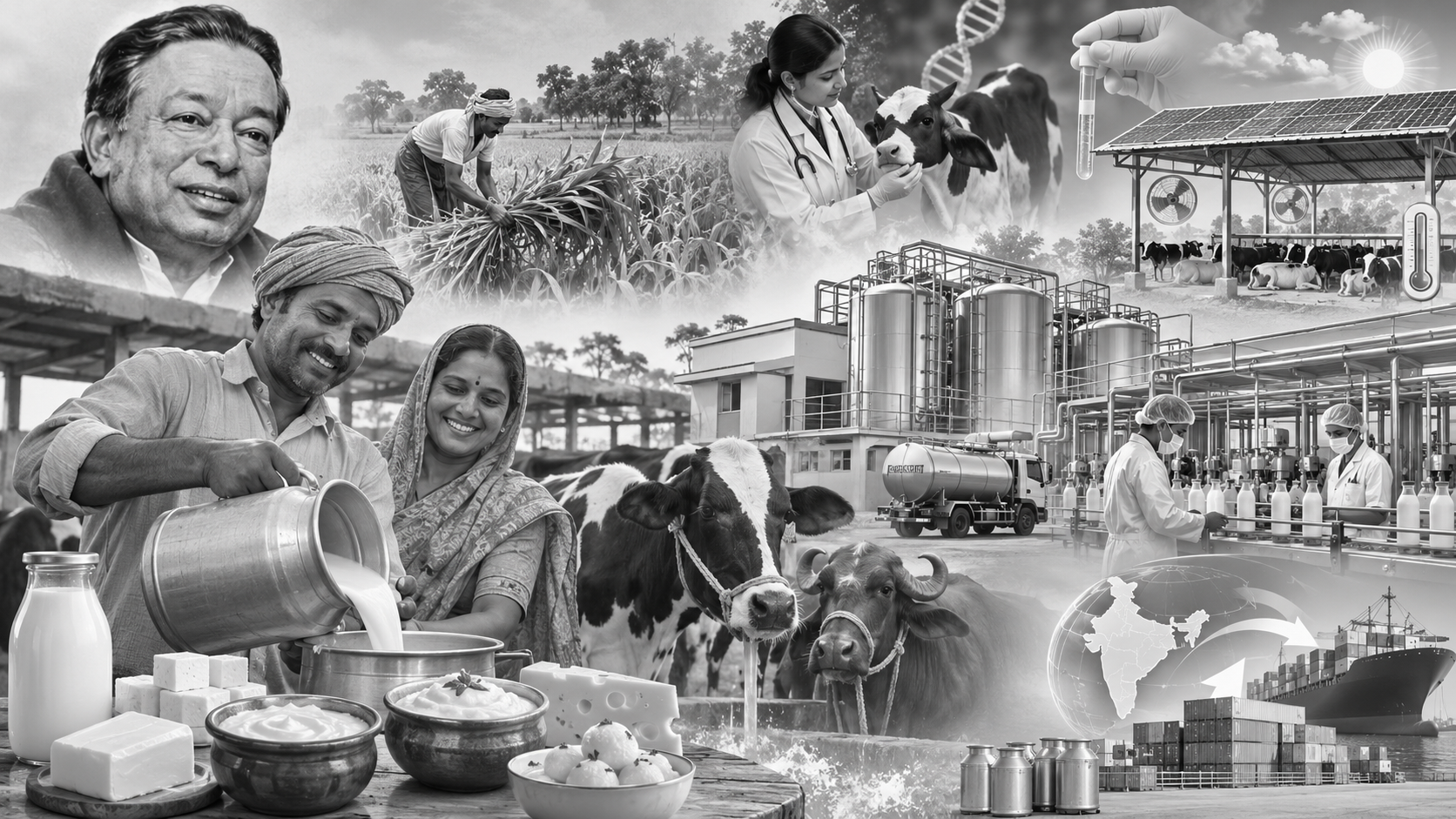
Dairy Sector's Next Big Leap: Better Yields, Stronger Cooperatives and Wider Markets
India’s dairy sector is preparing for a new phase of transformation, with infrastructure expansion, climate resilience, improved animal productivity and stronger farmer institutions expected to shape its future. These priorities will take centre stage during National Milk Day 2026, scheduled to be celebrated at Bapu Sabhagar in Patna, Bihar, on November 26. The programme will bring together Union and state leaders, dairy farmers and sector representatives to highlight the industry's achievements and address the challenges facing one of the country's most important rural economic activities.
Union Minister for Fisheries, Animal Husbandry and Dairying Rajiv Ranjan Singh, popularly known as Lallan Singh, will attend as the chief guest. Bihar Chief Minister Samrat Choudhary, Union Minister of State S.P. Singh Baghel and Bihar Minister for Dairy, Fisheries and Animal Resources Nand Kishore Ram are also expected to participate. The event will feature the presentation of the National Gopal Ratna Awards 2026, recognising outstanding contributions by dairy farmers rearing indigenous cattle and buffalo breeds, artificial insemination technicians and dairy cooperatives. Special recognition will also be given to participants from the North-Eastern Region and Himalayan States.
Infrastructure Push and New Initiatives
The celebrations will showcase several initiatives aimed at strengthening the dairy value chain. Under the National Programme for Dairy Development (NPDD), Data Processing and Milk Collection Units will be distributed, while mineral mixture plants at the Veterinary Polyclinic and Mobile Veterinary Unit facility in Patna and the Tirhut Milk Union in Muzaffarpur will be highlighted. An effluent treatment plant at the Mithila Milk Union in Samastipur is another important infrastructure intervention.
A major development is the proposed commissioning of Namaste India's two-lakh-litres-per-day milk processing plant at Sikandarpur in Bihta, Patna, with assistance under the Animal Husbandry Infrastructure Development Fund (AHIDF). The programme will also include certificates for veterinary medicine sales centres sanctioned under the Livestock Health and Disease Control Programme. Standard operating procedures for rating and grading dairy cooperatives and milk producer organisations, along with an online portal, are expected to improve transparency and institutional performance.
The launch of a Climate-Resilient Roadmap for India's Livestock and Dairy Sector will be another significant feature. The roadmap is intended to align the sector with the broader ambition of Viksit Bharat @2047. The Basic Animal Husbandry Statistics 2026 will also be released, providing estimates of milk, egg, meat and wool production, along with state-wise output and per capita availability. A dialogue with progressive dairy farmers and the launch of Sudha-branded Makhana Kheer and Rabri will add a regional dimension to the celebrations.
From Operation Flood to Global Leadership
National Milk Day commemorates the birth anniversary of Dr Verghese Kurien, widely regarded as the Father of India's White Revolution. His contribution to building a farmer-owned dairy cooperative movement transformed India from a milk-deficient country into the world's largest milk producer.
The establishment of the National Dairy Development Board in 1965 and the launch of Operation Flood in 1970 laid the foundation for this transformation. Implemented in three phases between 1970 and 1996, the programme connected rural milk producers with urban markets through a national milk grid. It strengthened cooperatives, improved procurement and ensured that farmers received a more reliable market for their produce. The Anand cooperative model became a blueprint for dairy development across the country.
Production Rises, but Productivity Remains a Concern
India's milk production has increased substantially over the past decade. According to the Basic Animal Husbandry Statistics 2025, output reached 247.87 million tonnes in 2024-25, registering annual growth of 3.58%. Production stood at 146.30 million tonnes in 2014-15, representing an increase of nearly 69.4% over the period. Per capita milk availability also rose from 319 grams per day in 2014-15 to 485 grams in 2024-25.
Uttar Pradesh remained the largest milk-producing state, accounting for 15.66% of national output, followed by Rajasthan at 14.82%, Madhya Pradesh at 9.12%, Gujarat at 7.78% and Maharashtra at 6.71%. Together, these five states contributed more than half of India's milk production. However, higher production does not necessarily translate into better animal productivity.
The national average daily yield stood at approximately 9.05 kg for exotic and crossbred cattle, compared with 3.86 kg for indigenous and non-descript cattle. State-level variations remain considerable. Punjab recorded a crossbred cattle yield of 14.10 kg per day, while Bihar's figure was 6.50 kg. The gap underlines the need for better breeding practices, balanced nutrition, veterinary care and improved farm management. It also shows why the next phase of dairy development must focus on raising productivity rather than merely expanding herd numbers.
Cooperatives and Government Schemes
The government has introduced several programmes to strengthen dairy infrastructure and improve farmers' access to markets. White Revolution 2.0, launched in 2024, aims to establish 75,000 new dairy cooperative societies and strengthen 46,422 existing ones between 2024-25 and 2028-29. It also seeks to increase milk procurement through cooperatives by 50%, from 660 lakh kg per day in 2023-24 to 1,007 lakh kg per day by 2028-29. The initiative places particular emphasis on expanding cooperative networks in uncovered villages and increasing women's participation.
The National Programme for Dairy Development supports milk procurement, chilling, processing and quality testing, while the Rashtriya Gokul Mission focuses on the genetic improvement and conservation of indigenous bovine breeds. The Livestock Health and Disease Control Programme strengthens vaccination, disease surveillance and veterinary services. Meanwhile, the National Livestock Mission supports fodder development and livestock-based entrepreneurship, and AHIDF encourages private investment in processing and value-addition infrastructure.
Digital initiatives, including the Bharat Pashudhan platform and 12-digit Pashu Aadhaar identification system, are also expected to improve animal tracking and the management of breeding, vaccination and healthcare records.
Export Potential and Import Challenges
Despite its dominant position in global milk production, India's share in international dairy trade remains relatively limited. APEDA data show that dairy product exports during 2025-26 stood at 97,524.82 tonnes, valued at $407.12 million. The United Arab Emirates, Saudi Arabia, the United States, Bhutan and Bahrain were among the major destinations.
At the same time, imports of specialised dairy products have increased. Government data show that imports across selected dairy product categories rose from around 14,983 tonnes in 2022-23 to approximately 30,810 tonnes in 2023-24. Whey and whey products accounted for a substantial portion, with imports increasing from 10,808 tonnes to 23,041 tonnes. This does not necessarily indicate dependence on imported liquid milk, but highlights gaps in the domestic supply of specialised dairy ingredients used by food-processing and nutrition industries.
Climate Risks and the Fodder Gap
The sector's biggest structural challenges include low animal productivity, inadequate fodder availability, fragmented production systems and climate-related stress. A 2025 study by the Council on Energy, Environment and Water found that 71% of surveyed cattle-rearing households identified feed and fodder shortages as a major constraint. The area under fodder cultivation also declined from 8.30 million hectares in 2018-19 to 6.39 million hectares in 2023-24.
Rising temperatures pose another threat. Heat stress affects animal health, reproductive performance and milk yields, with estimates suggesting annual milk losses of 1.8 to two million tonnes. Expanding fodder cultivation, promoting silage and balanced feeding, improving access to mineral mixtures and strengthening veterinary services will therefore be essential. Climate-resilient shelters, adequate drinking water and better heat-management practices must become integral to dairy farming.
Bihar's Opportunity in the Next Phase
Bihar, the host state for this year's celebrations, has considerable potential to strengthen its position in the dairy economy. The state produced approximately 13.40 million tonnes of milk in 2024-25, registering annual growth of 4.24%. The Bihar State Milk Co-operative Federation, better known through its Sudha brand, has played an important role in connecting producers with consumers. The proposed processing infrastructure, veterinary facilities and new value-added products could further strengthen the state's dairy ecosystem.
India's dairy success has been built on the cooperative movement and the participation of millions of small producers. The next stage, however, will depend on how effectively the country addresses productivity gaps, climate risks, fodder shortages and quality standards. As India moves towards Viksit Bharat @2047, the real measure of progress will not be milk production alone, but higher farmer incomes, healthier livestock, stronger cooperatives, better processing capacity and a more competitive presence in global markets.