
Cyclone Montha wreaks havoc across Telugu states
Widespread devastation was witnessed across Andhra Pradesh and Telangana as Cyclone Montha triggered heavy rains, floods, and large-scale damage over the past few days. The system, which crossed the coast earlier this week, left a trail of destruction across the Krishna River basin and several inland districts, paralysing normal life and causing severe losses to crops, infrastructure, and livelihoods.
In Andhra Pradesh, the cyclone’s impact was said to have caused an estimated ₹5,265 crore loss, estimated by the AP CM Office. The assessment, based on preliminary reports, covered damage to roads, bridges, irrigation systems, power supply, and agriculture. Over 1,583 villages across multiple districts were affected, while 779 roads, 89 bridges, and 473 culverts were damaged. Losses to drinking water supply schemes alone were pegged at ₹1.04 crore.
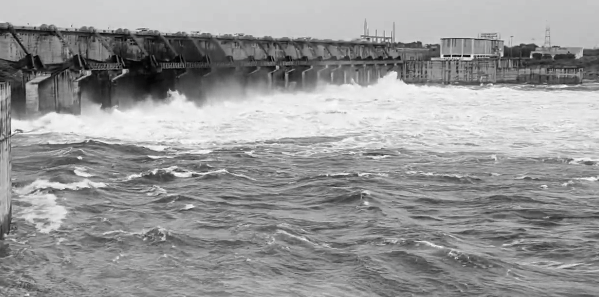
Severe flooding was reported in Krishna, Guntur, Bapatla, Palnadu, and Eluru districts, where rivers overflowed due to incessant rainfall. Heavy inflows were received at Pulichintala and Prakasam Barrages, forcing irrigation officials to maintain high outflows. The Prakasam Barrage at Vijayawada recorded an inflow and outflow of 5.38 lakh cusecs by Thursday evening, prompting authorities to consider issuing a second-level flood warning. The Pulichintala project saw inflows exceeding 5.20 lakh cusecs, leading to continuous discharge downstream.
Irrigation Minister Nimmala Ramanaidu was stated to be personally monitoring the flood situation from the control room in Vijayawada. District collectors were directed to maintain constant coordination with the irrigation and disaster management departments. The Andhra Pradesh State Disaster Management Authority (APSDMA) warned that more rainfall could worsen the situation and advised people in low-lying and riverbank areas to relocate to safer zones.
The APSDMA said that over 1,158 mobile sanitation teams had been deployed to prevent waterborne diseases, while relief camps were set up in flood-hit mandals. The National Disaster Response Force (NDRF) and State Disaster Response Force (SDRF) were kept on standby for emergency operations.
Chief Minister Naidu chaired a high-level review meeting and directed officials to expedite the enumeration of crop losses and property damage. Farmers were assured that compensation and insurance claims would be processed swiftly. “All necessary support will be extended to ensure quick recovery for affected families,” the Chief Minister said during the review.
Meanwhile, in Telangana, several districts including Warangal, Hanamkonda, and Mahabubabad were severely hit by heavy rainfall triggered by the same weather system. The Bhadrakali tank in Warangal overflowed following relentless downpours, flooding nearby colonies and submerging low-lying areas.
Telangana Minister Konda Surekha inspected affected areas in Warangal and reviewed ongoing rescue and relief operations. Officials were instructed to prioritise evacuation, supply of food and drinking water, and the restoration of power in submerged localities. Rescue teams were deployed to shift stranded residents to temporary shelters as floodwaters entered residential zones.
According to the India Meteorological Department (IMD), the remnants of Cyclone Montha weakened into a depression after crossing the coast but continued to cause widespread rainfall across coastal Andhra and adjoining Telangana regions. Moderate to heavy rain was forecast in isolated pockets over the next 24 hours.
Floodwaters were gradually receding in several areas of the Krishna delta, but officials maintained strict vigilance over inflows into major reservoirs. The APSDMA and Telangana Disaster Management Authority (TSDMA) continued round-the-clock monitoring, issuing alerts and coordinating relief measures.
Both state governments remained focused on rehabilitation efforts as thousands of families began returning to their homes. Damage assessment teams were deployed to document losses to agriculture, roads, and public infrastructure. Essential supplies were restored in several towns, though field reports indicated that full normalcy might take several more days.
The combined impact of Cyclone Montha on the Telugu states was described by officials as one of the most extensive in recent years, with both Andhra Pradesh and Telangana witnessing severe rainfall, overflowing rivers, and widespread disruption to public life.