
CSIR at 84: From labs to livelihoods, driving India’s scientific and socio-economic journey
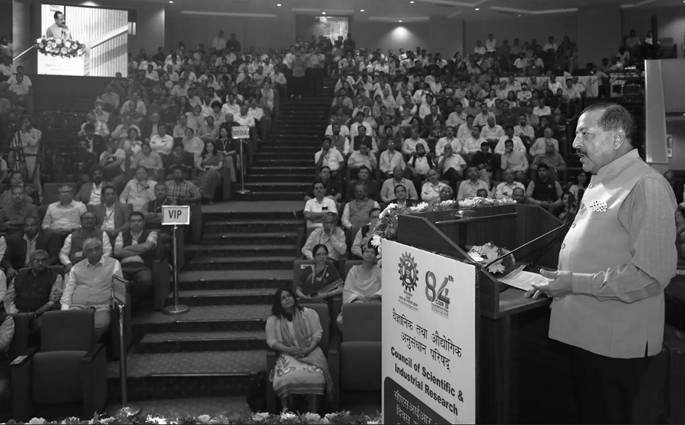
“Sovereignty in technology will determine geopolitical sovereignty in the times to come,” said Union Minister of State for Science and Technology and vice president of CSIR, Dr. Jitendra Singh, highlighting India’s ongoing transition into a technology-driven nation. He was speaking at the 84th foundation day of the Council of Scientific and Industrial Research (CSIR), emphasizing the institution’s enduring legacy and its role in shaping India’s path towards Viksit Bharat 2047.
The establishment and early vision of CSIR
The Council of Scientific and Industrial Research (CSIR) was established on 26 September 1942, during the final years of British India, under the leadership of Shanti Swarup Bhatnagar and Arcot Ramasamy Mudaliar, under the aegis of the Department of Scientific and Industrial Research (DSIR), Ministry of Science and Technology, Government of India. It aimed to create a coordinated scientific infrastructure to support industrial development, reduce import dependence, and foster homegrown innovation. From the beginning, CSIR focused on pharmaceuticals, chemicals, agriculture, and materials, ensuring science addressed both technological and socio-economic challenges.
Today, CSIR is an autonomous body under the Ministry of Science and Technology, with 37 laboratories and over 14,000 staff nationwide. It continues to advance research, contributing significantly to India’s scientific and technological progress.
Tracing CSIR’s history, Dr. Singh reminded the audience that it is one of the few national institutions established before independence. He acknowledged the contributions of its first vice-president, Dr. Syama Prasad Mookerjee, and Sir Ramnath Chopra, widely regarded as the father of pharmacology in India. “CSIR’s history is a reminder that science and innovation were integral to India’s journey even before freedom,” he said.
Critical analysis: Milestones and impact
Over the past eight decades, CSIR has consistently delivered breakthroughs across healthcare, agriculture, industry, and national security, with measurable impacts on India’s technological and socio-economic development:
• Healthcare: CSIR’s development of Nafithromycin, an indigenously produced antibiotic effective against resistant respiratory infections, showcases India’s ability to tackle critical public health challenges. Earlier, CSIR labs played a key role in producing vaccines and essential drugs domestically, such as polio vaccines and anti-malarial medicines, helping India reduce dependence on imports and respond quickly to health emergencies.
• Agriculture: Innovations in high-yield crop varieties, lavender cultivation in Jammu & Kashmir, and Tulip research in Palampur have transformed farmers’ livelihoods. These projects not only increased income but also diversified agricultural production, fostering regional economic development.
• Industry: CSIR has facilitated the translation of lab research into market-ready solutions, strengthening sectors such as chemicals, materials, pharmaceuticals, and floriculture. Initiatives like ‘One Week, One Lab’ demonstrate its commitment to bridging the gap between scientific discovery and industrial application.
• National security: CSIR technologies have contributed directly to national defense, including sensor technologies deployed in strategic operations like Operation Sindoor. These innovations highlight CSIR’s role in ensuring technological self-reliance in critical security domains.
Collectively, these contributions have helped India achieve technological self-sufficiency, promote economic development, and strengthen societal resilience. By combining research excellence with industrial partnerships and societal impact, CSIR has become a cornerstone of India’s scientific and socio-economic growth.
From labs to livelihoods: innovation, industry, and society
Focusing on the present, the minister stressed the need for India to strengthen capabilities in emerging technologies to remain globally competitive. With 37 laboratories across the country, CSIR is advancing research in healthcare, pharmaceuticals, agriculture, materials, and defense. Initiatives such as One Week One Lab and One Week One Theme have been launched to showcase these contributions more widely.
Dr. Singh highlighted the importance of collaboration across scientific institutions. He stressed that integration with allied departments like biotechnology is crucial for maximizing national outcomes.
Industry linkages remain central to CSIR’s mission of translating laboratory research into real-world impact. “All of our success stories,from vaccines to floriculture,have been possible because of early and robust engagement with industry partners,” Dr. Singh noted, urging companies to actively participate in innovation commercialization.
CSIR’s work also has a strong societal dimension. From lavender cultivation in Jammu and Kashmir to tulip innovation in Palampur, the institution’s projects have transformed farmers’ livelihoods. Technologies developed by CSIR have even contributed to national security, including sensors deployed in operations like Sindoor. “Our goal is to ensure that science improves ease of living and has a direct socio-economic impact,” he said.
Looking ahead, Dr. Singh outlined a three-pronged approach,awareness, affordability, and accessibility,to ensure scientific benefits reach all sections of society. He encouraged scientists to embrace modern communication tools and social media to connect directly with citizens and share their work.
The event was attended by distinguished figures from India and abroad, including Dr. V. K. Saraswat (member, NITI Aayog), Prof. Ajay Kumar Sood (principal scientific advisor), and Dr. Sethuraman Panchanathan (university professor of technology and innovation at Arizona State University, and former director of the U.S. National Science Foundation).
As CSIR looks toward its centenary in 2042, Dr. Singh said the institution must aspire to be the torchbearer of India’s technological rise. “The real tribute to our founding fathers will be to carry science to every section of society and lead the nation into 2047 with confidence and capability,” he concluded.