
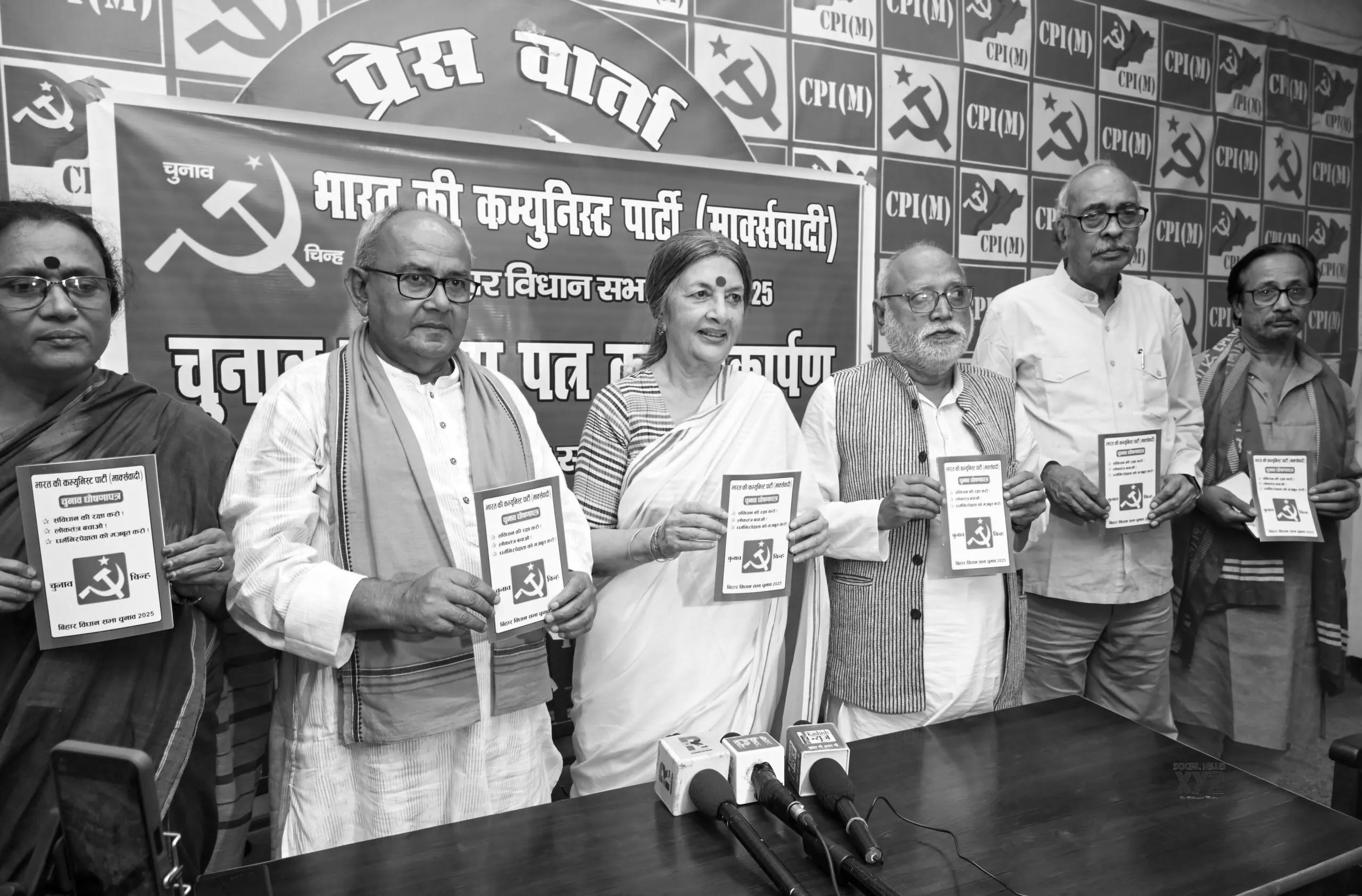
CPI(M) unveils Bihar manifesto, hits out at NDA’s ‘failed governance’
The Communist Party of India (Marxist) on Saturday released its manifesto for the Bihar Assembly elections, outlining a roadmap centered on employment generation, industrial revival, and social justice. Senior CPI(M) leader Brinda Karat, who unveiled the document in Patna, said the party’s agenda reflects “real solutions for real people,” contrasting it with what she described as the NDA’s failed governance and the RJD’s old-style politics.
Karat accused the ruling NDA of focusing on a “negative campaign” instead of highlighting achievements. “After 20 years in power, the NDA still cannot showcase any meaningful change in Bihar’s economy or governance. They’re desperate, pointing fingers because they have nothing to present,” she said. It was also stated by Karat that Bihar has been turned into a source of migration due to the NDA’s policies, and that the Mahagathbandhan has been formed to break that exploitative framework which forces people to leave their home state in search of work.
The CPI(M) is contesting the elections as a constituent of the INDIA bloc, popularly known in Bihar as the Mahagathbandhan, which also includes the RJD, Congress, CPI, and CPI(ML). While the RJD’s Tejashwi Yadav remains the principal Chief Ministerial face of the alliance, the Left parties, including CPI(M), are supporting him under a joint programme focused on employment, equality, and welfare-based development.
While the RJD has built its campaign around caste justice and reservation safeguards, the CPI(M) aims to link social justice with economic revival, focusing on employment and industrial development as the backbone of Bihar’s progress. Karat said the Left’s agenda would prioritize law, livelihood, and transparency, moving beyond mere slogans to ensure tangible outcomes for the people.
Citing the Mokama killing of Jan Suraaj Party supporter Dular Chand Yadav, Karat said the incident showed how “mafia raj continues under NDA rule.” She emphasized that the CPI(M) seeks to end the cycle of lawlessness and corruption that has plagued the state under successive governments.
The CPI(M) manifesto lays out a detailed plan of action for Bihar’s development. It promises state-backed job guarantees and large-scale public sector recruitment, along with revival of closed factories and new industrial hubs to create employment within the state. It also calls for strict enforcement of minimum wage laws and welfare measures to protect migrant laborers working outside Bihar.
The party’s other commitments include better support for farmers through assured prices and irrigation, education reform through stronger public institutions and affordable higher studies, and women’s empowerment through safety measures and economic inclusion. On governance, the manifesto pledges to break the nexus between crime and politics and ensure impartial policing. It also outlines plans for universal healthcare, including expanded government hospitals and free essential medicines in rural areas.
Condemning Assam Chief Minister Himanta Biswa Sarma’s remarks calling Congress leader Gaurav Gogoi “an agent of Pakistan”, Karat said such comments reflect “the moral collapse within the BJP’s political culture.”
Positioning itself as the left anchor of the INDIA bloc, the CPI(M) says its vision goes beyond rhetoric, to create a Bihar where development brings dignity, not dependence. “Our goal is simple,” Karat said, “to build a Bihar where people can live with work, respect, and justice.”
In comparison, the NDA’s manifesto focuses on continuing welfare schemes, infrastructure expansion, and digital governance, with promises of housing for all and broader Ayushman Bharat coverage. However, critics note that it lacks a clear roadmap for industrial jobs and fails to address migration directly. On the other hand, the INDIA bloc’s joint manifesto, led by the RJD and Congress, emphasizes employment guarantees, caste census implementation, and social welfare reforms. The CPI(M)’s manifesto complements this agenda but stands out for its sharper focus on industrialization, labor rights, and economic decentralization, positioning itself as the policy-driven, people-first voice within the alliance.