
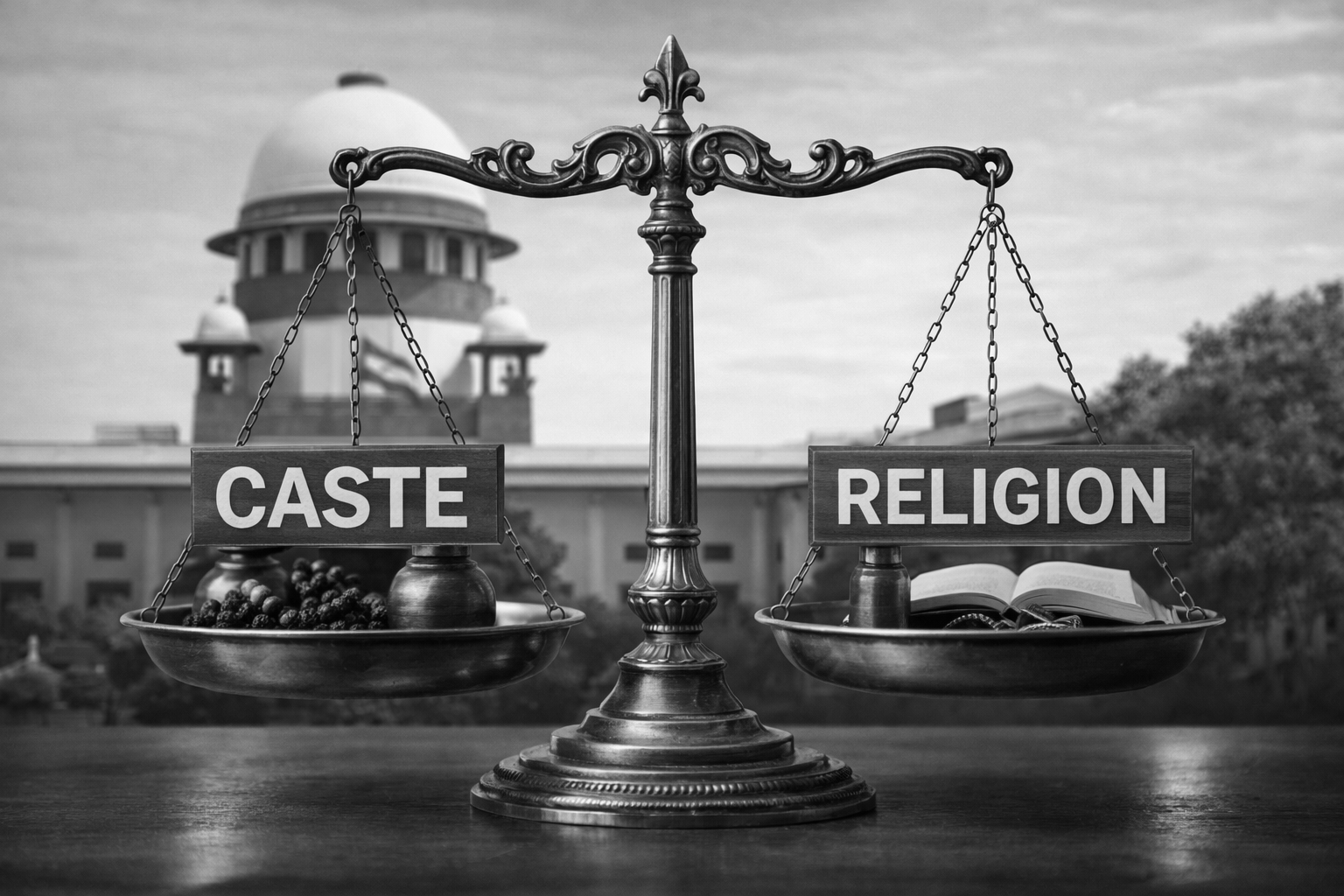
Conversion, Scheduled Caste Status and Constitutional Limits: Reflections on the Supreme Court’s Latest Judgment
The Supreme Court of India, in its judgment delivered today, once again clarified an important constitutional position regarding Scheduled Caste status and religious conversion. The Court observed that a person belonging to a Scheduled Caste who converts to a religion other than Hinduism, Sikhism, or Buddhism cannot continue to claim the benefits associated with Scheduled Caste status under the present legal framework. The judgment essentially reaffirmed the position laid down in the Constitution (Scheduled Castes) Order, 1950, which restricts recognition of Scheduled Castes to persons professing Hinduism and later extended to Sikhism and Buddhism. The ruling has reignited a long-standing national debate regarding the relationship between caste identity, religious conversion, and constitutional protections meant for historically oppressed communities.
To understand the significance of this debate, it is necessary to revisit the historical context of untouchability in India. For centuries, the caste hierarchy created a deeply entrenched system of social exclusion in which certain communities were treated as “untouchables.” These communities were subjected to humiliating and degrading practices that denied them access to basic human dignity. They were often prevented from entering temples, drawing water from common wells, living within the main areas of villages, or participating in social and religious life on equal terms. Untouchability was not merely a social stigma but an institutionalized system of discrimination that affected every dimension of life education, employment, property ownership, and civic participation.
The framers of the Indian Constitution were acutely aware of this historic injustice. Leaders such as Dr. B. R. Ambedkar argued that centuries of oppression could not be remedied by moral persuasion alone; structural remedies were required. Consequently, the Constitution introduced several safeguards aimed at dismantling caste-based discrimination. Article 17 abolished untouchability in all its forms and made its practice a punishable offence. In addition, the Constitution provided for affirmative action policies, including reservations in education, public employment, and political representation for Scheduled Castes and Scheduled Tribes. These provisions were intended to correct historical injustice and to provide disadvantaged communities with opportunities for social mobility and dignity.
In order to operationalize these protections, the President of India issued the Constitution (Scheduled Castes) Order, 1950. This order listed specific castes that would be recognized as Scheduled Castes and therefore eligible for constitutional safeguards and reservations. However, the order also contained a crucial clause: only persons professing the Hindu religion would be recognized as Scheduled Castes. The reasoning behind this provision was based on the assumption that the social practice of untouchability was historically rooted in the Hindu caste system. Therefore, the special constitutional protection was directed toward communities that suffered discrimination within that particular social framework. Over time, Parliament amended the order to extend Scheduled Caste status to Sikhs in 1956 and to Buddhists in 1990, recognizing that many members of these communities shared the same historical experience of caste-based discrimination. However, the order did not extend the same recognition to persons professing Christianity or Islam.
The constitutional validity of this restriction has been tested before courts on several occasions. One of the most significant judicial precedents in this regard is Soosai v. Union of India (1985). In this case, the petitioner, a person of Scheduled Caste origin who had converted to Christianity, argued that caste-based discrimination continued even after conversion. He contended that Dalit Christians should therefore be eligible for the same constitutional protections and reservations as Scheduled Castes. The Supreme Court, however, declined to accept this argument. The Court held that the Constitution (Scheduled Castes) Order, 1950 clearly restricted Scheduled Caste recognition to certain religions and that courts could not extend the scope of the order through judicial interpretation. The Court also observed that it was for Parliament, and not the judiciary, to decide whether the order should be amended in light of changing social realities.
Another important precedent is Kailash Sonkar v. Maya Devi (1984). This case dealt with the question of whether a person who had converted away from Hinduism and later reconverted could regain Scheduled Caste status. The Supreme Court held that if a person belonging to a Scheduled Caste converted to another religion and subsequently reconverted to Hinduism, the original caste status could be revived, provided that the community accepted the individual back into its fold. The judgment acknowledged that caste identity in India is not merely a matter of religious affiliation but is also tied to social recognition within the community. Thus, while conversion might interrupt the legal recognition of Scheduled Caste status, reconversion accompanied by social acceptance could restore it.
In recent years, courts have continued to reaffirm similar principles. In C. Selvarani v. The Special Secretary, Adi Dravidar and Tribal Welfare Department (2024), the Supreme Court dealt with a situation where an individual who had embraced Christianity sought to claim Scheduled Caste benefits by presenting herself as a Hindu. The Court held that such attempts amounted to a misuse of constitutional provisions and described them as a “fraud on the Constitution.” The judgment emphasized that constitutional benefits meant for historically disadvantaged communities cannot be claimed by misrepresenting one’s religious identity.
Similarly, several High Courts have addressed disputes arising from elections and public employment where individuals who had converted to Christianity sought to retain Scheduled Caste status. For instance, the Madras High Court in Amutha Rani v. State Election Commission (2025) ruled that a person professing Christianity could not contest an election from a constituency reserved for Scheduled Castes. The Court reiterated that the Constitution (Scheduled Castes) Order, 1950 clearly links Scheduled Caste recognition to specific religions and that any attempt to circumvent this provision would undermine the constitutional framework.
Despite these judicial precedents, the issue remains a subject of intense public debate. Advocates for extending Scheduled Caste status to Dalit Christians and Dalit Muslims argue that caste discrimination persists even after conversion. According to this view, caste identity in India is deeply embedded in social relations and does not disappear simply because an individual adopts a different religion. They point to sociological studies suggesting that caste-based distinctions continue to exist in some Christian and Muslim communities, affecting marriage patterns, social interactions, and economic opportunities. From this perspective, denying Scheduled Caste status to converts amounts to punishing individuals for exercising their freedom of religion.
On the other hand, critics of this demand argue that the original purpose of Scheduled Caste reservations was to address the specific social evil of untouchability within the Hindu social order. They contend that extending these benefits to communities outside that framework would dilute the constitutional rationale behind reservations. Moreover, some argue that religions such as Islam and Christianity, at least doctrinally, reject caste hierarchy and emphasize equality among believers. If discrimination persists within these communities, they argue, it should be addressed through broader social welfare measures rather than by expanding the Scheduled Caste category. There is also concern that expanding the category could reduce the share of benefits available to communities that continue to suffer from traditional forms of untouchability.
The government of India has, from time to time, appointed commissions to study this issue. The Ranganath Misra Commission (2007) recommended that Scheduled Caste status should be delinked from religion and extended to all Dalits regardless of faith. However, the recommendation has not been implemented. In recent years, further committees have been constituted to examine the matter in greater detail, reflecting the complexity and sensitivity of the issue.
Against this backdrop, the Supreme Court’s judgment delivered today does not create a new legal rule but rather reiterates the existing constitutional position. The Court has emphasized that the Constitution (Scheduled Castes) Order, 1950 remains the governing law and that any change to it must come through legislative action. By reaffirming this principle, the Court has maintained the institutional balance between the judiciary and the legislature. The judiciary’s role is to interpret and apply the law as it stands, while the power to redefine the scope of Scheduled Caste recognition lies with Parliament.
In evaluating the broader implications of this judgment, it is important to recognize the delicate balance between social justice and constitutional discipline. The Constitution was designed to address historical injustices through carefully structured mechanisms. While social realities evolve over time, any alteration to these mechanisms must occur through democratic deliberation and legislative reform rather than judicial expansion. The Supreme Court’s ruling reinforces this principle by respecting the limits of judicial authority.
In conclusion, today’s judgment serves as a reaffirmation of the existing constitutional framework governing Scheduled Caste recognition. By upholding the provisions of the Constitution (Scheduled Castes) Order, 1950 and by drawing upon established precedents such as Soosai v. Union of India (1985), Kailash Sonkar v. Maya Devi (1984), C. Selvarani v. State of Tamil Nadu (2024), and other related rulings, the Court has maintained continuity in constitutional interpretation. While the broader debate regarding caste, conversion, and social justice will undoubtedly continue, the Court has rightly emphasized that any fundamental change in this domain must originate from Parliament. From the standpoint of constitutional clarity and institutional propriety, the Supreme Court’s decision appears consistent with both the letter and spirit of the law.