
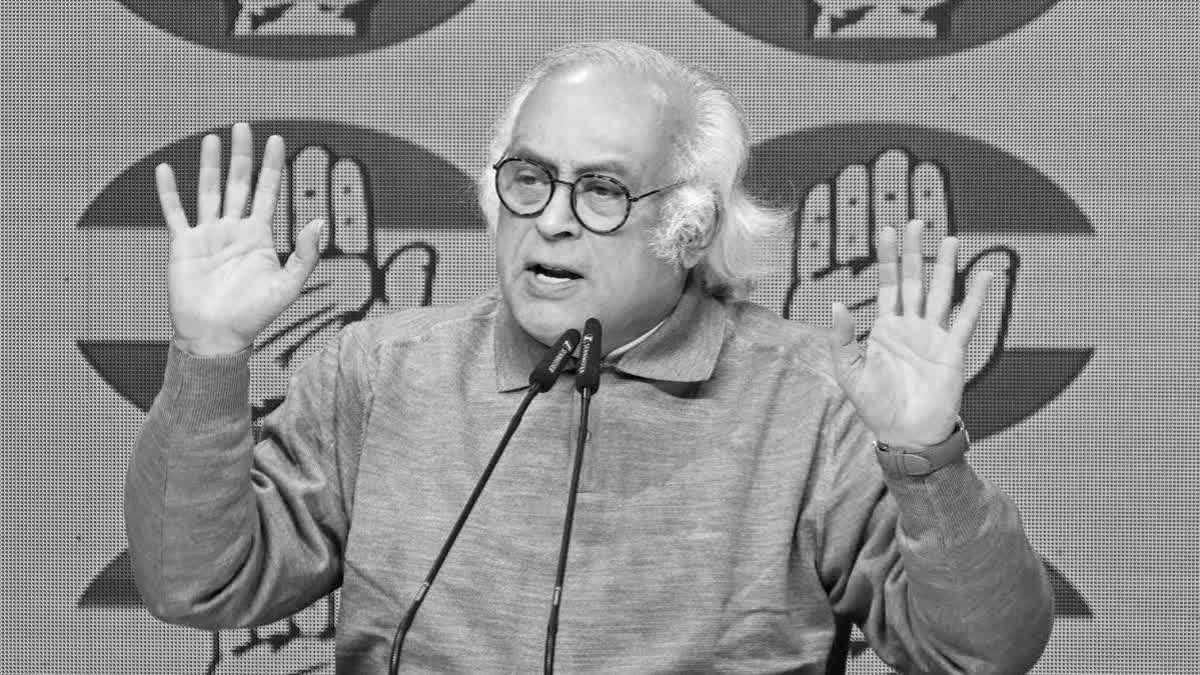
Congress slams government over ineffective air quality policies
The Congress on Sunday said India’s worsening air pollution crisis exposes the failure of government policies to curb toxic air, arguing that official responses have been ineffective, underfunded and poorly enforced despite repeated claims of action.
Citing a new analysis by the Centre for Research on Energy and Clean Air , Congress general secretary in charge of communications Jairam Ramesh said air pollution has become a nationwide, structural public health emergency. “This analysis confirms what has always been India’s worst kept secret, that air quality is a nationwide, structural crisis for which the government response has been exceedingly ineffective and inadequate,” he said. The study, based on satellite data, found that nearly 44 per cent of India’s statutory towns, or 1,787 out of 4,041 assessed, have suffered from chronic air pollution, with PM2.5 levels consistently exceeding national standards for five years between 2019 and 2024, excluding 2020.
Ramesh said this places India among the world’s most polluted countries, alongside Bangladesh, Pakistan, Tajikistan and Burkina Faso , highlighting the scale of the problem India now faces. According to recent air quality data, Byrnihat on the Assam-Meghalaya border recorded among the highest annual PM2.5 concentrations in the country, followed by New Delhi, Mullanpur in Punjab, Faridabad and Loni in Uttar Pradesh all with particularly high AQI levels in latest reports on city pollution, and all ranking among the worst in India’s annual PM2.5 assessments. These cities often exceed safe limits by many times, underscoring the public health hazard.
The programme initially set a target of reducing particulate pollution by 20 to 30 per cent by 2024, later revised to a 40 per cent reduction by 2026 or achievement of national standards, but Ramesh said the scale of the response does not match the scale of the problem. “Despite 1,787 towns suffering from chronic air pollution, only 130 cities are covered under NCAP,” he said, noting that of these, 28 still do not have continuous ambient air quality monitoring stations, meaning basic data is still missing in many places. “In totality, NCAP today addresses barely four per cent of India’s chronically polluted towns,” he added.
The Congress leader said other government measures have also failed to produce sustained improvements. Referring to the Graded Response Action Plan for Delhi NCR, he said, “GRAP is nothing more than a crisis response tool, activated after pollution has already reached emergency levels. It is not a preventive strategy.” On vehicle emission reforms, he said the rollout of Bharat Stage VI norms has been undermined by unchecked growth in vehicle numbers, weak enforcement and inadequate public transport investment.
He said outdated laws and weak standards continue to normalise unhealthy air. “The first step must be to acknowledge the public health crisis linked to air pollution across wide swathes of India,” Ramesh said. “We must revisit and totally revamp both the Air Pollution Control and Prevention Act of 1981 and the National Ambient Air Quality Standards notified in 2009.” He pointed out that India’s permissible PM2.5 limits remain far higher than World Health Organization guidelines, even as several Indian cities regularly exceed them.
Ramesh also flagged chronic underfunding as a core failure. “The current budget, inclusive of NCAP funding and the 15th Finance Commission grants , is about Rs 10,500 crore spread across 131 cities. Our cities need at least ten to twenty times more funding. NCAP must become a Rs 25,000 crore programme and be expanded to the 1,000 most polluted towns.”
Accusing the government of downplaying the health impact of air pollution in Parliament, Ramesh said, “Twice so far, the Modi government has tried to minimise the health consequences of air pollution. The government is not blind to the truth . It is attempting to cover up the scale of its incompetence and negligence.” He warned that without stronger laws, realistic standards, adequate funding and political will, clean air will remain out of reach for millions across the country.